An old One Big Happy strip, recently up in my comics feed, has Ruthie once again coping with vocabulary unfamiliar to her:
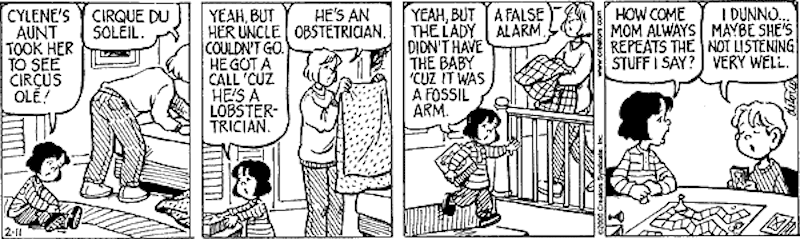
Cirque du Soleil (presumably pronounced in English, as if it were Sirk do sew-lay), obstetrician, and false alarm (which Ruthie takes to be circus ole, lobstertrician, and fossil arm, respectively). These are three different cases, as I’ll explain below.
But then — knowing that in the world around her, different people have different pronunciations for expressions — she takes her mother’s intended corrections of her creative misinterpretations to be just repetitions of them (“Mom always repeats the stuff I say”), but with a pronunciation alternative to hers. Attempted corrections of kids often run aground in similar ways.
The three examples. Three cases where Ruthie has misinterpreted what she heard and produces her interpretation, her version of the expression — which her mother then attempts to correct.
Cirque du Soleil. An unusual proper name, apparently in some language other than English, but referring to a circus, so Ruthie interpreted /sǝrk du s/ as circus /sǝrkǝs/, leaving /ole/ requiring interpretation. Ruthie might have taken this to be the name of the cosmetic Olay, but instead she recognized the Spanish exclamation olé — something you might actually cry out at a circus. Giving her Circus Olé.
obstetrician. An unfamiliar technical term, naming a medical specialty. But in Ruthie’s context, the word clearly referred to some kind of occupation (for Cylene’s uncle), so Ruthie recognized the –trician of the more familiar occupation names electrician, musician, politician, maybe physician and optician. That left her with /abstǝ/ to cope with, and the only common English word that’s close to this is lobster /labstǝr/. Giving her lobstertrician. Brava!, I say.
false alarm. You might think this one is a stretch, but hear me out.
To start with, in connected speech, the two-word expression false alarm is pronounced as a single chunk /fɔlsǝlarm/, with the /s/ of false syllabified phonetically with the following material: [fɔl.sǝ.larm] (where a period marks syllable divisions). Then, postvocalic [l] is very commonly “vocalized” in American English: realized as [ǝ] or as lengthening of the preceding vowel, or swallowed up entirely. (I do this myself; there’s frequently no lateral consonant in my fall and false, especially in fast speech — where there may in fact be no trace of an /l/ at all.) So false alarm can be, phonetically, [fɔ.sǝ.larm] or something very close to it.
Which is now very close to a connected-speech pronunciation of fossil arm, [fa.sǝ.larm] in standard AmE. In fact, in several varieties of AmE, fossil has the accented vowel /ɔ/ rather than /a/, so that fossil arm in connected speech is [fɔ.sǝ.larm] — not just close to false alarm, but homophonous with it.
Add to this the intense interest that many kids have with dinosaurs and other creatures known to us through fossils, plus the possibility that Ruthie might not be familiar with the metaphorical use of false alarm to refer to an incorrect diagnosis of a special state, namely pregnancy (“the lady didn’t have the baby ‘cuz it was a …”) — and Ruthie’s grasping for fossil arm no longer seems so bizarre. Well, Ruthie would maintain, defiantly, that’s what they said!
Two recent Ruthian dealings with unfamiliar vocbulary on this blog:
— from my 3/5/24 posting “Exceptional vocabulary comprehension for her age”:
exceptional vocabulary comprehension is not yet within the grasp of her exceptional vocabulary comprehension; Ruthie, in this One Big Happy strip that came up in my comics feed recently, does indeed know a lot of words, just not some of the 4- and 5-syllable killer items
— from my 3/20/24 posting “They’re a stink”:
two of the kids — Ruthie and the neighbor boy James — undertake to go on a dinosaur hunt, expecting the creatures to be easy to find because, according to James, they’re a stink
… Once again, the kids are coping with unfamiliar, technical vocabulary by interpreting it, eggcornishly, as more familiar material. Something of a stretch in this case, though extinct and a stink are indeed phonologically similar.
Leave a Reply