Archive for the ‘Pragmatics’ Category
July 21, 2024
Caption on a photo on the front page of today’s New York Times:
A Somber Procession
First responders at the funeral of a father of two killed in the attack on NN
(where NN stands for the name of 45, TFG, the Orange Menace, Helmet Grabpussy; the attack was an attempted assassination). In principle, the PSP (past participial) phrase at the end of the caption — killed in the attack on NN — could be parsed with the preceding material in (at least) four different ways, as a predicative or in one of three ways as a modifier (which I’ll label VHA (very high attachment), HA (high attachment), and LA (low attachment). I doubt that either of the first two parsings would occur to any normal reader (though a mechanical parser would entertain them), but the last two are more imaginable.
To look ahead: ceteris paribus, LA is the favored parsing, but plausibility in context is a powerful effect and often favors HA. I was lured into understanding the caption with LA and had a lot of trouble shaking that parsing, despite its incongruity with the facts of the situation as I knew them and the real-world unlikelihood of this understanding.
(more…)
Posted in Ambiguity, Context, Modifier attachment, Parsing, Pragmatics, Semantics, Syntax | 2 Comments »
July 20, 2024
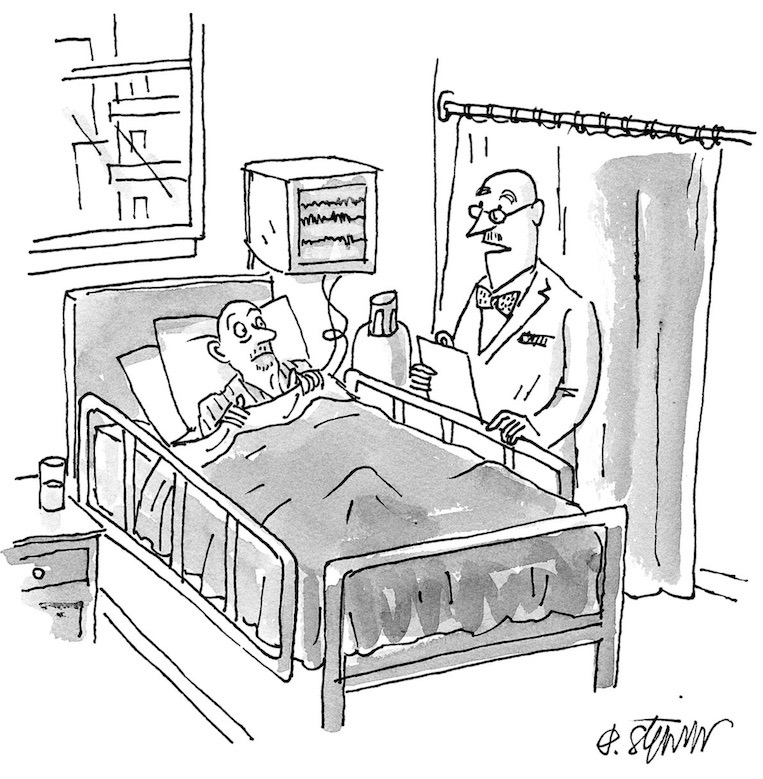
In e-mail from Larry Horn on 7/18, this Good News / Bad News (GN/BN) joke cartoon by New Yorker cartoonist Peter Steiner from 6/18/24 (in The New Yorker issue of July 1):
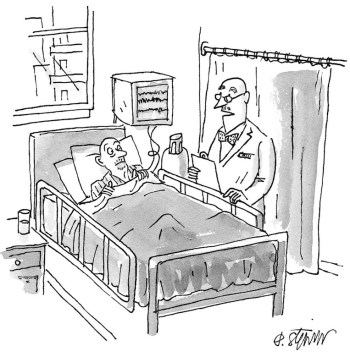
“First the good news, Mr. Edmonds: you’re going to get closure.”
(#1) Doctor to patient in hospital, offering the truncated variant of GN/BN, with (the dire) BN omitted (to be supplied by the reader from the context)
This is closure as in sense 3b from NOAD:
noun closure: … 3 [a] a sense of resolution or conclusion at the end of an artistic work: he brings modernistic closure to his narrative. [b] a feeling that an emotional or traumatic experience has been resolved: I am desperately trying to reach closure but I don’t know how to do it without answers from him.
In a GN/BN joke, the GN carries a sting in its tail, made overt in the BN. In #1, the GN is that the patient’s ordeal of illness is coming to an end — by his imminent death (the BN), which nobody says aloud.
Things to talk about. First, GN/BN, as treated in earlier postings on this blog (prominently featuring Larry Horn). Then, another joke form with a sting in its tail, kin to GN/BN: Genie’s Wish.
(more…)
Posted in Context, Formulaic language, Jokes, Linguistics in the comics, Pragmatics | 3 Comments »
April 1, 2024
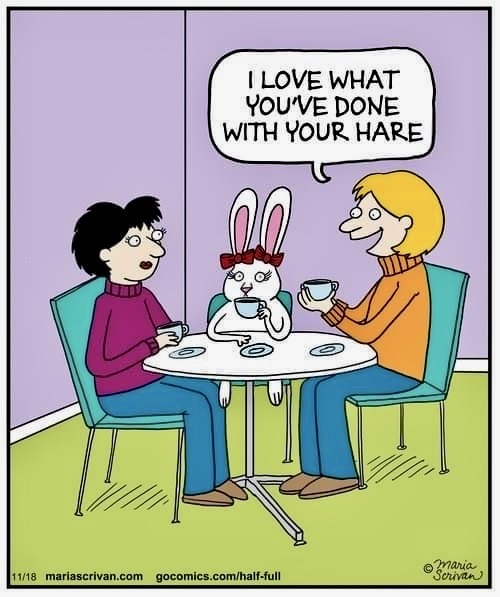
🐇 🐇 🐇 three rabbits to inaugurate the new month, 🃏 🃏 🃏 three jokers for April Fool’s Day, and 🌼 🌼 🌼 three jaunes d’Avril. yellow flowers of April, all this as we turn on a dime from yesterday’s folk-custom bunnies of Easter to today’s monthly rabbits; for this intensely leporine occasion, a Maria Scrivan hare-pun cartoon:

(#1) (phonologically perfect) pun hare on model hair, taking advantage of I love what you’ve done with your hair as an common exemplar of the stock expression (I) love what you’ve done with X; a cartoon posted on Facebook by Probal Dasgupta, who reported, “Even I groaned at this one”
Things to talk about here: my use of turn on a dime just above; Easter + April Fool’s; the yellow flowers of April (which will bring us to Jane Avril — Fr. Avril ‘April’); and the stock expression (I) love what you’ve done with X.
(more…)
Posted in Art, Color, Constructions, Dancers, Formulaic language, French, Holidays, Language and animals, Language and plants, Linguistics in the comics, Metaphor, Pragmatics, Puns, Signs and symbols, Speech acts, Stock expressions, Style and register, Syntax | 1 Comment »
March 29, 2024
For some time now, I’ve been collecting examples of a scheme of English derivational morphology I’ve called beheading, as in
crude (Adj) oil (N) -> crude (N), where the derived item crude ‘crude oil’ is a Mass N (like oil)
commemorative (Adj) stamp (N) -> commemorative (N), where the derived item commemorative ‘commemorative stamp’ is a Count N (like stamp)
A great many of the examples come from jargons, the vocabularies of specific occupational or interest groups, like people in the energy business or philatelists — or medical professionals (N attending ‘attending physician’), food preparers, servers, and sellers (N Swiss ‘Swiss cheese’), and so on. More generally, most beheadings are notably context-specific. But some come from everyday language and don’t need much contextual backing.
Here, after a somewhat more careful account of what beheadings are, I’ll add a few everyday beheadings to supplement the ones in my files (see the Page on this blog). Then I’ll veer all the way to the other pole and note that with enough contextual backing, completely novel beheadings can be coined and understood. Finally, I’ll cite the everyday beheading that inspired this posting: three squares a day ‘three square meals a day’, from US President Joe Biden, which I put off because some commenters took it — or, possibly, the idiom square meal itself — to be outdated, hence a sign of Biden’s being old and out of touch, a development that merited some discussion on its own. But there are plenty of cites, including a NOAD entry for the beheading square; and then all those comments vanished from the net, so I had no one to bash.
(more…)
Posted in Beheading, Context, Conversion, Jargon, Language and culture, Language and politics | Leave a Comment »
March 19, 2024
🧨 🧨 🧨 Firecrackers! For a prize from the Swedish royal academies, something you might think of as a Nobel Prize’s little brother, awarded to two colleagues in linguistics and philosophy, one an old friend (and exact contemporary) of mine. From the website of the Swedish royal academies, “Science, art and music meet in the Rolf Schock Prizes 2024”, a press release of 3/14/24:
2024 Rolf Schock Prize in Logic and Philosophy is jointly awarded Hans Kamp, University of Stuttgart, Germany and Irene Heim, Massachusetts Institute of Technology, Cambridge, USA
“for (mutually independent) conception and early development of dynamic semantics for natural language.”
Natural languages are highly context-dependent – how a sentence is interpreted often depends on the situation, but also on what has been uttered before. In one type of case, a pronoun depends on an earlier phrase in a separate clause. In the mid-1970s, some constructions of this type posed a hard problem for formal semantic theory.
Around 1980, Hans Kamp and Irene Heim each separately developed very similar solutions to this problem. Their theories brought far-reaching changes in the field. Both introduced a new level of representation between the linguistic expression and its worldly interpretation and, in both, this level has a new type of linguistic meaning. Instead of the traditional idea that a clause describes a worldly condition, meaning at this level consists in the way it contributes to updating information. Based on these fundamentally new ideas, the theories provide adequate interpretations of the problematic constructions.
Kamp was born in the Netherlands in 1940. He received his PhD from University of California, Los Angeles, in 1968 and has been a professor at University of Stuttgart, Germany, since 1988.

(#1) Hans Kamp (photo: Kerstin Sänger)
Heim was born in Germany in 1954. She received her PhD from the University of Massachusetts, Amherst, in 1982 and has been a professor at the Massachusetts Institute of Technology (MIT), Cambridge, USA since 1997.

(#2) Irene Heim (photo: Philipp Heim-Antolin)
(more…)
Posted in Awards, Context, Discourse, Pragmatics, Semantics, Speech acts | Leave a Comment »
March 18, 2024
An old One Big Happy strip that’s been hanging around on my desktop for a couple of years. When you go to explain why it’s so weirdly funny, it turns out to be a complex exercise in what’s known in the linguistics trade as quantity implicature: someone uses a quantity expression, like 6 people or 18 years old, and we understand the speaker’s intentions to be to suggest exactly that quantity, or at least that quantity, or no more than that quantity — in technicalese, we take the speaker’s words to implicate one of these things — depending on the context and our assessments of the speaker’s reasons for mentioning that quantity in the context.
The standard discussions of quantity implicature are about reports of states of affairs. If, for example, a well-intentioned speaker tells you that there were 6 people at their birthday party, you take them to be conveying that there were exactly 6 people. I mean, if there were 8 people at the party, it would be true that there were 6 people; but then it would be uncooperative to say that there were 6 people, because if you knew there were 8 you should and would have said so, therefore saying there were 6 implicates that there were exactly 6. (This would be a good time to take a deep breath and rest for a moment.)
(more…)
Posted in Context, Implicature, Linguistics in the comics, Pragmatics, Semantics, Speech acts | Leave a Comment »
March 17, 2024
(Part of this posting will dive right into gay porn for the day, with street-talk musings on man-on-man sex that’s totally off-limits for kids and the sexually modest; I’ll hold this part off until the end, so if you need to you can bail out then)
☘️ ☘️ ☘️ It’s St. Patrick’s Day, and in my e-mail: two Bob Eckstein cartoons for the day (on turning and wearing green for the day); and a Falcon Studios sale on gay porn, made holiday-appropriate by the mere addition of a shamrock, but which opens the topic of gay porn with actual St. Patrick’s day themes.
(more…)
Posted in Clothing, Color, Costumes, Facial expressions, Flags, Gay porn, Hats, Holidays, Homosexuality, Language and food, Language and plants, Language and religion, Language and the body, Language of sex, Linguistics in the comics, Point of view, Signs and symbols | 2 Comments »
March 13, 2024
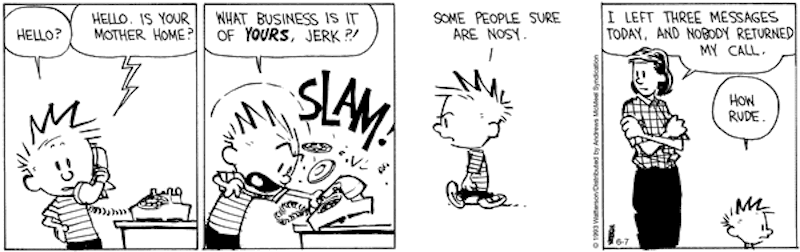
To cope with a day when I’m overwhelmed with e-mail to answer, an old Calvin and Hobbes strip salted away for just such days:
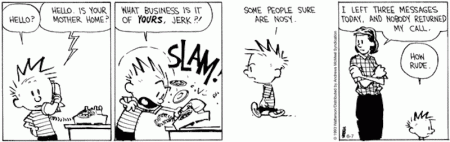
They exchange greeting hellos, and then the caller, detecting that the phone has been answered by a child, shifts to an indirect speech act designed to have the child get an adult — the caller specifically asks about their mother — to come to the phone: instead of (directly) asking Calvin to call his mother to the phone, they ask (politely) if his mother is home, assuming that Calvin will understand that they’re asking this because they assume she’s home and they want to talk to her, so they want him to turn the call over to her
The overall story here doesn’t depend on the phone being answered by a kid. It’s enough that the caller recognizes that the person answering the phone is not the one they want to talk to. In which case they could ask for them indirectly: Is Marcia home / in? (this being one big step of indirection beyond the conventionally indirect question May / Can I talk to Marcia?).
The crucial step in dealing with the yes-no question Is X home? is recognizing that because a literal understanding of it would be bizarre — why would some random caller need to know if X is home? — the caller must have some other motive in asking it. And on from there. But that’s where Calvin runs aground.
Well, that’s a lot for a little kid to work out in less than a second on the phone (and Calvin is not a patient or especially cooperative child). I actually remember being taught, explicitly, that if a phone caller, or someone at the door, asked if my mother was at home, that meant they wanted to talk to her, so I should get her. I imagine I could have worked this out eventually, but it might have taken some misfires for me to get the point.
Posted in Implicature, Linguistics in the comics, Pragmatics, Speech acts | 2 Comments »
February 6, 2024
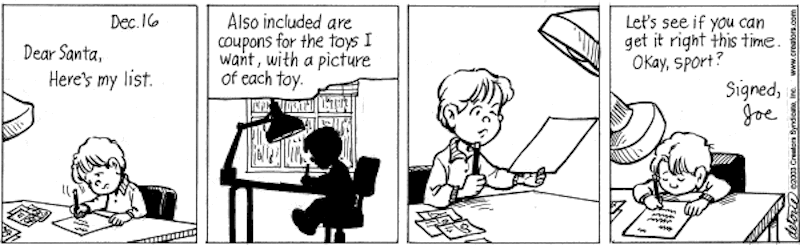
An old One Big Happy strip that recently came up in my comics feed:

Joe writes to Santa with a very specific gift list, with an accusatory flourish at the end (presupposing that in earlier years Santa had failed to honor Joe’s requests and telling Santa that now it’s time for the old guy to get it right) in which he addresses Santa as sport
This is one of those occasions where I pose questions that I’m in no position to answer, because I don’t have the resources to pursue them. I am an address terms guy — see the Page on this blog with links to my postings on the topic — but sport isn’t a term I use myself, so I have no self-report data on it; and though dictionaries have some useful information on sport, they aren’t able to describe the complexities of usage of address terms like it; and, finally, sport is not one of the high-frequency address terms (like guy) that have gotten the attention of variationist sociolinguists, so we have no systematic data on the way it’s used.
Even so, my first response to Joe’s use was that it was odd. Somewhat antique, but more significantly, impertinent — treating Santa as if he were an equal, or in fact a subordinate. My impression is that Santa, in a somewhat old-fashioned way, might amiably address a little boy as sport, but little kids don’t talk to adults (especially powerful adults) that way. Such an impertinence would, however, fit right in with Joe’s challenge to Santa to get with the program of supplying Joe with the toys he’s asking for (well, demanding). Cheeky monkey.
(more…)
Posted in Address terms, Variation | 4 Comments »
November 25, 2023
An old One Big Happy strip, one in a long series in which Ruthie or her brother Joe is confronted with some type of test question (rather than an information-seeking question):

Ruthie is laboring at a workbook — a culture object that subjects a student to test questions, in this case a question requiring the student to demonstrate their understanding of the culturally appropriate grounds for publicly assessing the characteristics of other people: industriousness is an appropriate ground for assessing a farmer (because it’s relevant to his doing his job), while a conventionally attractive appearance is not
Even though she’s filling in questions in a workbook, Ruthie falls back on treating busy-or-pretty? as a question about her opinions, rather than her knowledge of cultural appropriateness. In fact, for all we can tell from the workbook picture, Farmer Brown might not be at all busy; he might be sitting upright in a stationary tractor, daydreaming about what’s for supper. But he could perfectly well be busy, while even if was drawn to look like a handsome film star, his looks would be culturally irrelevant to his job. (Subtle point: they would, however, be culturally relevant in general, since men judged to be conventionally good-looking have a social edge over other men in various contexts.)
Here, Ruthie personalizes her response by giving her opinions. In other OBH test-question strips she looks situations from her point of view or takes her own experiences as background for answering questions. But test questions demand a depersonalized stance — and then regularly plumb very fine points of sociocultural awareness. Fine points that for the most part aren’t treated in the workbooks, aren’t explicitly taught in schools. I’ll give one further example from an earlier posting of mine below.
(more…)
Posted in Childhood, Culture, Linguistics in the comics, Questions, Speech acts, Teaching | 2 Comments »