Archive for the ‘Context’ Category
November 24, 2024
(There will be mentions — in vernacular but not actually vulgar terms — of male-male sexual practices that some will find icky, so this posting will not be to everyone’s taste; and it might stretch some kids’ horizons a bit, so a gentle warning)
From back on 10/30, e-mail from Gadi Niram, with a video gift for me, saying: I found this video (and the young man in it) to be quite a pleasant diversion:

(#1) Screen shot from the video, which you can view here
A shirtless young man in ripped denim shorts playing the 3rd movement of Beethoven’s “Moonlight” Sonata (Piano Sonata No. 14 in C-sharp minor, Op. 27 No.2) on a fancy grand piano (with a mirrored fallboard, as in the finest piano lounges). alongside the pool at at what looks like a tropical oceanside resort. (For a bit of extra sexiness, those shorts are down far enough in the back to expose the waistband of his black Calvins; here the girls and the gay boys swoon.)
(more…)
Posted in Back formation, Compounds, Context, Conversion, Derivation, Language and the body, Language of medicine, Lexical semantics, Morphology, Music, Portmanteaus, Technical and ordinary language | 4 Comments »
November 22, 2024
(Well, consider the title if this posting, which tells you that it’s going to get into some vivid descriptions of sexual parts and sexual acts — plus a photo that’s just barely WordPressable — and you’ll see that it’s not suitable for kids or the sexually modest; and from here on, you’re going to get the C-word raw and unconcealed, but your enthusiasm for this dirty talk will probably be diminished when it turns out that this posting is mostly about lexical semantics)
(more…)
Posted in Address terms, Context, Dialects, Gay porn, Insults, Language and the body, Language change, Lexical semantics, Metaphor, Metonymy, Personification, Style and register, Taboo language and slurs, Variation | 6 Comments »
October 17, 2024
… in yesterday’s (10/16) Bizarro (Wayno’s title: “Subaquatic Psychology Session”):
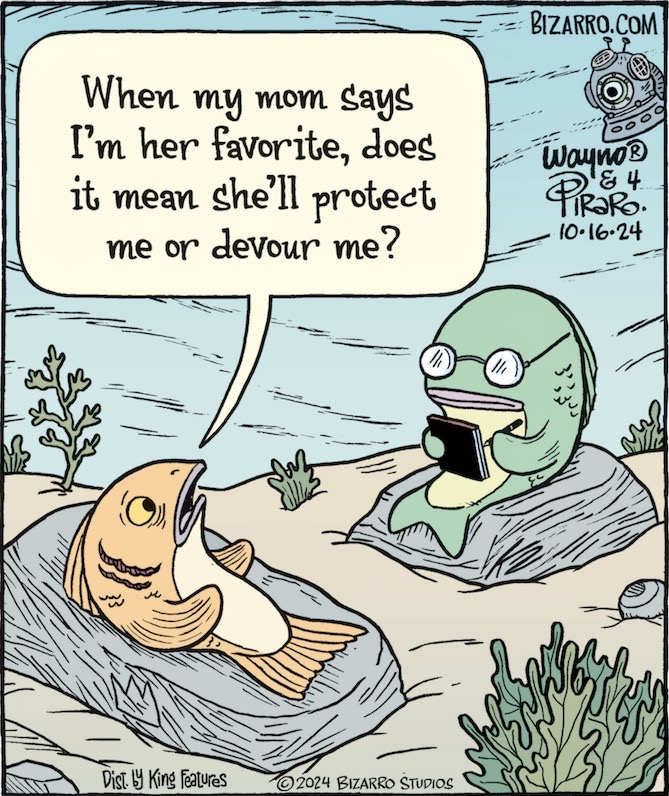
All about the noun favorite: an implicit superlative, denoting a top-ranking element in some comparison set, but it’s way more complex than that, and the joke turns on one of those complexities (if you’re puzzled by the odd symbols in the cartoon — Wayno says there are 4 in this strip — see this Page)
The relevant complexity becomes clear when you look at some explicit superlatives, in questions like these:
Who is the biggest? What is the best?
These are baffling out of context. Because they are consistent with so many different contexts. But these aren’t differences in what the questions mean; dictionaries wouldn’t have different entries for the many kinds of being the biggest or the best. In technical talk, the questions aren’t many-ways ambiguous, but are instead, neutral, or unspecified, with regard to the different kinds of being biggest or best.
It’s much the same for the implicit superlatives, in questions like:
Who is your favorite? What is my favorite?
There are so many kinds of favorite things (try not to think of The Sound of Music). Favorite places, favorite friends, favorite songs, and on and on. Favorite children and favorite foods, in the case of the cartoon. If your mom tells you you’re her favorite, and you’re a fish (of a race of talking fish, from CartoonWorld), then either of those is a genuine possibility — but of course maybe she’s saying you’re her favorite tennis partner or her favorite artistic swimmer or whatever. Neutrality all the way. (Though the more you know about the context, the narrower the range of understandings becomes.)
(more…)
Posted in Comic conventions, Context, Lexical semantics, Linguistics in the comics, Paradoxes, Pragmatics, Semantics | Leave a Comment »
September 13, 2024
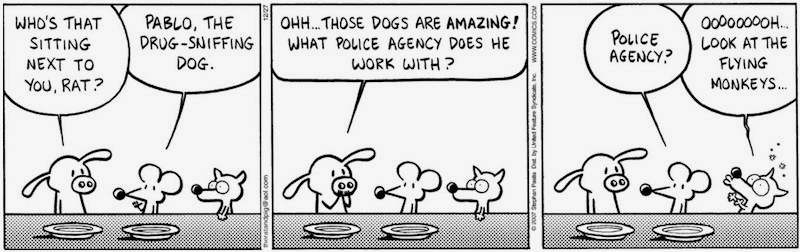
A delightful old Pearls Before Swine strip (from 12/27/07) that Jeff Bowles posted on Facebook this morning:

Pig understands drug-sniffing dog (as will most of us reading this) to refer to a dog that sniffs out drugs, detects / discovers them by its sense of smell, so as parallel to cadaver-sniffing dog; but it turns out that the dog in question actually sniffs — inhales — drugs to get high on them, so that Rat’s use of drug-sniffing dog is parallel to, say, glue-sniffing teenager (glue sniffing ‘the practice of inhaling intoxicating fumes from the solvents in adhesives’ (NOAD)) or snuff-sniffing aristocrat
So drug-sniffing dog is ambiguous — with two different meanings for the PRP-form synthetic compound drug-sniffing — and the strip plays with the ambiguity.
(more…)
Posted in Ambiguity, Compounds, Context, Language and animals, Lexical semantics, Linguistics in the comics, Semantics of compounds, Synthetic compounds | Leave a Comment »
July 21, 2024
Caption on a photo on the front page of today’s New York Times:
A Somber Procession
First responders at the funeral of a father of two killed in the attack on NN
(where NN stands for the name of 45, TFG, the Orange Menace, Helmet Grabpussy; the attack was an attempted assassination). In principle, the PSP (past participial) phrase at the end of the caption — killed in the attack on NN — could be parsed with the preceding material in (at least) four different ways, as a predicative or in one of three ways as a modifier (which I’ll label VHA (very high attachment), HA (high attachment), and LA (low attachment). I doubt that either of the first two parsings would occur to any normal reader (though a mechanical parser would entertain them), but the last two are more imaginable.
To look ahead: ceteris paribus, LA is the favored parsing, but plausibility in context is a powerful effect and often favors HA. I was lured into understanding the caption with LA and had a lot of trouble shaking that parsing, despite its incongruity with the facts of the situation as I knew them and the real-world unlikelihood of this understanding.
(more…)
Posted in Ambiguity, Context, Modifier attachment, Parsing, Pragmatics, Semantics, Syntax | 2 Comments »
July 20, 2024
In e-mail from Larry Horn on 7/18, this Good News / Bad News (GN/BN) joke cartoon by New Yorker cartoonist Peter Steiner from 6/18/24 (in The New Yorker issue of July 1):
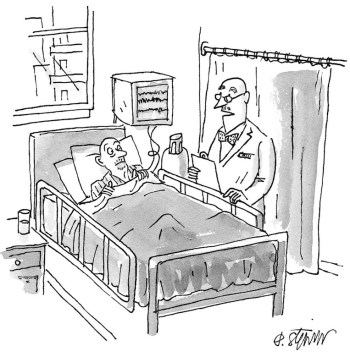
“First the good news, Mr. Edmonds: you’re going to get closure.”
(#1) Doctor to patient in hospital, offering the truncated variant of GN/BN, with (the dire) BN omitted (to be supplied by the reader from the context)
This is closure as in sense 3b from NOAD:
noun closure: … 3 [a] a sense of resolution or conclusion at the end of an artistic work: he brings modernistic closure to his narrative. [b] a feeling that an emotional or traumatic experience has been resolved: I am desperately trying to reach closure but I don’t know how to do it without answers from him.
In a GN/BN joke, the GN carries a sting in its tail, made overt in the BN. In #1, the GN is that the patient’s ordeal of illness is coming to an end — by his imminent death (the BN), which nobody says aloud.
Things to talk about. First, GN/BN, as treated in earlier postings on this blog (prominently featuring Larry Horn). Then, another joke form with a sting in its tail, kin to GN/BN: Genie’s Wish.
(more…)
Posted in Context, Formulaic language, Jokes, Linguistics in the comics, Pragmatics | 3 Comments »
March 29, 2024
For some time now, I’ve been collecting examples of a scheme of English derivational morphology I’ve called beheading, as in
crude (Adj) oil (N) -> crude (N), where the derived item crude ‘crude oil’ is a Mass N (like oil)
commemorative (Adj) stamp (N) -> commemorative (N), where the derived item commemorative ‘commemorative stamp’ is a Count N (like stamp)
A great many of the examples come from jargons, the vocabularies of specific occupational or interest groups, like people in the energy business or philatelists — or medical professionals (N attending ‘attending physician’), food preparers, servers, and sellers (N Swiss ‘Swiss cheese’), and so on. More generally, most beheadings are notably context-specific. But some come from everyday language and don’t need much contextual backing.
Here, after a somewhat more careful account of what beheadings are, I’ll add a few everyday beheadings to supplement the ones in my files (see the Page on this blog). Then I’ll veer all the way to the other pole and note that with enough contextual backing, completely novel beheadings can be coined and understood. Finally, I’ll cite the everyday beheading that inspired this posting: three squares a day ‘three square meals a day’, from US President Joe Biden, which I put off because some commenters took it — or, possibly, the idiom square meal itself — to be outdated, hence a sign of Biden’s being old and out of touch, a development that merited some discussion on its own. But there are plenty of cites, including a NOAD entry for the beheading square; and then all those comments vanished from the net, so I had no one to bash.
(more…)
Posted in Beheading, Context, Conversion, Jargon, Language and culture, Language and politics | Leave a Comment »
March 19, 2024
🧨 🧨 🧨 Firecrackers! For a prize from the Swedish royal academies, something you might think of as a Nobel Prize’s little brother, awarded to two colleagues in linguistics and philosophy, one an old friend (and exact contemporary) of mine. From the website of the Swedish royal academies, “Science, art and music meet in the Rolf Schock Prizes 2024”, a press release of 3/14/24:
2024 Rolf Schock Prize in Logic and Philosophy is jointly awarded Hans Kamp, University of Stuttgart, Germany and Irene Heim, Massachusetts Institute of Technology, Cambridge, USA
“for (mutually independent) conception and early development of dynamic semantics for natural language.”
Natural languages are highly context-dependent – how a sentence is interpreted often depends on the situation, but also on what has been uttered before. In one type of case, a pronoun depends on an earlier phrase in a separate clause. In the mid-1970s, some constructions of this type posed a hard problem for formal semantic theory.
Around 1980, Hans Kamp and Irene Heim each separately developed very similar solutions to this problem. Their theories brought far-reaching changes in the field. Both introduced a new level of representation between the linguistic expression and its worldly interpretation and, in both, this level has a new type of linguistic meaning. Instead of the traditional idea that a clause describes a worldly condition, meaning at this level consists in the way it contributes to updating information. Based on these fundamentally new ideas, the theories provide adequate interpretations of the problematic constructions.
Kamp was born in the Netherlands in 1940. He received his PhD from University of California, Los Angeles, in 1968 and has been a professor at University of Stuttgart, Germany, since 1988.

(#1) Hans Kamp (photo: Kerstin Sänger)
Heim was born in Germany in 1954. She received her PhD from the University of Massachusetts, Amherst, in 1982 and has been a professor at the Massachusetts Institute of Technology (MIT), Cambridge, USA since 1997.

(#2) Irene Heim (photo: Philipp Heim-Antolin)
(more…)
Posted in Awards, Context, Discourse, Pragmatics, Semantics, Speech acts | Leave a Comment »
March 18, 2024
An old One Big Happy strip that’s been hanging around on my desktop for a couple of years. When you go to explain why it’s so weirdly funny, it turns out to be a complex exercise in what’s known in the linguistics trade as quantity implicature: someone uses a quantity expression, like 6 people or 18 years old, and we understand the speaker’s intentions to be to suggest exactly that quantity, or at least that quantity, or no more than that quantity — in technicalese, we take the speaker’s words to implicate one of these things — depending on the context and our assessments of the speaker’s reasons for mentioning that quantity in the context.
The standard discussions of quantity implicature are about reports of states of affairs. If, for example, a well-intentioned speaker tells you that there were 6 people at their birthday party, you take them to be conveying that there were exactly 6 people. I mean, if there were 8 people at the party, it would be true that there were 6 people; but then it would be uncooperative to say that there were 6 people, because if you knew there were 8 you should and would have said so, therefore saying there were 6 implicates that there were exactly 6. (This would be a good time to take a deep breath and rest for a moment.)
(more…)
Posted in Context, Implicature, Linguistics in the comics, Pragmatics, Semantics, Speech acts | Leave a Comment »
August 23, 2023
The One Big Happy strip that came up in my comics feed on 12/7/18 — the Ramona St. posting mill grinds slowly, very slowly — is all about pragmatics, in particular what we take to be the point of questions we’re asked. In the strip, Ruthie asks her father what you can do to stop hiccups. Her father doesn’t inquire into why she’s asking, but assumes that she’s not merely asking an information question (she might, after all, be researching the matter for a presentation at school), and it never occurs to him that she’s asking a quiz question (to which she already knows the answer, but is checking his paternal competence at everyday medical care, should the occasion arise). Instead, he assumes that she has a personal interest in the answer to the question — this turns out to be so — indeed, that she has the hiccups and wants to know how to stop them — that’s a good guess, and it’s close, but it’s wrong — so instead of answering Ruthie’s question, by describing an appropriate remedy, he leaps to supplying the remedy himself:

(#1) A well-intentioned action misfire that follows from the various (literal) meanings of questions; practical reasoning about which ones are likely to be relevant to the situation at hand; the calculation of meanings that can be indirectly conveyed given a literal meaning — most pressingly the calculation of Ruthie’s intentions in asking this particular question, so that her father can respond to those intentions; and then his short-circuiting his reaction to all of this by dispensing with a verbal reply and going right to the action it would recommend
Why is she asking? That’s the crucial point, where it would be easy to go wrong.
(more…)
Posted in Context, Linguistics in the comics, Pragmatics, Questions, Semantics, Speech acts | Leave a Comment »