A delightful old Pearls Before Swine strip (from 12/27/07) that Jeff Bowles posted on Facebook this morning:
Pig understands drug-sniffing dog (as will most of us reading this) to refer to a dog that sniffs out drugs, detects / discovers them by its sense of smell, so as parallel to cadaver-sniffing dog; but it turns out that the dog in question actually sniffs — inhales — drugs to get high on them, so that Rat’s use of drug-sniffing dog is parallel to, say, glue-sniffing teenager (glue sniffing ‘the practice of inhaling intoxicating fumes from the solvents in adhesives’ (NOAD)) or snuff-sniffing aristocrat
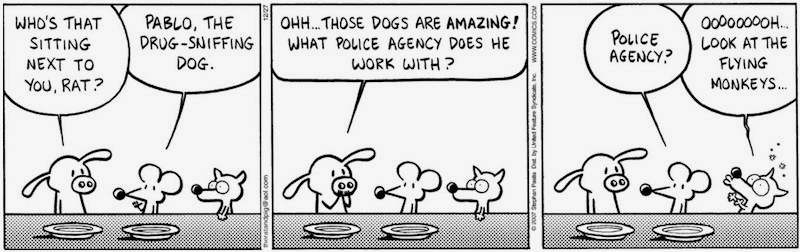
So drug-sniffing dog is ambiguous — with two different meanings for the PRP-form synthetic compound drug-sniffing — and the strip plays with the ambiguity.
The prevalence of ambiguity. Compounds are highly compressed constructs, with few (if any) indicators of the semantic relationship between head and modifier, so they’re potentially ambiguous in a great many ways. Some combinations have conventional idiomatic interpretations, and many interpretations are unlikely in the real world, or in the discourse, but potential ambiguities always lurk in the underbrush.
Cases in point: cadaver-sniffing in cadaver-sniffing dog will normally be understood as having the ‘discover’ interpretation, but a really gross ‘inhale’ interpretation is possible (with the cadavers ground up and suspended in some solvent). Conversely, glue-sniffing in glue-sniffing teenager will normally be understood as having the ‘inhale’ interpretation, but a rather silly ‘discover’ interpretation is possible (imagine teenagers going from house to house, sniffing out places where residents have stashed containers of glue). And then both compounds could be used to refer to events in which material is expelled from the nose by sniffing. Or to refer to the use of cadavers or glue as substances facilitating the drawing of air into the nose. And on and on. Any of these interpretations could be pulled out into the open by being made the point of a joke.
A note on detection dogs. From Wikipedia:
A detection dog or sniffer dog is a dog that is trained to use its senses to detect substances such as explosives, illegal drugs, wildlife scat, currency, blood, and contraband electronics such as illicit mobile phones. The sense most used by detection dogs is smell. Hunting dogs that search for game, and search and rescue dogs that work to find missing humans are generally not considered detection dogs but fit instead under their own categories. There is some overlap, as in the case of cadaver dogs, trained to search for human remains.
Leave a Reply