Archive for the ‘Context’ Category
August 6, 2023
The Mother Goose and Grimm strip of 12/3/15 (lots of stuff hangs around on my desktop for a really long time), depicting a canine guardian of the gates of dog heaven:

The definite article of uniqueness, here distinguishing a proper name St. Bernard (unique in some salient world for the user and their audience), the name of a specific saint, from a common noun St. Bernard (a type name), the name of a breed of dogs
Now it turns out that this usage can be employed to distinguish two proper nouns (according to their salience in a particular sociocultural context); and to distinguish two common nouns (picking out the salient type, rather than naming an individual). (Necessarily rather complex) examples follow.
(more…)
Posted in Context, Definiteness, Language and animals, Language and religion, Linguistics in the comics, Pragmatics, Reference, Semantics | Leave a Comment »
April 17, 2023
Well, the title pretty much gives the joke away. An outrageous (but phonologically perfect) pun in a Bizarro cartoon from 9/6/12:

(#1) (If you’re puzzled by the odd symbol in the cartoon — Dan Piraro says there’s just 1 in this strip — see this Page.)
What the woman and her two kids get to view is Disney on ice —
(the body of the dead-since-1966 Walt) Disney (resting) on (a block of preservative) ice (in a display case)
What she bought tickets to was an entertainment (especially aimed at children) called Disney on Ice —
(an entertainment in which characters from the Walt) Disney (Company’s animated cartoons are portrayed by performers skating) on ice
(more…)
Posted in Ambiguity, Common vs. proper, Context, Linguistics in the comics, Movies and tv, Names, Puns, Reference, Relevance | 4 Comments »
February 5, 2023
Today’s (2/5/23) Doonesbury strip shows us artist J.J. Caucus and her husband Zeke Brenner in her studio, with J.J. fuming about being labeled a creative:

(#1) “I’m a noun, not an adjective!” But then Zeke shifts the ground from be a creative to be creative, noting (in effect) that be creative denotes a characteristic, not an identity, so “less pressure”
J.J.’s complaint is about the nouning of the adj. creative, yielding a C[ount] noun creative that apparently just means ‘creative person’, but she’s more than a creative person, she’s a professional creator, an artist. As it turns out, the C noun creative is a great deal more specific that ‘creative person’ — and in its established usage it refers to a type of professional in the advertising industry, so in fact doesn’t apply to J.J. at all. Gripe on, J.J.!
(more…)
Posted in Beheading, Context, Conversion, Nouning, Pragmatics, Style and register | Leave a Comment »
January 25, 2023
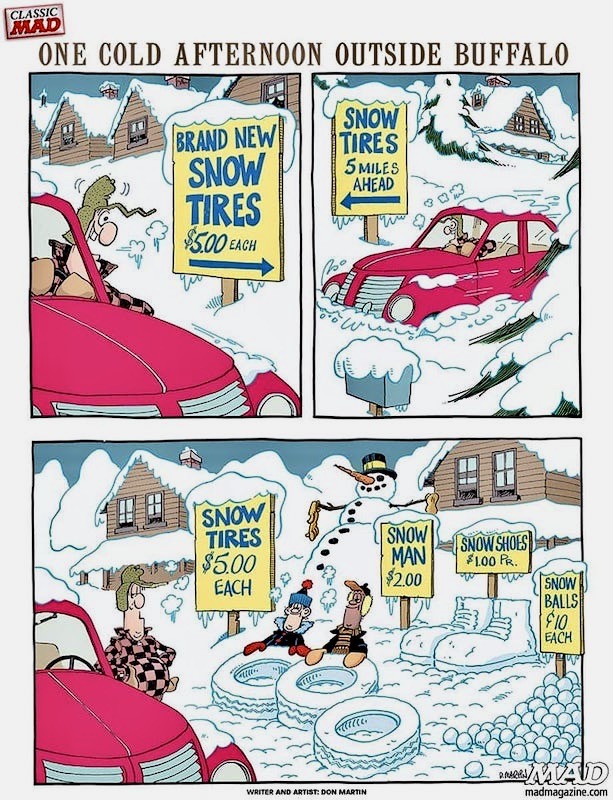
A classic Don Martin Mad magazine cartoon for the winter season, illustrating the utility and flexibility of N + N compounds in English — and also their enormous potential for ambiguity, which has to be resolved in context:
 (#1)
(#1)
Four examples of N1 + N2 compounds in English, all four highly conventionalized to very culture-specific referents. In these conventionalized uses, two (snow tire, snowshoe) are use compounds (‘N2 for use in some activity involving N1’), two (snowman, snowball) are source compounds (‘N2 made from N1’). But N + N combinations are potentially ambiguous in multiple ways; this lack of clarity is the price you pay for the great brevity of these combinations (which lack any indications of the semantic relationship between the two elements).
So: we get snow tire and snowshoe understood as source compounds in #1: ‘(simulacrum of a) tire made of snow’, ‘(simulacrum of a) shoe made of snow’.
I’ll turn to the four snow + N2 compounds in #1 in just a moment, but this presentation is now interrupted by breaking news from the snow-cartoon world, a wonderful wordless cartoon by snowman maven Bob Eckstein in the 1/30/23 issue of the New Yorker, which has in fact not yet arrived in my mailbox.
(more…)
Posted in Brevity vs. Clarity, Compounds, Context, Linguistics in the comics, Pragmatics, Semantics, Semantics of compounds | 1 Comment »
October 19, 2022
… and, eventually, how to abracadabra things out of sight. Yes, it’s Verbing Day on AZ Blog!
Politics and real estate: to door knock. It started on the Rachel Maddow Show on MSNBC on 10/11, with the cite presented here in its larger context:

(#1) to door knock / door-knock ‘knock on doors’ (in political canvassing): a N + V verb, whose origin lies in a back-formation from the synthetic compound door knocking / door-knocking
The semantics / pragmatics of the synthetic compound is specialized — not merely knocking on doors, but doing so in specific sociocultural settings (political canvassing and door-to-door solicitations by real estate agents, in particular) — and this specialization is shared by the 2pbfV (two-part back-formed V)
(more…)
Posted in Back formation, Compounds, Context, Conversion, Innovations, Lexical semantics, Nouning, Pragmatics, Semantics of compounds, Synthetic compounds, Verbing | 1 Comment »
September 1, 2022
🐇 🐇 🐇 (the commencement of September) The Calvin and Hobbes comic strip from 9/1/92, reprised in my comics feed on 8/30:

(#1) We can achieve intergenerational incommunicability! Yes we can!
Calvin articulates a view of word use, call it CalWord, which comes in two parts:
Endless lability. Any word can be used to convey any meaning. In the CalWord view, a word is merely substance — pronunciation or spelling — that can be put to any use. So words are the stem cells of the linguistic world. From NOAD:
compound noun stem cell: Biology an undifferentiated cell of a multicellular organism which is capable of giving rise to indefinitely more cells of the same type, and from which certain other kinds of cell arise by differentiation.
Social fencing. Socially distributed variants can serve as social fences, separating the Ins from the Outs and impeding the Outs’ ability to comprehend and communicate with the Ins — impeding, for example, one generation’s ability to comprehend or communicate with the generations after it. The fencing effect is very noticeable for lexical variants — different bits of substance for the same use (soda vs. pop, say); or, especially relevant here, different uses for the same substance (gay ‘lighthearted, carefree’ vs. ‘homosexual’ vs. ‘foolish, stupid, unimpressive’, say).
(more…)
Posted in Context, Language change, Lexical semantics, Linguistics in the comics, Morphology, Naming, Pragmatics, Semantics | Leave a Comment »
August 30, 2022
Today’s Piccolo / Price Rhymes With Orange strip is a play on specific American tv commercials (with some gentle old-age mockery folded in), so will be baffling to any reader who doesn’t recognize the Kool-Aid Man mascot or know the wall-breaking “Oh Yeah!” tv ads featuring KAM:

(#1) There is, however, a hint to the reader in the “So not kool” (with kool instead of cool) in the title panel; note also the generational disparity reinforced by the GenX so there (see my 11/14/11 posting “GenX so“)
(more…)
Posted in Ambiguity, Context, Language and food, Language in advertising, Linguistics in the comics, Logos, Mascots, Technical and ordinary language, Understanding comics, Variation | 1 Comment »
June 3, 2022
A little study in N + N compounds in English, their great utility and versatility (they pack a lot of content into two-word expressions), and their consequent massive potential ambiguity (so that divining the intended meaning can require vast amounts of background knowledge and appreciating details of the context in which the compound is used). You can have (great) brevity, or you can have (great) clarity, but you can’t have both at once.
From the world of commerce, the compound dog spot (which many of us will not have encountered before, or will take to be a reference to the coat pattern of Dalmatian dogs). From the comic strips, two compounds that have conventional interpretations but can also be understood in fresh and unconventional ways: from One Big Happy, dancing school; from Bizarro, cowboy.
(more…)
Posted in Ambiguity, Brevity vs. Clarity, Compounds, Context, Lexical semantics, Linguistics in the comics, Music, Pragmatics, Semantics of compounds, Snowclonelet composites | 2 Comments »
May 14, 2022
Taking off from a delightful ad for Romperjacks on Facebook back in November and December:

Here I give you the ad photo, and inventory some of the things it inspires me to write about in future postings (several being themes from earlier postings on this blog).
(more…)
Posted in Art, Categorization and Labeling, Clothing, Context, Facial expression and gesture, Fashion, Homosexuality, Lexical semantics, Masculinity, Music, My life, Race and ethnicity | 1 Comment »
June 20, 2021
A comic gem from the very first episode (“Give Me a Ring Sometime”) of the American tv show Cheers (S1 E1 9/30/82). An exchange (call it the D&C exchange) between the character Diane — at this point, merely a patron sitting in the bar Cheers — and Coach, the bartender on duty:
Diane to Coach: Excuse me. Where is your bathroom?
Coach in response : Uh, next to my bedroom.
The character Coach turns out to be empathetic and warm-hearted, but regrettably slow and defective at calculating people’s intentions in speaking as they do. In this brief exchange with Diane, Coach is faced with several linked tasks in understanding deictic elements: the locative deixis in where, the person deixis in your.
(more…)
Posted in Context, Deixis, Metonymy, Movies and tv, Pragmatics | 1 Comment »