(Another warning about male genitals in fine art)
Encountered on Pinterest on 10/29, a poster of a stunning wooden sculpture of Icarus by Ukrainian artist Bogdan Goloyad:
(Another warning about male genitals in fine art)
Encountered on Pinterest on 10/29, a poster of a stunning wooden sculpture of Icarus by Ukrainian artist Bogdan Goloyad:
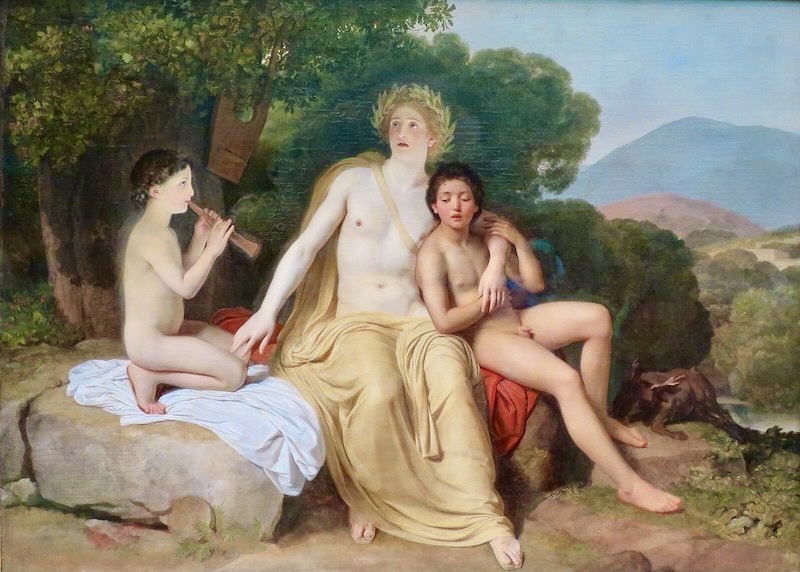
Encountered on Pinterest on 10/28, in a collection of mostly homoerotic images — Pinterest strives to cater to your interests, and mine aren’t hard to suss out — this painting, identified as being an early 19th-century work by Russian painter Alexander Ivanov (an artist completely unknown to me):
(#1) My first response was that the painting was truly creepy, looking to modern eyes like high-class kiddie porn: a beautiful young man (wearing a laurel wreath, therefore noble or divine), naked but with drapery over his lower body (his gaze fixed dreamily on something in the middle distance), embracing a totally naked young teenage boy (whose eyes are closed, apparently in enjoyment), while another fully naked boy, considerably younger, plays a wind instrument (apparently an aulos, an ancient Greek double-reed) for his companions’ pleasure; a lyre hangs from a tree in the background
A gauzily Romantic painting, set in a rough scenic wilderness, apparently of some classical or mythological subject in which music plays a significant role. Ok, so the beautiful young man is probably the god Apollo, famously skilled at the lyre (bonus: by far my favorite of the pantheon of ancient Greece and Rome). In this painting as the god of music and also the protector of the young. The boys are naked because they are true pre-pubertal innocents. Or just because the scene is set in the Arcadian wilderness, suffused with divine presence, a territory in which the gods and those within their aura have no need for the garb of ordinary mortals. Well, certainly not in artworks; consider the famous Apollo of the Belvedere statue (my 9/23/24 posting “Godlike beauty” has a section on the Belvedere Apollo and his full-frontal divinity).
So I tracked down #1: it’s Alexander Ivanov’s Apollo, Hyacinthus and Cyparissus making music and singing (painted during 1831-34), which I’ll call AH&C for short. At this point, things just got puzzling. The Russian painter Ivanov (1806-58) was new to me; he turns out to have a remarkable life history (summarized below). And then there’s the scene in #1.
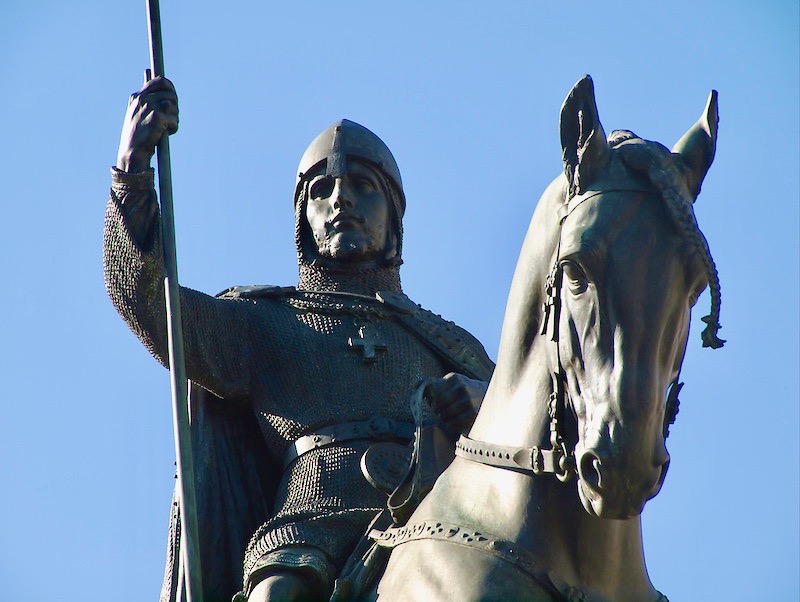
Hana Filip (Professor of Semantics at the Heinrich Heine University in Düsseldorf, Germany, and a daughter of Moravia) reminds us on Facebook that today is Wencesla(u)s Day in the Czech Republic. St. Wenceslas Day is the feast day of the saint, commemorating his death in 935; and in 2000 also became a national public holiday, Statehood Day of the Czech Republic. The Duchy of Bohemia was founded in the 9th century; the Czech lands — Bohemia, Moravia, and Czech Silesia — were then integrated into the Holy Roman Empire and later the Austro-Hungarian Empire, emerging as part of the First Czechoslovak Republic in 1918, which was then peacefully dissolved into the Czech Republic and Slovakia in 1992 (yes, it’s complicated — well, the history stretches over 12 centuries and wars too many to count — but you can see why opting for the saint’s feast day as the national holiday makes some sense).
From the statue of Saint Wenceslas in Prague:
The statue in Wenceslaus Square (Flickr photo)
Encountered on Pinterest today, this cover of Collier’s magazine from 1/19/1907: an early J.C. Leyendecker work of gay soft porn in the style of classical sculpture (an art form that lets the artist get away with a lot), which is also a hymn to rapid transport in the early 20th century:
“The Speed God” posed with a stylized caduceus against a hot air balloon, while the messenger of the Roman gods poses his muscular body on the hood of an early automobile
And then there are Mercury’s truly fabulous winged sandals, which appear to be living creatures in their own right.
(JCL appears every so often on this blog — most recently in my 9/2 posting “Leyendecker Labor Day”.)
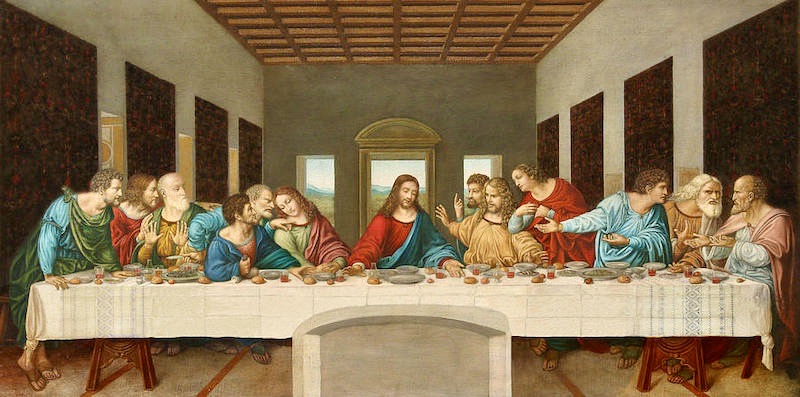
The July 26th opening ceremonies for the Paris Olympic games included a tableau — of drag queens posed as presiding over a banquet — that vaguely resembled Leonardo da Vinci’s Last Supper painting:
(#1) The Olympic drag pose
(#2) The Leonardo original
Temporarily poleaxed by a long period of low air pressure — not dead yet, just not functioning at all well — I’m posting a little thing from the most recent issue (July 8 & 15, 2024) of the New Yorker:
Cartoon by Pia Guerra and Ian Boothby
Pandora’s disastrous opening, in mythical times, of the box containing all the evils that beset mankind comes round again in her opening the comments section on her laptop, thus freeing all the vileness of the human spirit. As it was once, so must it be again.
June 30th, specifically. It also happens that there are Pride celebrations lots of places, including San Francisco, but such events have long been out of my grasp, and being trapped in my house on an unmanageably hot day, facing a pile of vexing mail, has sent me into an emotional tailspin. I know from experience that if I ride this out, things will seem better tomorrow, but for the moment, I can’t cope. So I’ll just re-post the core of my June 30th posting from two years ago — “Ultimate Queen Day”, from 6/30/22:
🐆 🐆 🐆. (That’s a ritual tiger-tiger-tiger for the last day of the month …) Today is Ultimate June, the final day of a month packed with occasions of considerable emotional content, also (etymologically) a month dedicated to the Roman goddess Juno: queen of the gods (in fact, also called in Latin Regina ‘queen’), counterpart to Greek Hera; protector of women and motherhood; also embracing warlike features of Greek Athena, the goddess of wisdom and war (the deities of classic times were marvels of intersectionality, as we would now put it), and oh yes, wife of Jupiter, the counterpart to Greek Zeus.
So I am suggesting that 6/30 be recognized as Ultimate Queen Day, especially celebrating men who are flamboyant (in any way) and those who are effeminate (in their presentation of themselves). Stereotypically, these two bundles of characteristics are manifested together, in the cultural type the queen (not to be confused with royalty, with the drag queen, with X queen used to label tastes or preferences of many kinds — imagine a white-cross queen, a man who prefers Swiss men as sexual partners, or a fan of Swiss things — or with various other uses of /kwin/).
You could think of UQD as F-Gay Day, with F for fem / femmy / femboy, flaming / flamer, flagrant, faggy / fag / faggot / fag-ass, fairy / fairy-boy, fuckboy / fucktoy / fuckhole, and all that good stuff.
From a little while back, a morning on which I came to full consciousness to the music from the final section of Handel’s Acis and Galatea. Ravishingly beautiful music, as gorgeous as anything Handel ever wrote. When it all came to an end, I wheeled into the living room so I could get my Apple Music program to play the section again, And again, this time while I took notes on the music. Eventually I went on with things and was overwhelmed by the needs of my daily life — and am only now getting back to A&G.
This was not my first Morning Music Moment with A&G. A couple years back — on 5/3/22, in the posting “A moment of joy on waking up” — I celebrated some fabulously joyous music in the early sections of A&G, with some notes on the work.
A&G was written as an entertainment (like a little opera or a masque, for a private audience), in fact as a parody of pastoral opera, but ended up as what some critics consider to be the pinnacle of the genre. It has been altered by many hands for different purposes, so there are many versions (Mozart did one). In any case, Handel poured some of his most joyous music and some of his most drippingly beautiful melodies into the work, along with some delightful counterpart between different voices. Making it (in my estimation) entirely comparable to his Messiah — but full of fun instead of the glorification of God.
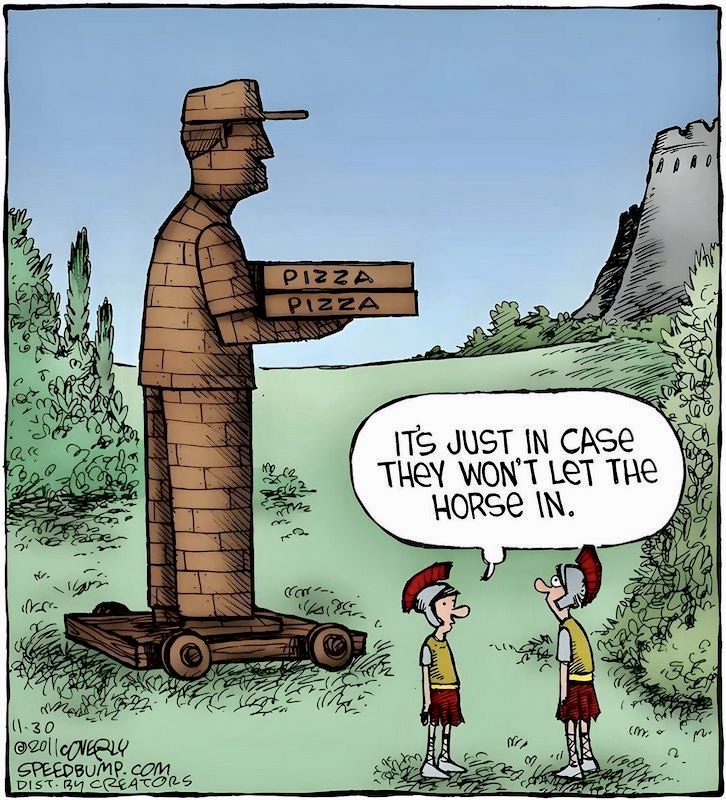
From Susan Fischer on Facebook today, a link to a very old (11/30/11) Dave Coverly Speed Bump cartoon depicting the Trojan Pizza Boy:
(#1) Pizza Boy wears a cap, and he comes bearing two pizza cartons (plus, we assume, a lot of concealed Trojan warriors)