Hana Filip (Professor of Semantics at the Heinrich Heine University in Düsseldorf, Germany, and a daughter of Moravia) reminds us on Facebook that today is Wencesla(u)s Day in the Czech Republic. St. Wenceslas Day is the feast day of the saint, commemorating his death in 935; and in 2000 also became a national public holiday, Statehood Day of the Czech Republic. The Duchy of Bohemia was founded in the 9th century; the Czech lands — Bohemia, Moravia, and Czech Silesia — were then integrated into the Holy Roman Empire and later the Austro-Hungarian Empire, emerging as part of the First Czechoslovak Republic in 1918, which was then peacefully dissolved into the Czech Republic and Slovakia in 1992 (yes, it’s complicated — well, the history stretches over 12 centuries and wars too many to count — but you can see why opting for the saint’s feast day as the national holiday makes some sense).
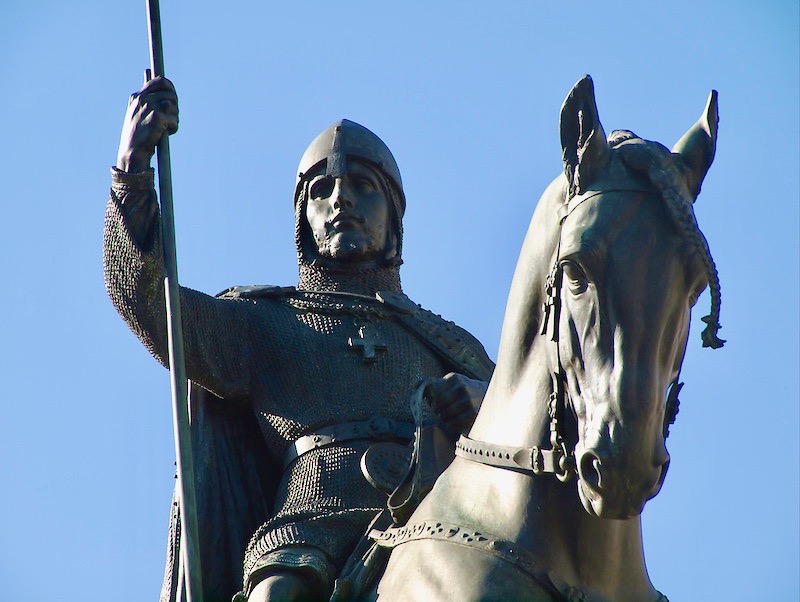
From the statue of Saint Wenceslas in Prague:
The statue in Wenceslaus Square (Flickr photo)
From Wikipedia:
The statue of Saint Wenceslas in Prague, Czech Republic depicts Wenceslaus I, Duke of Bohemia. It is installed at Wenceslas Square.
The mounted saint was sculpted by Josef Václav Myslbek in 1887–1924, and the image of Wenceslas is accompanied by other Czech patron saints carved into the ornate statue base: Saint Ludmila, Saint Agnes of Bohemia, Saint Prokop, and Saint Adalbert of Prague. The statue base, designed by architect Alois Dryák, includes the inscription [in English translation] “Saint Wenceslas, duke of the Czech land, prince of ours, do not let perish us nor our descendants”
The story of the saint. Suppressing all the 10th-century action, with its large cast of frequently bloodthirsty characters, and concentrating on the development of his legend. From Wikipedia:
Wenceslaus I (Czech: Václav; c. 907 – 28 September 935), Wenceslas I or Václav the Good was the Prince (kníže) of Bohemia from 921 until his death, probably in 935. According to the legend, he was assassinated by his younger brother, Boleslaus the Cruel. [AZ: fortunately for us, the legend comes with a specific date for the assassination, which can then provide Wenceslas with a feast day, 9/28]
His martyrdom and the popularity of several biographies gave rise to a reputation for heroic virtue that resulted in his sainthood. He was posthumously declared to be a king and patron saint of the Czech state. He is the subject of the well-known “Good King Wenceslas”, a carol for Saint Stephen’s Day.
… Wenceslaus was considered a martyr and saint immediately after his death, when a cult of Wenceslaus grew up in Bohemia and in England. Within a few decades, four biographies of him were in circulation. These hagiographies had a powerful influence on the High Middle Ages concept of the rex justus (righteous king), a monarch whose power stems mainly from his great piety as well as his princely vigor.
… Although Wenceslaus was only a duke during his lifetime, Holy Roman Emperor Otto I posthumously “conferred on [Wenceslaus] the regal dignity and title”, which is why he is referred to as “king” in legend and song.
… Legends of Wenceslaus began to appear around the second half of the 10th century, several decades after his death, and spread throughout both Bohemia and abroad, including Italy, Germany, and even Russia.
… [An] enduring legend claims an army of knights sleeps under Blaník, a mountain in the Czech Republic. They will awake and, under the command of Wenceslaus, bring aid to the Czech people in their ultimate danger. There is a similar legend in Prague which says that when the Motherland is in danger or in its darkest times and close to ruin, the equestrian statue of King Wenceslaus in Wenceslaus Square [above] will come to life, raise the army sleeping in Blaník, and upon crossing the Charles Bridge his horse will stumble and trip over a stone, revealing the legendary sword of Bruncvík. With this sword, King Wenceslaus will slay all the enemies of the Czechs, bringing peace and prosperity to the land
So Václav, after the saint, is a decidedly euominous Czech male personal name; and then, wonderfully, it’s the first name of Václav Havel — statesman, author, poet, playwright and dissident — who served as the last president of Czechoslovakia from 1989 until 1992 and the first president of the Czech Republic from 1993 to 2003 (information boiled down from Wikipedia). Who could be seen as having slain enemies of the Czech people, but by peaceful (though pointed and passionate) means — his voice and his writing — rather than by taking up arms against them.
September 28, 2024 at 8:40 am |
Good King Wenceslaus clearly should have looked out on September 28th, rather than on December 26th.
Or as cartoonist Walt Kelly paraphrased hymnographer John Mason Neale, on his feets uneven.
Euominous? Neither Google nor OED2 knows this word. Perhaps euonymous. According to OED, the euonymus shrub was “well-named” apotropaically, since legend had it that its flowering heralded a pestilence.
September 28, 2024 at 9:07 am |
I have of course posted about Good King Sauerkraut.
As for euominous, I was trusting on my readers’ being able to read it as ‘of good omen’, hence ‘well-named’. I would have gone for euonymous, but botanists have taken that word for the shrub.
September 28, 2024 at 3:33 pm |
Hana Filip is a daughter of Moravia (in the Czech Republic, which has 9/28 as its Statehood Day). I am a son and grandson of Pennsylvania Dutch Country, specifically Berks County PA (in the United States of America), and a grandson of Canton Glarus (in the Swiss Confederation). So my ancestral national days are American Independence Day, 7/4, and Swiss National Day, 7/1 (Germany wasn’t unified into a single state until long after my Pennsylvania German ancestors left the Rheinland / Palatinate; but German Unity Day, the country’s national day, is coming up very soon, on 10/3).