The July 26th opening ceremonies for the Paris Olympic games included a tableau — of drag queens posed as presiding over a banquet — that vaguely resembled Leonardo da Vinci’s Last Supper painting:
(#1) The Olympic drag pose
(#2) The Leonardo original
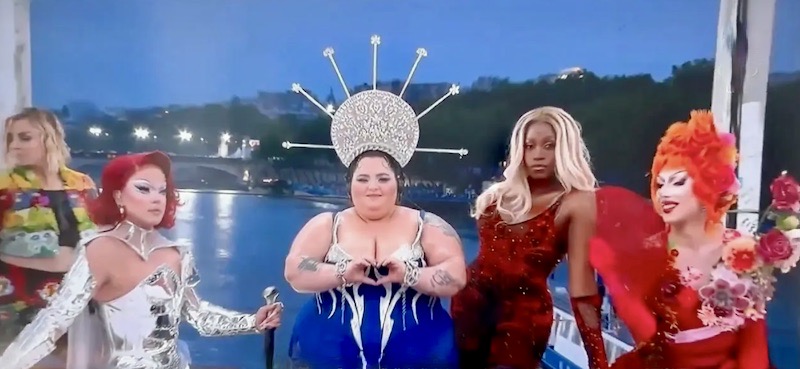
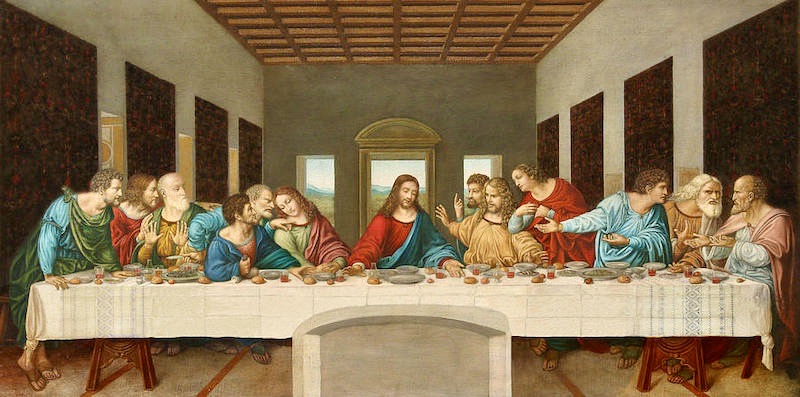
Though the creative director maintained that the performance was a re-enactment of Jan Bijlert’s Feast of the Gods (a painting that is a French national treasure):
(#3) The Bijlert Feast

The director was of course aware that many people would take the tableau to be a parody of the Leonardo masterpiece, but noted that the Leonardo had been endlessly parodied, including by Andy Warhol and The Simpsons — the implication being that a drag-queen re-enactment of the painting would be no more sacrilegious than pop-art or pop-cultural parodies (a stance that I’m deeply in sympathy with).
Now, the program for this posting. I’m going to talk about:
— The Feast of the Gods as a subject of artworks in Europe (going back to antiquity)
— Bijlert’s Le Festin des dieux as a notable painting in this tradition; the painting highlights the two gods Apollo (as the central figure at the table) and Dionysus / Bacchus (as the central figure in the foreground of the painting)
— parody magnets in the art world, with Leonardo’s Last Supper as the most powerful parody magnet of all time, attracting imitations of many sorts
— the opposition between Priapus / Dionysus and Apollo as archetypes of masculinity, male attractiveness, male power, and male sexuality
Deities feasting. From Wikipedia:
The Feast of the Gods or Banquet of the Gods as a subject in art showing a group of deities at table has a long history going back into antiquity. Showing Greco-Roman deities, it enjoyed a revival in popularity in the Italian Renaissance, and then in the Low Countries during the 16th century, when it was popular with Northern Mannerist painters, at least partly as an opportunity to show copious amounts of nudity.
The revival of the subject in the Renaissance took off with Bellini’s Feast of the Gods. From Wikipedia:
(#4) The Bellini painting, with the gods feasting on the groundThe Feast of the Gods (Italian: Il festino degli dei) is an oil painting by the Italian Renaissance master Giovanni Bellini, with substantial additions in stages to the left and center landscape by Dosso Dossi and Titian. It is one of the few mythological pictures by the Venetian artist. Completed in 1514, it was his last major work. It is now in the National Gallery of Art in Washington D.C., which calls it “one of the greatest Renaissance paintings in the United States”.
The painting is the first major depiction of the subject of the “Feast of the Gods” in Renaissance art, which was to remain in currency until the end of Northern Mannerism over a century later. It has several similarities to another, much less sophisticated, treatment painted by the Florentine artist Bartolomeo di Giovanni in the 1490s, now in the Louvre.
… The figures shown are usually taken to be (left to right): a satyr, Silenus with his ass, his ward Bacchus as a boy, Silvanus (or Faunus), Mercury with his caduceus and helmet, a satyr, Jupiter, a nymph serving, Cybele, Pan, Neptune, two standing nymphs, Ceres, Apollo, Priapus, Lotis.
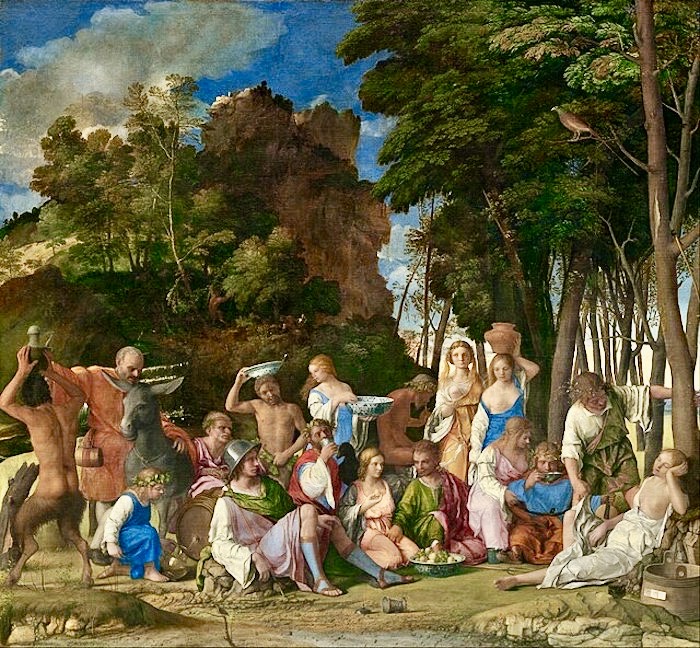
The Bijlert painting. In #3. From Wikipedia:
Le Festin des dieux (‘The Feast of the Gods’) is a painting by the Dutch painter Jan van Bijlert, created around 1635–1640. It is in the Musée Magnin in Dijon, France [and is owned by the French State].
It is one of a number of pictures in western art to depict the feast of the gods, in this case at the marriage of Thetis and Peleus, with Bacchus in the foreground, and a prominent dancing satyr.
… The painting represents a banquet taking place on Mount Olympus to celebrate the marriage of Thetis, a nereid, and Peleus, king of Phthia, in which many gods from Greco-Roman mythology participate. In the centre, Apollo is crowned [as the sun god, with a halo of light] and holds a lyre [as the god of music]. In the left part we can recognize Minerva, Diana, Mars, Venus, and Love and, behind, Flora, the goddess of spring. On the right are Hercules and Neptune, as well as Eris, recognizable by the golden apple of discord that she brought as revenge for not having been invited. In the foreground are a dancing satyr and Bacchus, eating a bunch of grapes.
The left part of the painting has been cut off, explaining the absence of certain gods. For example, Juno’s peacock is present, but not the goddess herself.
Meanwhile, the painting highlights two of the gods: Apollo (with his sun-god halo) in the middle of the diners; and the wine-crazed celebrant Bacchus / Dionysus in the foreground.
Parody magnets. In the world of verbal art, certain works, because of their obsessions with content or quirkiness of style, invite parody — so they are endlessly played on; Poe’s The Raven and Moore’s A Visit From St. Nicholas are monuments of parody magnetism.
So it is in visual art — as with parody magnets like Hopper’s Nighthawks , Wood’s American Gothic, and Munch’s The Scream — except that some works develop their parody magnetism simply from being extraordinarily well-made, famous, or culturally significant; here Michelangelo and Leonardo lead the pack, Leonardo with his Mona Lisa and especially with the most powerful parody magnet of all, his Last Supper. There are countless parodies out there, some respectful, some affectionate, some silly, some outrageous; some from the world of high art, some from pop art, many from various corners of pop culture. A sampling …
— from my 8/24/11 posting “Marisol”: artist Marisol’s Last Supper: translation, reinterpretation, burlesque?
— from my 11/22/17 posting “Superhero supper”, superhero parodies of the Leonardo
— from my 3/28/18 posting “Deviant Last Suppers”, starting with a 2017 Salerno (in southern Italy) gay sex-filled version of the Last Supper — with Jesus and his disciples in various stages of undress, kissing, engaged in oral sex, and one offering his body for anal sex — and going on to 8 other queer and female versions
The opposition between Priapic Man and Apollonian Man. Between Priapus / Dionysus / Bacchus and Apollo, as archetypes of masculinity, male attractiveness, male power, and male sexuality. Extended discussion from my 4/8/22 posting “The Aussie firedog”:
Priapic Man is not all there is, though you might not appreciate that, because he gets most of the press. But there’s another world, the domain of Apollonian Man, the decorative and accomplished young man — the musician, the singer, the dancer, the poet; also the artist, the creator and designer of beautiful things; the caring healer; and the educator of children. Usually represented as a beardless, athletic youth.
Apollonian Man doesn’t get such great press, because in the context of the stringent standards of (fiercely binary) normative sexuality in the culture that currently surrounds us, he is seen as feminine and therefore as deficient and distasteful.
… (Note on the mythology. The Greek mythic embodiments here are Dionysus vs. Apollo (Priapus is a minor fertility god, but he’s as intensely male as you could wish for, so I use his name). As far as absolutely root maleness goes, both Dionysus and Apollo spread their seed, Apollo rather more than Dionysus apparently; and then both also took youths as male lovers — notably, Apollo had Hyacinth and Dionysus had Ampelos — but that was indeed the Greek way… )
I strongly urge you to try thinking of the Priapic and the Apollonian simply as two different ways of being masculine, with neither tied directly to stages of life; Priapus / Dionysus and Apollo are, after all, metaphors. So you can exhibit Priapic or Apollonian masculinity at any any age; your sexual desires can incline towards men or towards women, your sexual practices can be with men or women, you can identify with a gay community or a straight community, while exhibiting either of these forms of masculinity; if you’re a man and your sexual desires or practices are directed towards other men, you can be receptive or insertive, submissive or dominant, and so on, while exhibiting either of these forms of masculinity. (Yes, there are associations between these factors, many weak, some quite strong, but the factors are distinct.)
Very very crudely, Priapic guys are hunky and Apollonian guys are adorable. The guys in the Australian Firefighters calendars and their ilk are hunky and Priapic; a lot of the guys in the the Cocky Boys calendars and their ilk are adorable — the adjectives twinky and twinkish are sometimes bruited about — and Apollonian
August 6, 2024 at 8:10 pm |
A striking image based on ‘The Last Supper’ comes from ‘Battlestar Galactica’. According to https://en.battlestarwikiclone.org/wiki/The_Last_Supper: ‘”The Last Supper” is the unofficial name of a promotional picture concocted by the SciFi Channel to promote the Re-imagined Series.’