Ich weiß wohl, was soll es bedeutenDass ich so traurig bin
An anguish of old age is living immersed in death — of family, friends, loves, colleagues, mentors and models, students, people who have entertained, enriched, and illuminated you — while laboring just to get from day to day yourself. I have failed to memorialize many of the departed, I cannot cope any more, and I am ashamed of all of that. And now comes the death of Manfred Bierwisch, not exactly a surprise, since he was a full decade older than me, but then he was one of the few who should have been granted a life forever. And with a special role in my life.
Martin Haspelmath on Facebook this morning:
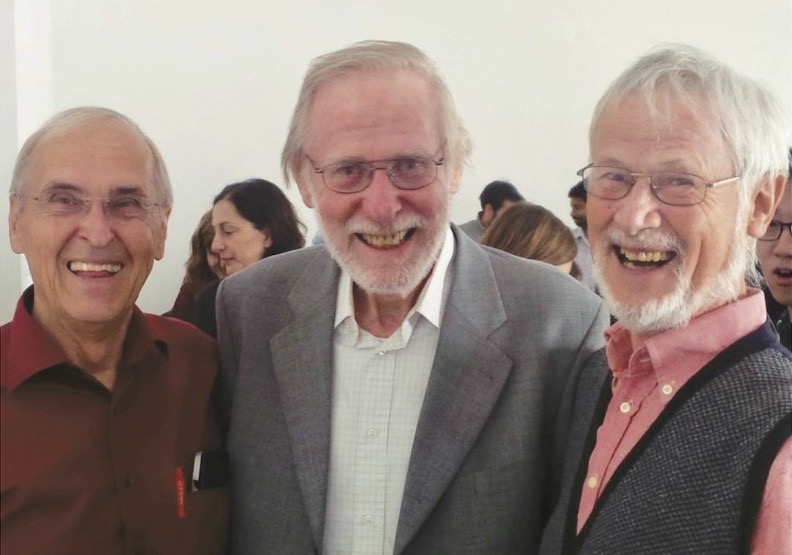
RIP Manfred Bierwisch (1930-2024, in the middle of the picture).
(MH:) The picture shows [MB] with his close friends Paul Kiparsky and Dieter Wunderlich (taken from Kiparsky’s 2023 memoir in the [Annual Review of Linguistics])He was the GDR’s most prominent linguist, but he made no compromises with the regime. When some people were doing “Marxist linguistics” because it was good for their careers, he kept pursuing “structural linguistics”. Unlike some of his friends from the 1950s (e.g. Heinz Vater and Ewald Lang), he did not try to leave for the freer West Germany, but he stayed in the East. In 2005, he was awarded an honorary doctorate from Leipzig University, where he had studied in the 1950s (and where he was jailed for 10 months for possession of illegal writings).
My response on FB:
A friend and model colleague from my earliest days in linguistics, also enormously charming. All this while remaining, doggedly, in full resistance, in the GDR (because it was his country). Some kind of miracle. Now we mourn the death of a good man.
From my list of publications, in the articles section:
5. Umlaut and noun plurals in German [in English]. Studia Grammatica 6 (Phonologische Studien), 35-45 (1967), edited by Manfred Bierwisch [obviously, about morphophonology rather than automatic phonology]
This was my first publication in linguistics in a journal: in Studia Grammatica, the linguistics journal of the Deutsche Akademie der Wissenschaften zu Berlin, in the GDR.
Sadly, my copy of the journal and my copies of this ancient paper were lost in the dispersal and destruction of my scholarly library and files. So I can’t show the paper to you. I do recall it, though, enough to say that I would no longer defend the clever idea advanced in it. Hey, that was 57 years ago; you learn new things.
Leave a Reply