Another report from Jeff Shaumeyer on Facebook:
“If you happenly want to convert …”. I don’t think I’ve ever heard “happenly” before, but it seems potentially quite useful.
Another report from Jeff Shaumeyer on Facebook:
“If you happenly want to convert …”. I don’t think I’ve ever heard “happenly” before, but it seems potentially quite useful.
A Zippy with the surprising verb inexplicate (in the past tense):

We start with the adjectives perplexing and inexplicable. Perplexing is based on the verb perplex. What, then, is the verb that inexplicable is based on? Obviously, inexplicate, the meaning of which is hard to, um, explicate.
(The semantics of perplexing and inexplicable are, of course, quite different, and the in- of inexplicable is a negative prefix associated with the adjective explicable rather than with the verb explicate. But Bill Griffith understood that.)
Cartoon #2 for today: a Bizarro:

Recutting (or metanalysis — see here) at work, with the pro of provolone and the anti of antipasto treated as derivational prefixes. Historically, the provol- part of provolone represents provola, a type of Italian cheese (made with cow or buffalo milk), and the anti- part of antipasto is ante- ‘before’.
From several sources: repticide, reptard, danglology.
A combination of two things: telephonoscopy (also telephonotomy) on this blog, here; and a recent card to me from Chris Ambidge, reporting a friend (observing him putting shirts and towels into the automatic washing machine) saying jocularly, “Ah, you’re committing laundricide”.
The common factor is “combining forms”, learnèd elements that are mostly like compound elements but somewhat like derivational affixes: -(o)scopy (and -(o)tomy) and –(i)cide.
In a recent Zippy, Griffy and Zippy manage to weave together telephone hassles and gastroenterology:
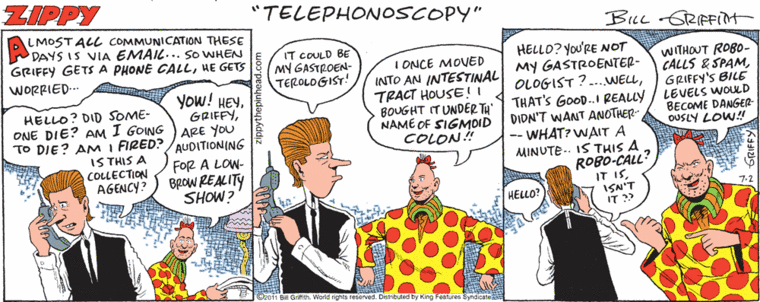
Once gasteroenterologists are in the conversation, Zippy lurches into the absurd phrasal overlap portmanteau intestinal tract house (intestinal tract + tract house), adding the absurd pseudonym Sigmoid Colon (predictably, the name has been used by others, in particular on the blog Sigmoid Freud: The life and views of a Forensic Psychiatrist).
Then there’s telephonoscopy, using the learnèd “combining form” (part compound element, part derivational suffix) -scopy. From Michael Quinion’s affixes site on the combining form:
-scope Also -scopic and -scopy.
An instrument for observing, viewing, or examining something.
[Greek skopein, look at.]This ending appears in the names of a wide variety of instruments in engineering, medicine, the sciences, and other fields, most containing the linking vowel -o- before the ending. All can have associated adjectives in -scopic, as in spectroscopic or gyroscopic. Many have a linked noun in -scopy that describes an observation or examination made using the instrument: laryngoscopy, endoscopy (among those in which that form is rare are kaleidoscope and periscope, in which names do not represent a scientific instrument).
The link between telephonoscopy (presumably ‘an examination made using the telephone’) and gastroenterology lies in the procedures of colonoscopy and sigmoidoscopy (and endoscopy in general).
(Getting rid of your telephone, cutting it out of your life, would of course be telephonotomy.)
Attached to (and largely covering) the front of the May 20 issue of Science, an ad labeled “The Rabbit Monoclonal Advantage”, for rabbit monoclonal antibodies offered by the Epitomics company (“Better Antibodies ● Better Science”). I have nothing to say about RabMAbs, as they seem to be known in the trade, but I do have a bit to say about the company’s name.
On Sunday I got a long-overdue haircut (no, this isn’t going to turn into an IM-like message on the moment-to-moment details of my life); I’d gotten much much too shaggy. In describing this to friends, I said that I’d gotten (satisfyingly) deshagged.
Deshagged would seem to imply a previous stage in which I was shagged, in the sexual sense. (I have in fact been shagged, often, though not for a very long time now.) But that’s not the way the morphology of deshag works.
People in the public eye, especially celebrities and political figures, are often subject to linguistic scorn, either by quotations that take on a memic life of their own (Bushisms from George W. Bush, Cruisiana from Tom Cruise) or by morphological formations (portmanteaus and derivatives) that allude to these public figures (Reaganaut/Reagonaut).
Scornful portmanteaus are scarcely new: see feminazi (feminist + Nazi) from the political right, Repuglican (repugnant + Republican) from the political left. But certain figures are attractors for them. Barack Obama, for instance; beyond a small number of examples like BarackBerry (Barack + BlackBerry), there are endless Obamamanteaus (I wish I could say I’d invented this one, and there aren’t a lot of citations, but I surely didn’t get in there first), a few of them collected in Mark Liberman’s Language Log posting “Lexical Obamanations” (here) and Ben Zimmer’s comment on it.
But now Charlie Sheen has come along and opened up a whole new world, of Sheenisms or Sheenonyms or Sheen-guistics (respectively, an ordinary derivative, a compound-like word with Sheeno- as a combining form, and a portmanteau), and of course of words for talking about Sheen and his bizarre public rants.
From two weeks ago, this report from Elizabeth Daingerfield Zwicky on an exchange between her and her daughter, Opal:
Me: Now you can just scoot down the block!
Opal: Mom! You said ‘scoot’!
Me: Yes?
Opal: You didn’t say ‘scooter down the block’, you said ‘scoot down the block’!
Me: Isn’t that what you do on a scooter? Scoot?
Opal: No! You scooter on a scooter! You scoot on a scoot. (rides off, singing ‘Scooter on a scooter! Scoot on a scoo-ooot!”)
Elizabeth was treating the noun scooter as a derivative in –er from the verb scoot ‘move swiftly’, while Opal (not seeing the verb as connected to scooter — in the way she fails, not unreasonably, to connect sweat and sweater) creates a verb scooter ‘use a scooter’ by verbing the noun directly.
“You scoot on a scoot” looks like it has a nouning of the verb scoot, though I’m not sure what sort of object Opal thinks a scoot is; maybe it’s just the result of morphological reasoning-by-analogy.