A few notes on morning wood ‘erection upon awakening’, on my X blog because of the accompanying image: here.
In a note on my little posting on the zero-nouning of the adjective unsatisfactory, in which I mentioned the (somewhat awkward) default –ness nominalization unsatisfactoriness, commenter TC floats, somewhat hesitantly, the possibility of a –tion nominalization unsatisfaction.
Here a few quick remarks on the two items in dictionaries and on the Web.
Three language-related cartoons: in order, a Zippy, a Zits, and a Bizarro.
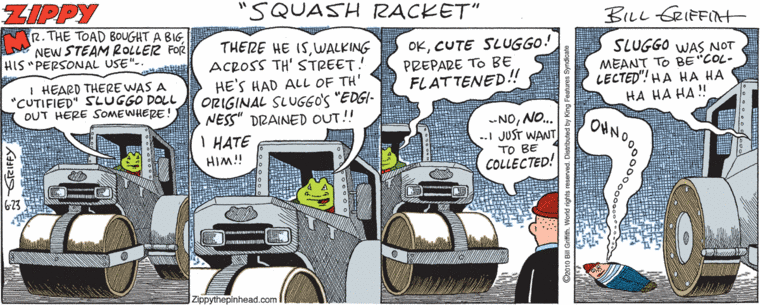
Mr. Toad’s cutified (in quotation marks, note, to signal its ostentatiously innovative character) — adjective cute + causative/inchoative derivational suffix -ify — exemplifies Zippyworld playfulness with derivational morphology (on which, see, most recently in this precinct, my “creepitude” posting here). Here’s the relevant part of the entry on -fy in Michael Quinion’s affix list, where it’s glossed ‘make or produce; transform into; become’:
Many verbs in this ending exist, formed either from nouns or adjectives. Some examples are amplify, certify, dignify, exemplify, horrify, identify, liquefy, magnify, pacify, ratify, satisfy, stupefy, testify, and verify. [AMZ: Note that many of the examples in this list, though historically related to noun or adjective stems (example – exemplify, dignity – dignify, liquid – liquefy, peaceful – pacify) are now not productively related to these sources. The way is then open to “liberate” the derivational suffix and apply it afresh to noun and adjective words (not just stems).]
The ending is in active use, forming verbs both from nouns and adjectives. Because many existing examples contain the linking vowel -i-, its form is usually taken to be -ify rather than -fy.
Verbs are sometimes created with humorous intent, as in trendify, to make trendy or fashionable, and yuppify, to make an area attractive to yuppies; others of similar kind are cutify [right there in Quinion’s list, Mr. Toad], uglify, and youthify.
If the examples I’ve collected (as contributions to Beth Levin’s more extensive lists on verbings with zero, -ize, and -ify) are any indication, the playful innovations appear most commonly in PSP forms (cutefied) and in nominalized versions with -ification (cutification). (My lists include the variant cutesify, which is even cutesier than cutify.]
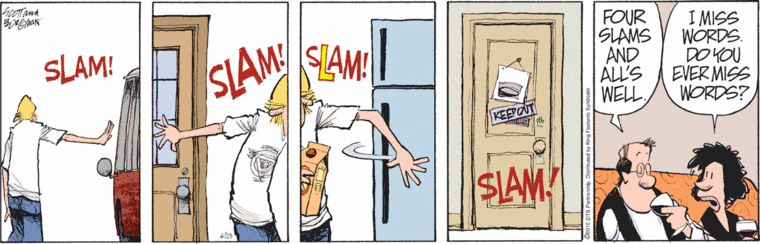
Now the Zits, in which Jeremy does the stereotypical sullen-teenager wordless thing:
Finally, another Bizarro disquisition on (potential) ambiguity, presented here not in an actual pun, but in the juxtaposition of two different senses of an expression (work for, ‘work to obtain something’ or ‘work in the employ of someone’):
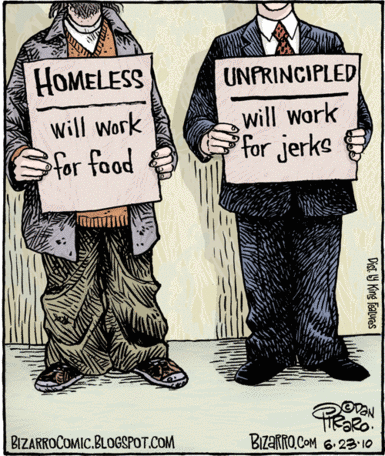
These distinct senses won’t conjoin, except in deliberately joking zeugma: “I’ll work for food but not Daddy Warbucks.”
Remember: Ambiguity Is Everywhere.
A final Commencement Weekend cartoon posting, occasioned by a comment from Kaitlyn Wierzchowski on my “Disney creepitude” posting, about the verbing (in a Zippy cartoon) of the proper name Disney via the derivational suffix -(i)fy (and then on to the nominalization Disneyfication).
Wierzchowski suggested a parallel with the coinage Californication, which would be from the proper name California verbed by the derivational suffix -ic-ate and then nominalized — a formation likely to be facilitated by the existing sexual noun fornication, though Californication as a playmanteau doesn’t necessarily have a sexual sense. (On the other hand, the sense of a playfully formed word can’t always be pinned down exactly. It’s often a matter of fugitive allusions and suggestive echoes, rather than compositional semantics.)
[For some discussion, see my posting on “California + ify” and the comments on it. The current popularity of Californication seems to be due to the Red Hot Chili Peppers’ song and to the television series.]
But, really, I’d like to wrench this discussion around to my use of the noun creepitude ‘creepiness’ in the title of that Zippy posting. The word has a lot of Zippitude.
More educational jargon, from Michael Quinion’s World Wide Words #689, 5/8/10:
LEARNING TERMS An unfamiliar word, GRADUATISED (GRADUATIZED if you’re American or very formal) appeared in an British article. It refers to a profession or occupation, the entry to which has been restricted to university graduates. The article addressed the problems of school leavers, who are increasingly finding it hard to get jobs for this reason. Educationalists have used GRADUATISED, its verb GRADUATISE, and its linked noun GRADUATISATION, at least since the early 1970s, though it’s still a term of art in the profession and is rarely found outside specialist or scholarly publications. A rare sighting of the noun was a comment by the (then) British PM Gordon Brown in the Evening Standard of London on 30 April 2008: “This is one of the wider problems with today, the graduatisation of the political and media worlds. So many people are now excluded because they left school at 16 or 18.”
Educational jargon tends to get very bad press (though both educational rubric and graduatize can be defended on the grounds that they are not only compact but also useful in their context), and innovations in -ize (verbings by derivational suffix) have been reviled for a long time, so graduatize gets a double dose of scorn. And, in fact, if you’re not familiar with it (as I was not, until Michael put this entry in WWW), its meaning can be very hard to guess even in context. But you can see its utility.
Reported yesterday on ADS-L by Steve Kleinedler (of the American Heritage Dictionary), the portmanteau aquapocalypse, referring to the disastrous water main break in the Boston area (just repaired) that had millions of people boiling their drinking water. Steve remarks that it’s lots of fun to say.
Echoes of snowpocalypse (among the portmansnow words I reported on here and here; discussion by Jan Freeman here; and by many others).
I asked Steve if he had other -pocalypse words, but he had only these two in his files so far, though he suggested that Grant Barrett might have more. And indeed, Grant has so far picked up two for his Double-Tongued Dictionary site: carpocalypse (based on car, not carp), here; and shopocalypse, here.
And he notes that a Google search with word-initial wildcarding — here — pulls up a whole lot more playful -pocalypse words, among them: E-Pocalypse (EP by Welsh pop punk band Kids in Glass Houses), text-pocalypse (that awful txtng), yo-pocalypse (frozen yoghurt), Taco-pocalypse (from Taco Bell), O-pocalypse (reaction brought on by Obama’s policies), pork-pocalypse (swine flu), eco-pocalypse, e-pocalypse (environment). Some of these maintain some reference to, or at least connotation of, actual or predicted distaster, but in others, what’s conveyed by -pocalypse is some kind of extravangance.
These coinings are beginning to straddle the line between portmanteaus (playful, to be sure, but portmanteaus nevertheless) involving the second part of apocalypse and words with a suffix-like element (a libfix) –pocalypse, like the -gate of coinings for the names of scandals, which is no longer (necessarily) connected to the original Watergate.
[Ack. In a distracted moment this went off as published when it was merely supposed to be saved. Now for some text …]
Zippy is given to flights of playful word formation. Here he takes off on Lady Gaga:

There’s the relatively staid Gagamania, a compound of Gaga and the now-freestanding mania (in the snowclonelet pattern Xmania). And over-Gagaing, with the derivational prefix over- attached to the direct verbing of Gaga (which gives a verb to Gaga that can then take prefixes).
And the complex de-Gagafy, which has both a derivational prefix de- and a derivational suffix -(i)fy. Here, the suffix would have done on its own, since de– with secondary accent can combine with a N to yield a verb with (roughly) the meaning ‘remove N from’, as in debug, defog, and delouse. (The prefix de– with secondary accent has other uses as well.) In de-Gagafy, Gaga has apparently been verbed via the transitivizing suffix -(i)fy, and the resultant Gagafy has then gotten the secondarily accented prefix de– of removal that combines with verbs, as in decaffeinate, decalcify, and defeminize.