In the latest Zippy:

Note the title, a play on “Isn’t it romantic?”.
Also note that although the decision was that she would no longer be allowed to say pundant, no punishment is attached. What happens if she flouts the decision?
In the latest Zippy:
Note the title, a play on “Isn’t it romantic?”.
Also note that although the decision was that she would no longer be allowed to say pundant, no punishment is attached. What happens if she flouts the decision?
From Rhymes With Orange, playing with morphophonology:
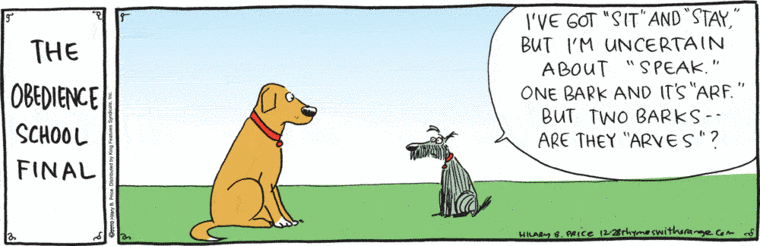
Some English nouns ending in voiceless fricatives (especially in /f/) voice these fricatives in the plural. There are three classes of cases:
(1) voicing obligatory in standard English: wife – wives, shelf – shelves;
(2) voicing variable in standard English: wharf – wharves/wharfs, dwarf – dwarves/dwarfs (see the Language Log posting here and the posting in this blog here on the plural of dwarf );
(3) no voicing in standard English: fife – fifes, oaf – oafs.
Nouns in class (1) are subject to regularization; there’s some pressure to move them into class (2). Nouns in class (3) are subject to playful irregularization — yielding things like arves.
A Zits on the difficulty of interpreting brief responses when you don’t have the full context of the responses or knowledge of the speaker’s intentions — and especially when the speaker is a stereotypically laconic teenager:
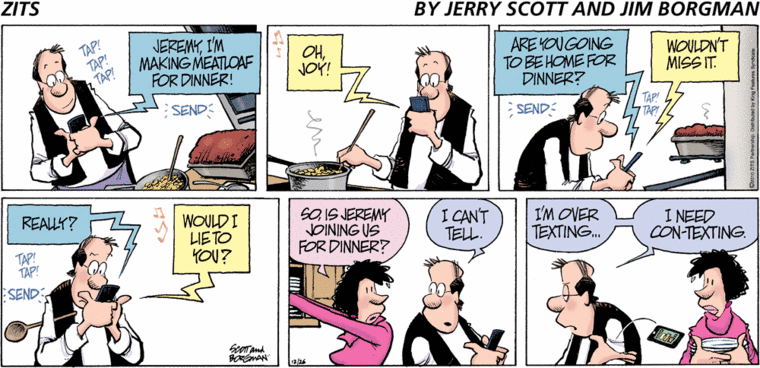
Sarcasm? Irony? Rhetorical question?
[Added December 28, discussion by Mark Liberman and commenters on Language Log: 12/27/10: Txt and context (link), 12/27/10: Oh great (link)]
Not much language in this Christmas Eve Zippy, though there are allusions to various bits of formulaic language (and, of course, popular culture):
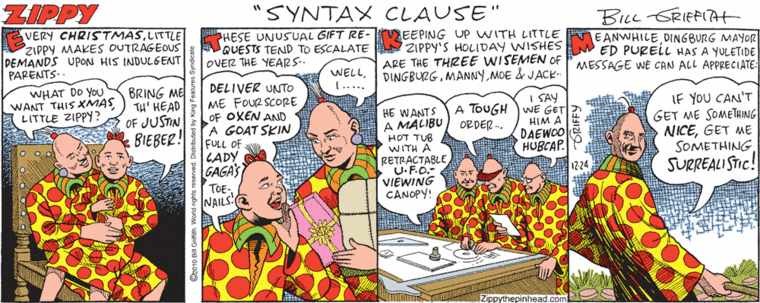
The last panel echoes “If you can’t say anything nice, (then) don’t say anything at all” (with other variants of the consequent clause: “run for President”, “say it in Yiddish”, and so on) — a saying I know nothing about the history of.
A Zits in which Jeremy’s mother confronts the disaster that is his bedroom:
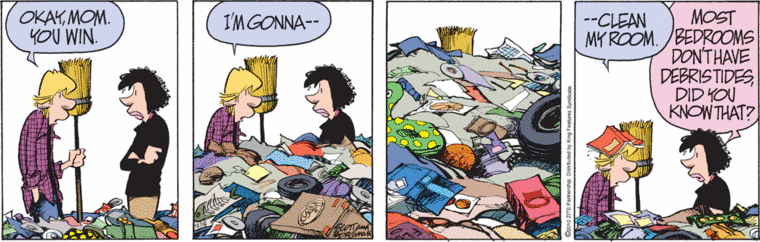
The linguistic point is the compound debris tide (here spelled solid), which is reasonably transparent as used for tidal flow of natural and man-made debris, deposited on a beach, here used metaphorically for waves of trash in Jeremy’s bedroom.
The only debris compound in OED2 is debris-cone ‘a cone formed by the accumulation of volcanic ejecta, debris, etc.’, though surely debris flow (and maybe also debris tide) will be added eventually. Wikipedia says:
A debris flow is a fast moving, liquefied landslide of unconsolidated, saturated debris that looks like flowing concrete. It is differentiated from a mudflow in terms of the viscosity and textural properties of the flow. Flows can carry material ranging in size from clay to boulders, and may contain a large amount of woody debris such as logs and tree stumps. Flows can be triggered by intense rainfall, glacial melt, or a combination of the two.
Debris flows in the San Gabriel Mountains of southern California are the subject of one of the three main sections in John McPhee’s gripping book The Control of Nature.
Yesterday’s Zippy:
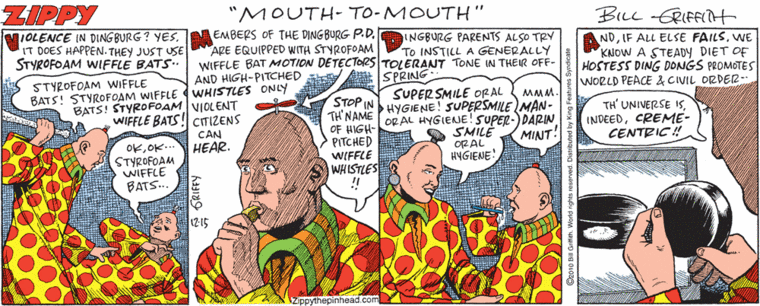
Another chapter in the Bill Griffith book of wonderful expressions, this time from commercial names: Styrofoam Wiffle bats, high-pitched Wiffle whistles, Supersmile oral hygiene, and his old favorite Hostess Ding Dongs.
Today’s Zits, on the language of teenaged boys, with a translation for Jeremy’s mother:

The tip for the interpreter is a nice touch.
From Mary Ballard, a link to Dante Shepherd’s webcomic Surviving the World (“Daily Lessons in Science, Literature, Love, and Life”). Here’s Lesson 29, “Civil Unions”, from 2008:
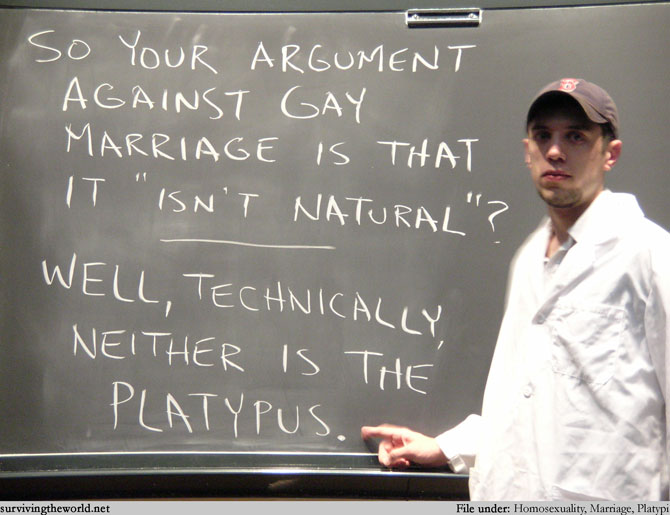
Yet another example of a webcomic by an artist who cannot draw but can caption (and take photographs).
We might also think about the work that technically is doing in this lesson.
A Zippy on reinventing yourself:
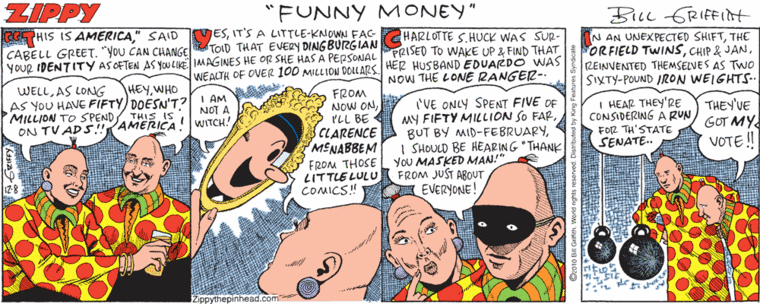
Which brings me to Alexis de Tocqueville and to Alan Ryan’s review of Leo Damrosch’s Tocqueville’s Discovery of America (New York Review of Books, December 9). (more…)
A silly Zippy that I’m passing on for its use of the verb doff (though there’s also the pun in the title “Clothes Call”):
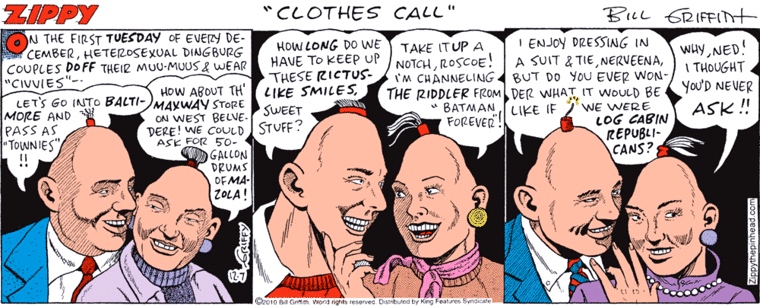
No big point here; I’m just tickled by the verbs don and doff, and have been ever since I realized, as a kid, that they were originally do on and do off, respectively.
Doff is older, with attestations in the OED (where it’s described as a “coalesced form” of do off) from the 14th century on. The OED‘s first attestation for don is 1567; the verb is described as “contracted”, and indeed many of the early attestations have it spelled do’n.