Today’s Zippy takes on pop music, in the processing mentioning two items I’ve posted about here, for their linguistic interest:

That’s Cee Lo Green (here and here) and Vampire Weekend (here). We’re up to date here on AZBlog.
Today’s Zippy, with mangled poetry — a genre of humor that delights me unreasonably:

I calibrate my elf!
Today’s Scenes From a Multiverse:
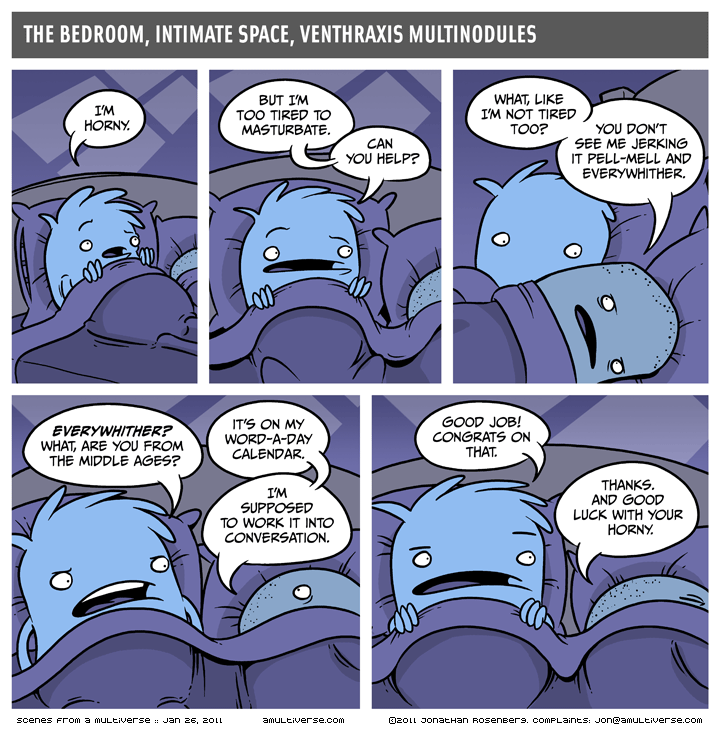
Cute nouning of horny (along with everywhither and, in fact, pell-mell, plus the colloquial clipping congrats), to mean ‘horniness’, or possibly ‘sexual arousal’. (And, yes, OED2 has everywhither, with cites from 1398, 1851, and 1888. And in OED3 (August 2010), pell-mell in the sense ‘in disordered haste; headlong, in a rush; at reckless or breakneck speed’, frequently referring to the action of a single person, with cites from 1584 through 1986. And in OED2, congrats for congratulations, with cites from 1884 through 1962.)
Today’s Zippy, another one in which Griffy bemoans the digitalization of everything:

The New York Times doesn’t do editorial cartoons, but on Sundays, it reproduces a collection of them from other papers. Two from this Sunday (January 16): one, by Patrick Chappatte in the International Herald Tribune, alluding (alarmingly) to the Tucson shootings; and the other, by John Cole in the Scranton Times Tribune, with playful taboo avoidance, alluding to provocative political rhetoric.
Today’s Dinosaur Comics, horsing around:
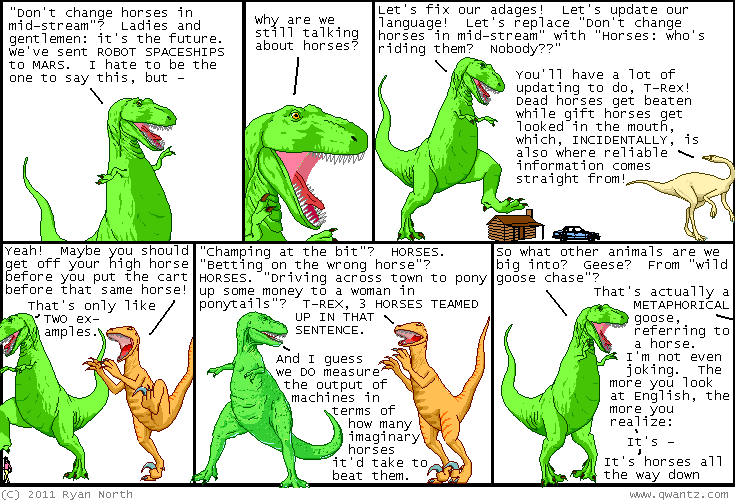
Bruce Webster pointed me to this, saying that “It’s horses all the way down” was already (early in the morning) the phrase of the day for him.
But what happened to the turtles?
Today’s Zippy is adrift in snow and youth sports slang:
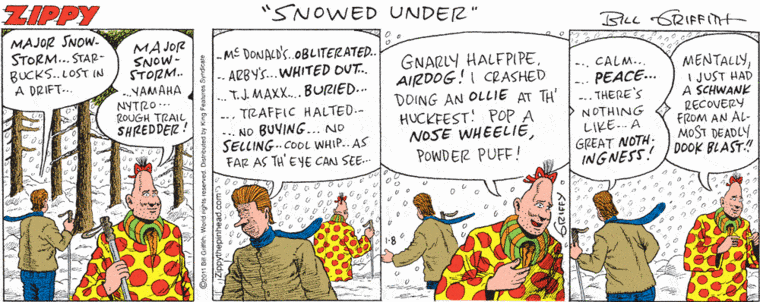
I won’t try to gloss all the slang and sport-specific terms in the last two panels, but instead focus on just one, huckfest, a term used for demonstrations (often in competitions) of daring and skill, especially in stunts and tricks involving going airborne or going over a drop-off. In the world of snow sports, it’s applied to skiing, snowboarding, and snowcatting/snowmobiling, but it’s also applied to sandboarding, skateboarding, mountain biking, kayaking, and similar events with trucks (in the sand) and remote-controlled airplanes.
There’s even the magazine Huck, “a bi-monthly lifestyle magazine rooted in surf, skate and snowboarding”, published in English, German, and French, and distributed internationally. (Note the nice “reduced coordination” in surf, skate and sandboarding, going “inside” compounds.) And a Go Huck Yourself website, which provides a gloss:
Huck (hŭk): verb. To throw, to toss; in cycling, kayaking, snowboarding, and similar sports, to ride over a drop-off. See also: sending it, try it with more speed.
(Urban Dictionary has related definitions, but with less precision.) It’s easy to find lots of occurrences of huck used as a euphemistic replacement for fuck, and the name of the blog (suggesting go fuck yourself) and the term huckfest (suggesting fuckfest) point to fuck as the origin of huck. Perhaps related to the idiom fuck around, though huckers are in fact quite serious about their play.
Hucking seems to be very heavily an activity for dudes — and except for the truck events and the remote-controlled airplane events, mostly dudes in their teens. So the racy associations of huck fit right into this social world.
Following up on my posting about the pinhead (microcephalic) Schlitzie in the film Freaks, Tim Wilson noted on Facebook that he thought that Bill Griffith had done a cartoon based on the wedding feast scene in the movie (with the memorable lines “One of us! One of us!” and “Gobble gobble gobble” in it). I haven’t found it yet, but I did find a Zippy where Griffith makes an explicit connection to Schlitzie, and to a 19th century microcephalic Zip:
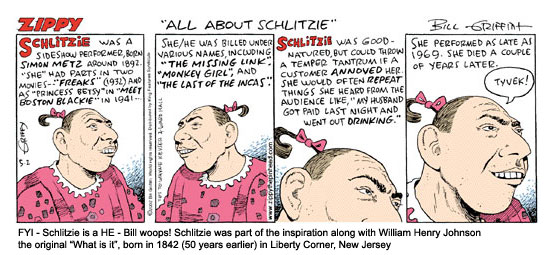
Tyvek is a brand name for flashspun polyethylene material. I’m not sure what it’s doing in this cartoon.
A Zippy about Pancake Circus:
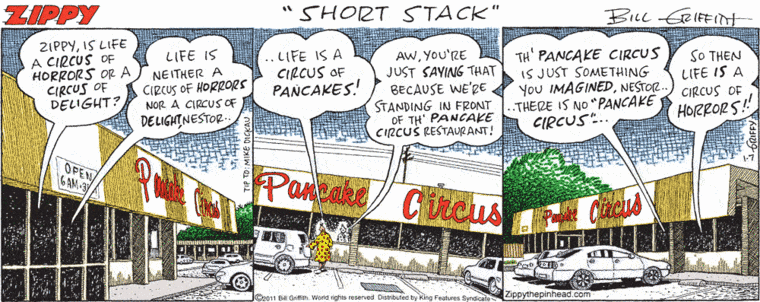
But: yes, Nestor, there is a Pancake Circus. In Sacramento CA; photo by Tom Hulse here:

From a Yelp review:
Pancake Circus isn’t a place you visit for the food. It is about the ambience, which is something like a cross between a Tom Waits fever-dream, and a senior-home casino trip gone wrong.
It’s unintentionally ironic, and a wee bit creepy. But, simultaneously, it’s sentimental and authentic in the best possible ways. The waitresses call the regulars by name, and know their orders by heart.
Griffy and Zippy’s kind of place. And it’s a circus of sorts.
Pancake Circus is a N+N compound with the head N, circus, understood metaphorically, as in a circus of pancakes ‘(a place supplying) a great number or variety of pancakes’.
A Zippy on speech balloons (a.k.a. speech bubbles, word balloons, etc.):
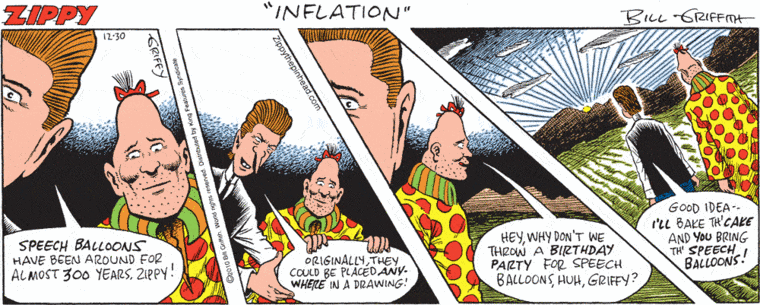
Where does the “almost 300 years” come from? Here’s the relevant part of the fascinating Wikipedia entry:
In Western graphic art, labels that reveal what a pictured figure is saying have appeared since at least the 13th century. Word balloons began appearing in 18th century printed broadsides and political cartoons from the American Revolution often used them.
Unfortunately, the link to “The Evolution of the Speech Balloon” that the article gives (and that you can find many places on the web) doesn’t work.
Some sample balloons:
From top to bottom: an ordinary speech balloon, a thought balloon, a scream balloon.
