Archive for the ‘Linguistics in the comics’ Category

The cowbell industry

October 18, 2010

Via Federico Escobar, a 10/5/09 Farley Katz cartoon in the New Yorker:

As I note every month or so, N + N compounds have a large range of possible interpretations, hinging on the relationship between the referents of the two nouns. Even sticking to the canonical relationships, every such compound is potentially ambiguous, though some of the interpretations will be absurd.

As in this case. The conventionalized interpretation for cowbell is ‘bell for cows’, but here the cartoonist has chosen the alternative ‘bell made of cows’. Not a pretty sight.

Two obscenicon cartoons

October 13, 2010

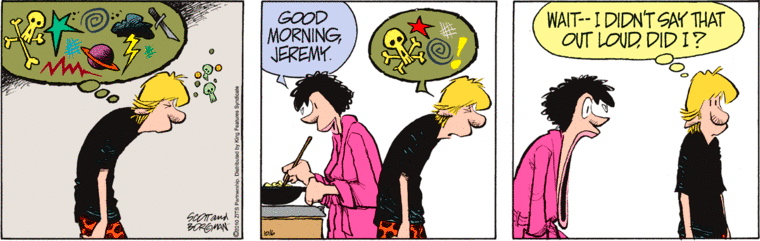
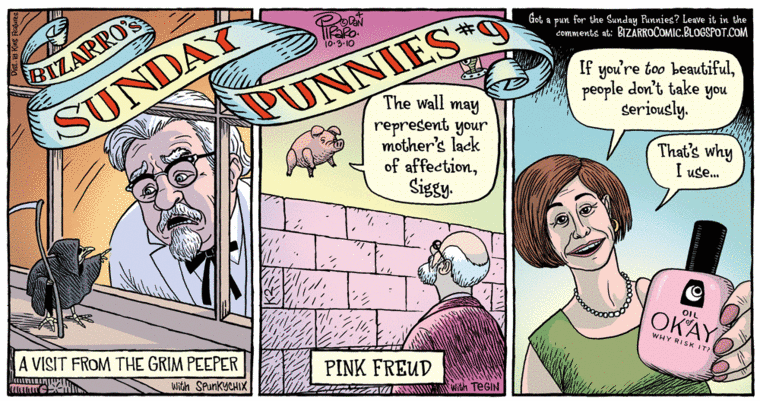
Obscenicons began as a device in the comics, and cartoons return to them again and again in an assortment of meta-referential ways, using them not merely for ostentatious concealment of taboo vocabulary, but also in play about them. Two recent examples, from Zits and Bizarro:

Jeremy’s cursing is conveyed by some standard obscenicons, plus an assortment of dire symbols, thus harking back to the early days of obscenicons in the comics, before they became largely conventionalized.


(Note the use of adult here, as in adult movies and adult book store.)

Then we have the conceit that the whole spoken taboo word is represented by a sequence of obscenicons (@*%&!), but can be broken down into its separate glyphs, just as, say, SHIT represents a spoken word and also a sequence of letters.


More Pink Freud

October 11, 2010

Back a while, I posted on the Pink Freud pun (and since have gotten a t-shirt with the first of the images there on it — much appreciated in my department). Now Dan Piraro has picked it up:


Guns and fountain pens

September 14, 2010

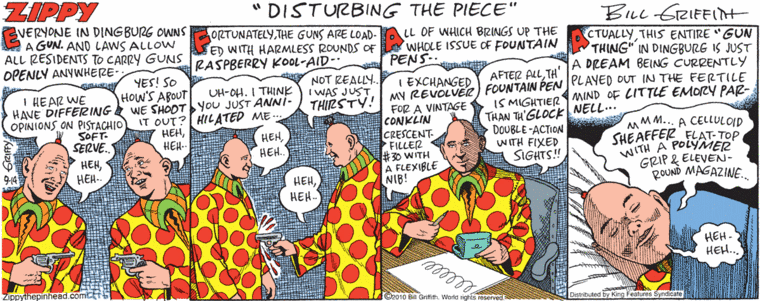
The fountain pen is mightier than the Glock, at least in Dingburg’s dream world:

The real-world Emory Parnell was a vaudevillian and character actor — yet another of Griffy’s film associations (see Theophylact’s comment here).

Meanwhile, guns and pens are of course phallic symbols, and I’ve been slogging my way through a series of postings on phallicity on my X blog.  So far:

9/5/10: Phallicity: the introduction (link)

9/12/10: Phallicity: Würste (link)

9/13/10: Phallicity: innocent? (1) (link)

9/13/10: Phallicity: innocent? (2) (link)

Several more to come.

Aroo, Abie, and Nibsy

September 13, 2010

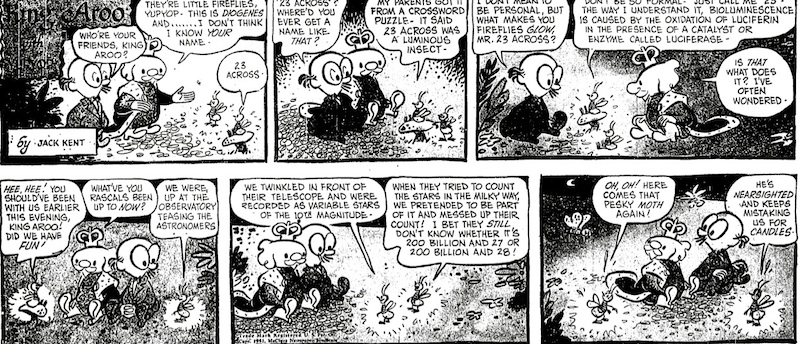
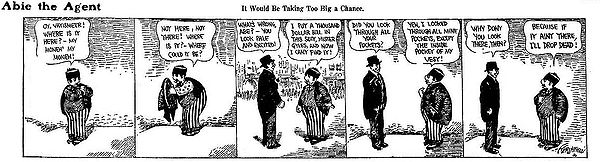
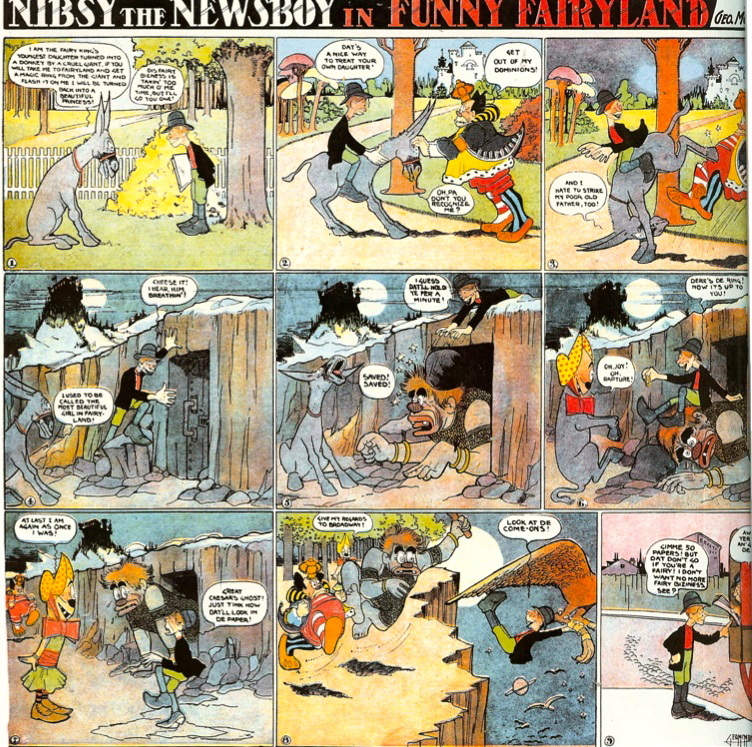
John Baker wins the Language Glass Prize (announced here) with samples of all three of the classic comic strips from the Zippy strip in that posting: King Aroo, which Griffy cited for its big words; Abie the Agent, for its Yiddish dialect humor; and Nibsy the Newsboy, for its almost nonsensical syntax.

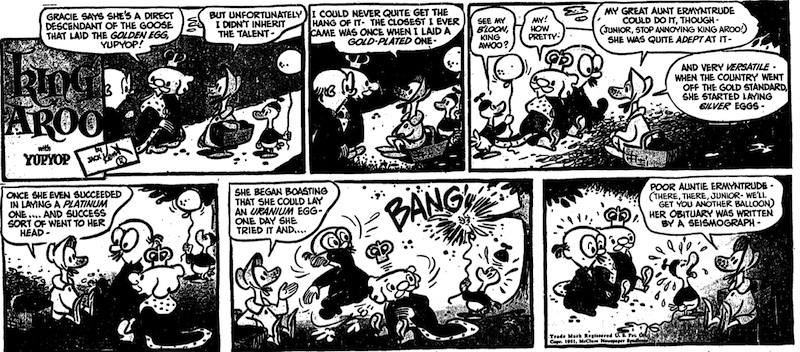
Baker notes that King Aroo “tended to be a pretty intellectual strip, by mainstream newspaper standards, but most of the strips did not use particularly long words”. Here in the 10/28/1951 strip, the reader is expected to know the word seismograph:

(for all the strips, click on the image to embiggen it)

and in the 12/2/1951 strip, a firefly gives an explanation that really delivers the vocabulary goods:

And Abie the Agent — Abie is Abraham Kabibble, an agent for an automobile manufacturer — was generally rich in Yiddishisms, as in this strip from 7/20/1917:

But Nibsy the Newsboy, Baker reports, is pretty disappointing in the syntax department; the strip seems to have relied heavily on casual speech forms and Irish-English pronunciations, but otherwise to have been unsurprising in its syntax, as in this strip from 7/1/1906 :

(Aroo from ProQuest Historical Newspapers, Chicago Tribune; Abie from Wikipedia; Nibsy from Blackbeard, Crain & Vance, 100 Years of Comic Strips (2004). Baker apologizes for the cutoff in scanning the Nibsy in. Other image-massaging by my own hand.)

Classic cartoons; and two contests

September 12, 2010

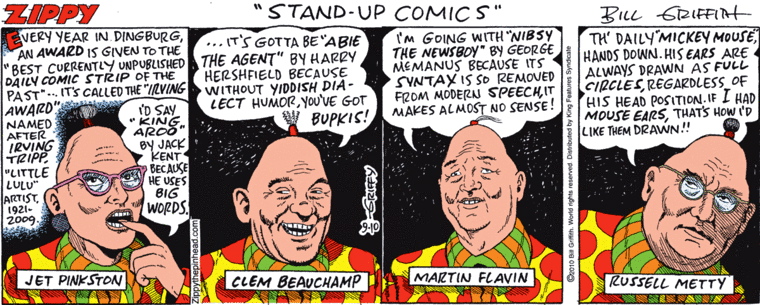
Bill Zippy the Pinhead Griffith is something of a student of the history of cartooning and also a great appreciator of proper names. These two threads are woven together in this recent strip:

Though in the past, I’ve taken the trouble to track down the names that Griffith gives to his Dingburgers, I’m too pressed for time at the moment, so I’m passing the task on to you, rough readers: to the reader who provides the most satisfying account of the names Jet Pinkston, Clem Beauchamp, Martin Flavin, and Russell Metty, I offer the Bonk Prize, a (paperback) copy of Mary Roach’s recent Bonk (on “the curious coupling of science and sex”) donated by Max Vasilatos. (Contest prizes don’t have to be connected with the topics of the contests; I just give away stuff I happen to have extra copies of.) Comment away!

Then there are the historic cartoons the Dingburgers mention, especially the first three, with their characteristics of potential linguist interest: King Aroo, with its big words; Abie the Agent, with its Yiddish dialect humor; and Nibsy the Newsboy, with its “syntax so removed from modern speech, it makes almost no sense”.

I was so intrigued by Nibsy that I spent an embarrassing amount of time trying to find examples of its extraordinary syntax, but without success (I don’t have access to the archives that might bring such things up in a snap). I did learn that it was based on Winsor McCay’s wonderful Little Nemo in Slumberland, and that it preceded George McManus’s great, long-lasting success, Bringing Up Father.

So, another contest, one that I think is much harder than the Bonk competition: the Language Glass Prize, a (hardback) copy of Guy Deutscher’s Though the Language Glass: Why the World Looks Different in Other Languages (as so often happens, after I bought a copy of the book, the author sent me a complimentary copy), for the best examples of big words from King Aroo, Yiddishisms from Abie, and remarkable syntax from Nibsy.

In both contests, the decision of the judge is final.

GenX so in the funnies

September 11, 2010

Zippy takes on the passage of the years with GenX so:

As I said about the syntactic construction in Language Log four years ago:

GenX so — so-called because it seems to have first appeared in the speech of Generation Xers (in the 80s, with the movie Heathers as a major boost for its spread) — is recognizable in speech by its characteristic high-rising-falling intonation (which distinguishes it from ordinary intensifying so, even when the intensifier is accented), but can be detected in writing only through its syntactic context: clear cases of GenX so occur in contexts that otherwise are not available for intensifiers — with dates and similar time expressions (“That is, like, so 1980s”, “It was so two years ago”), proper nouns and pronouns (“This is so Iceland”, “It’s so you”), absolute adjectives (“You are so dead!”), negatives (“It’s so not entertaining”, “A pizza delivery man who can’t find a campus address is so not my problem”), and VPs (“We so don’t have a song”, “Parker so wanted to be included”, “I am so hitting you with the September issue of Vogue!”).  There are cases — like the title of this posting [“So in style at the NYT”, 4/6/06] — that aren’t so easy to classify, but the Times editorial’s so [“This is so not amnesty”] is a solid example of a GenX use, with a negative.

GenX so is a development from ordinary intensifying so (“That is so beautiful!” ‘That is very beautiful’), which has been around since Old English.

[Since my latest medical adventure started (a few details here), I’ve been largely out of things; in that period 16 cartoons for posting piled up and at least that many new other topics. I’m still involved in a medical mystery story, but no longer in crippling pain, and I’m trying to catch up.]

Dingburgers having fun

August 31, 2010

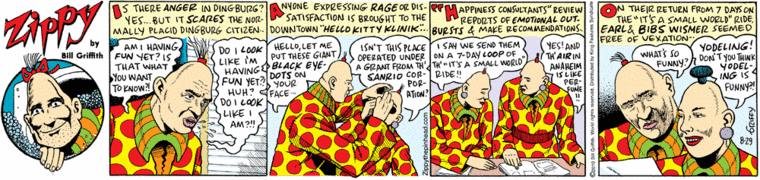
A Zippy that leads with the question “Am I having fun yet?”

This is familiar territory for the strip. On Language Log, we’ve had “Am I empathetic yet?” on 1/20/07; “Are we playing “Risk” in an underground bunker beneath th’ White House yet?” on 7/14/07, with some discussion of the models for the Are We X Yet snowclone (the children’s question “Are we there yet?” and the Zippy catchphrase “Are we having fun yet?”), a quick survey of the many fillers for X, and a variant with now (“Are we middle-aged now?”); and “Am I questioning all accepted notions of gender marking & display yet?” on 6/24/08 and again on this blog on 4/20/09.

(more…)

More Zippy names (and things)

August 26, 2010

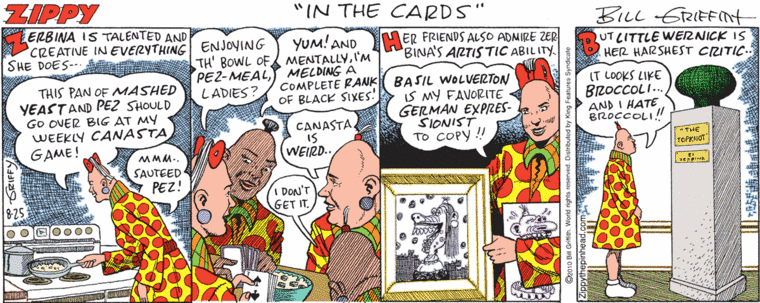
Zerbina takes up art, as well as Pez cuisine — to little Wernick (I say it’s broccoli and I say the hell with it)’s disgust:

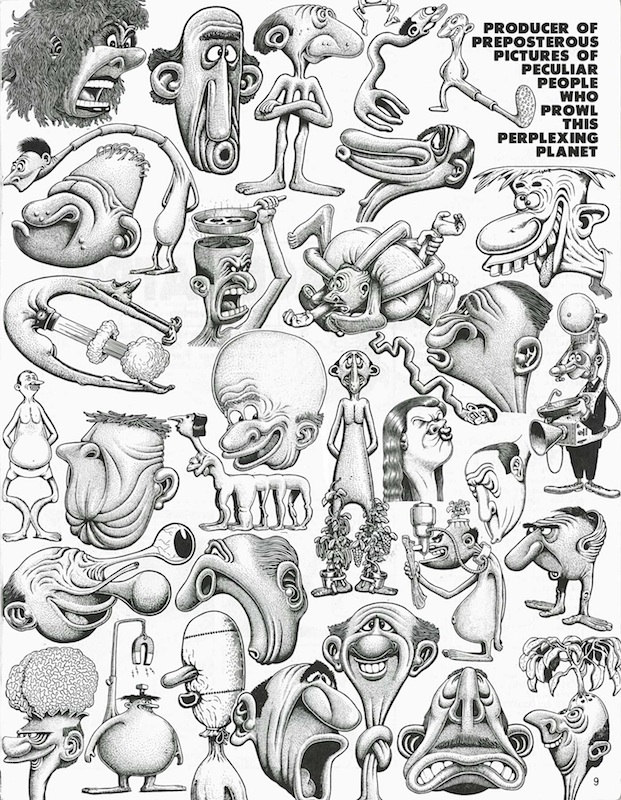
Bill Griffith is famous in these parts for his fascination with words, especially names, and for re-using existing names rather than make up new ones from scratch. This time it’s Basil Wolverton, who was not in fact a German expressionist, though he was an artist, a comic book writer and artist, known for his grotesque images of people:

Despite the man’s very British-sounding name (which no doubt tickled Griffith), he was solidly American. But, oh, that wonderful name!

I’m guessing that Zerbina’s sculpture (or Chia Pet construction?) of a Pinhead topknot is entirely Griffith’s invention. But, knowing Griffith’s inclination to use real art objects as well as real names in his strips, it’s also possible that Topknot has some artistic reality (which I have yet to discover) outside of the Dingburgish lands.

Stowbody Gillingwater

August 24, 2010

And Doofus.

Bill Griffith delights in the names he gives his Dingburger characters; he seeks out names with satisfying phonological properties (tapping into the vein of phonesthemic associations in English), semantic associations (usually, like the phonological effects, subliminal and indefinite, rather than straightforwardly meaningful), and sociocultural connections. (Some discussion of Zippylicious names here.)

This time Zippy takes us to the family names Stowbody and Gillingwater (I like to think of them combined into a single name, with the last name Stowbody made into a patrician first name: Stowbody Gillingwater, called Stow for short), and the personal name Doofus:

As so often happens with Zippyesque names, the name Stowbody seemed hauntingly familiar to me. And, in fact, Ezra Stowbody is the (grumpy) president of Ionic Bank in Gopher Prairie MN, the setting of Sinclair Lewis’s Main Street (this seems to be Main Street Week on this blog; see the McCall illustration here), and he has a daughter Ella. (The name Ezra Stowbody reminded me — prosodically and at several other levels — of the wonderfully named Jonas Starkadder in Stella Gibbons’s wickedly parodic Cold Comfort Farm, set in the village of Howling SX.)

Then there’s Gillingwater. Probaby an allusion to Claude Gillingwater, a Hollywood actor who played cranky skinflints and irascible old men all his life.

Finally Doofus, one of those generic-fool common nouns often made into a nonce proper name (“Don’t give it to Doofus here; he’ll just drop it”). Here’s the complete OED draft entry of June 2010:

slang (orig. and chiefly U.S.).

[Origin uncertain: perhaps an alteration of GOOFUS n.1 Perhaps compare German doof stupid, dopey (early 20th cent.; < German regional (Low German) doof in this sense, spec. use of doof deaf: see DEAF adj.).]

A. adj. Characteristic of a stupid or foolish person; dumb, dopey. Cf. GOOFUS adj.

1967 C. L. COOPER Farm I. iii. 27 Miss Ann..smiling a greatbig [sic] stupid doofus grin. 1985 Campus Voice Apr. 22 He speaks in his best dufus voice. 2000 Sunday Herald (Glasgow) (Electronic ed.) 20 Feb., He’s a cartoon character in human form, what with those lanky doofus locks, those boggly eyes.

B. n. A foolish or stupid person, an idiot; also as a general term of contempt. Cf. GOOFUS n.1

[1955 J. LARDNER in N.Y. Times Mag. 25 Dec. 10/1 Doofus lost every round from the third, but they give him the duke!] 1977 Amer. Speech 1975 50 58 Don’t bother to see Dean Fairchild; he’ll do his best to make you feel like a doofus. 1989 L. MOORE in New Yorker 13 Nov. 53/2 We’re in our forties here. You can’t use words like ‘dork’ anymore… He’s not a dork. He’s a dufus. Maybe. Maybe a doink. 2001 L. BLOCK Hit List 203, I feel sorry for Mapes, but he’s sort of a doofus, isn’t he?

(The OED here sticks to its long-established practice of labeling attributive nouns, as in doofus grin, as adjectives.)

As is typical of nouns of disparagement, doofus has a bunch of sound-symbolic elements: the /d/ of deaf, dumb, dope, etc.; the /u/ and /f/ of fool and goof/goofy/goofus; the /u/ of puke, mook, etc.; the /f/ of fag, fop, fuck, etc.