Archive for the ‘Linguistics in the comics’ Category

News of the World

September 2, 2011

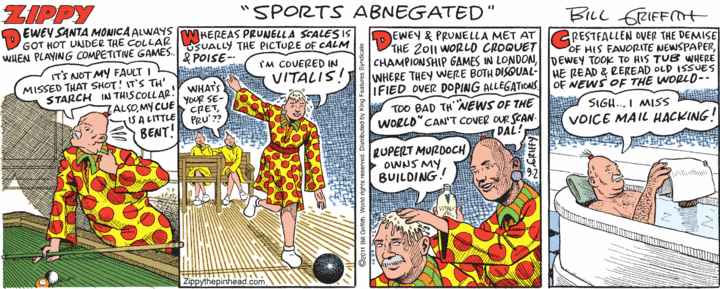
Today’s Zippy, with two new characters:

What caught my eye was the names: Dewey Santa Monica and Prunella Scales. Prunella Scales I recognized immediately: British actress who played, among other things, Sybil Fawlty in the British tv comedy Fawlty Towers. All I can say about Dewey Santa Monica is that there’s a Dewey St. in Santa Monica CA. And, of course, people with the (first or last) name Dewey in Santa Monica.

Disjunctive syllogism

August 31, 2011

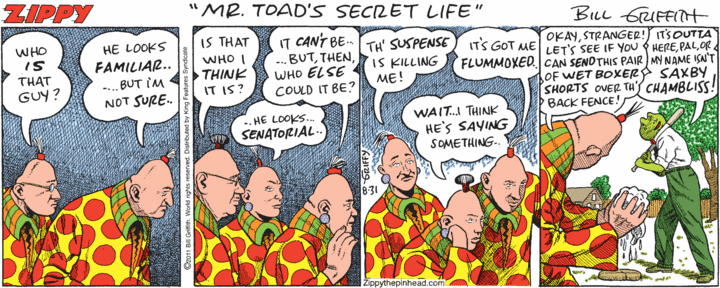
Today’s Zippy:

“It’s outta here … or my name isn’t Saxby Chambliss.” A disjunction, with the logical form P ∨ Q. (P in this case is something like “I’ll hit it out of the park”, expressed colloquially as “It’s outta here”.)

(more…)

The martyrdom of St. Jeremy

August 26, 2011

The trials of adolescence, as depicted in Zits:

Another playful allusion to Saint Sebastian in art (examples both serious and playful here), minus the homoerotic tones.

Cartoon POP

August 24, 2011

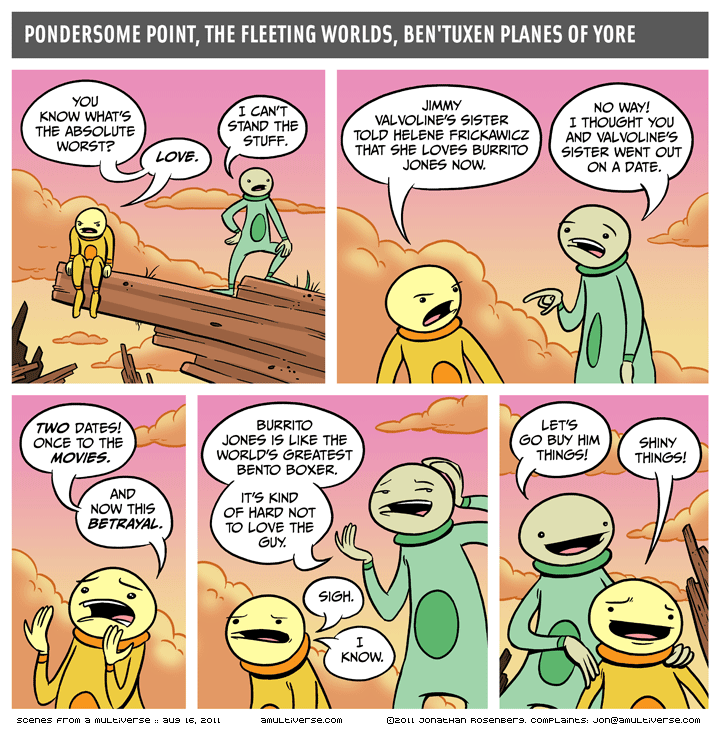
From a recent Scenes from a Multiverse:

The linguistic point is the cute POP (phrasal overlap portmanteau) bento boxer: bento box + boxer.

On bento box, from the Wikipedia page:

Bento (弁当 bentō) is a single-portion takeout or home-packed meal common in Japanese cuisine. A traditional bento consists of rice, fish or meat, and one or more pickled or cooked vegetables, usually in a box-shaped container. Containers range from disposable mass produced to hand crafted lacquerware. Although bento are readily available in many places throughout Japan, including convenience stores, bento shops (弁当屋 bentō-ya), train stations, and department stores, it is still common for Japanese homemakers to spend time and energy for their spouse, child, or themselves producing a carefully prepared lunch box.

Bento boxes are widely available as lunch specials in Japanese restaurants outside Japan (for instance, in several restaurants within a mile or two of my house in Palo Alto).

I’m still trying to imagine the sport of bento boxing.

Think of the children

August 24, 2011

It’s hard to talk about taboo vocabulary without someone explaining that children need to be protected from “adult” language, because it’s intrinsically damaging to them. So with “adult” imagery — at least (in the United States) if it’s sexual in character, but not (in the United States) if it’s violent. Ruben Bolling’s Tom the Dancing Bug on the subject:

For those of you outside the Americas, Cheez E. Chainsaw’s is a play on Chuck E. Cheese’s (Wikipedia page here). (Local note: The first Chuck E. Cheese’s was located right here in Santa Clara County, in San Jose, in 1977.)

Zippy subs, take 2

August 24, 2011

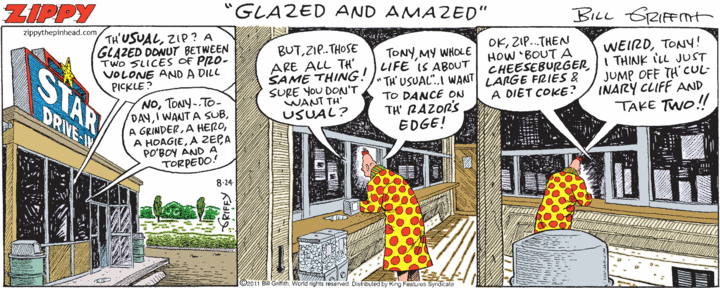
Zippy continues on his quest for something different to eat:

(more…)

Satanic fast food

August 23, 2011

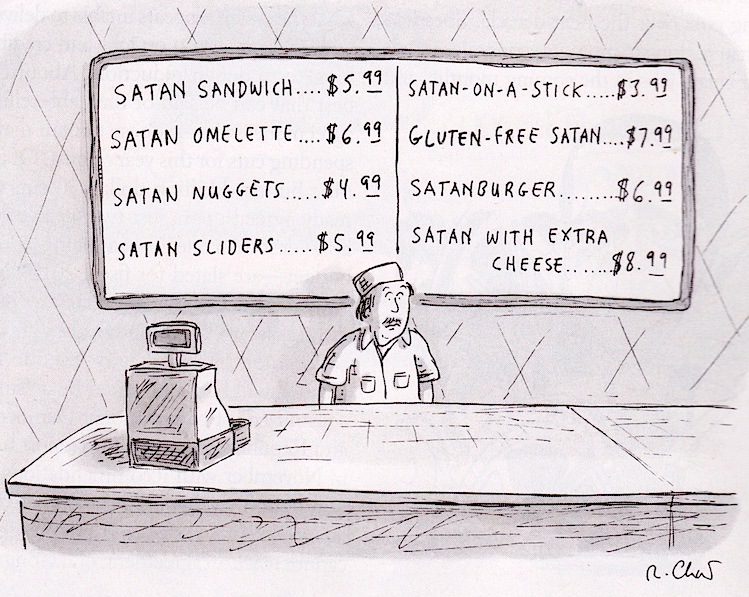
Roz Chast in the August 15 & 22 New Yorker:

As Mark Liberman observed in his recent LLog discussion of Satan sandwich in the political news, Satan here is a shit-avoidance term, with demonic overtones as a bonus. Chast has taken this and run with it.

In connection with the state fair food-on-a-stick theme, note Satan-on-a-stick among the offerings. There’s also a Satanburger, with the common libfix -burger; along these lines, Chast could have included a Satan dog (a hot dog wrapped in Satan) on the board.

Isn’t it bromantic?

August 23, 2011

From the August 15 & 22 New Yorker, this Michael Crawford cartoon:

Bromance has come up on this blog a number of times, starting with “Manecdotes and brobituaries” (here). (And was paired with male-odrama here.)

Zippy makes a sandwich

August 22, 2011

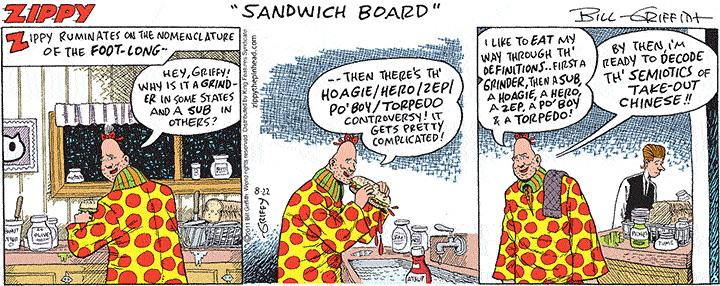
… but he’s not sure what to call it:

The idea of taking a long roll of bread (like a French baguette or an Italian ciabatta), slicing it lengthwise, and filling it with an assortment of meats, cheeses, vegetables, condiments, and sauces must have occurred to many people in many places over the years, but in the United States such sandwiches have been associated with Italians since the early 20th century.

The ingredients vary from community to community (the New Orleans version the muffuletta has olive salad as a crucial component, for example). And the names are, for the most part, equally local. The Wikipedia page takes submarine sandwich (or sub) to be the closest thing to a generic term for the family, though it lists many local variants. So do Dave Wilton’s article “A Hoagie by Any Other Name” (Verbatim 28.3, Autumn 2003) and Barry Popik’s blog entry for  “Submarine Sandwich (Sub Sandwich)” (April 5, 2008).

[I first knew these sandwiches as Italian sandwiches (in the Reading PA area in the 40s and 50s) — vulgarly called by their near-rhyming name wop jobs — but then cultural influences from southern New Jersey and Philadelphia gave us hoagies, and from New York City, submarine sandwiches or subs. At Princeton, we consumed grinders, using a name we associated with grinding (studying hard) — there was a Student Grinder Agency that delivered the sandwiches to men studying in their rooms — though that connection is surely historically inaccurate.]
The miracle of human speech

August 22, 2011

Via Chris Waigl, this Wondermark cartoon:

Ah, a coding problem.