Archive for the ‘Linguistics in the comics’ Category

-uzzle

September 9, 2011

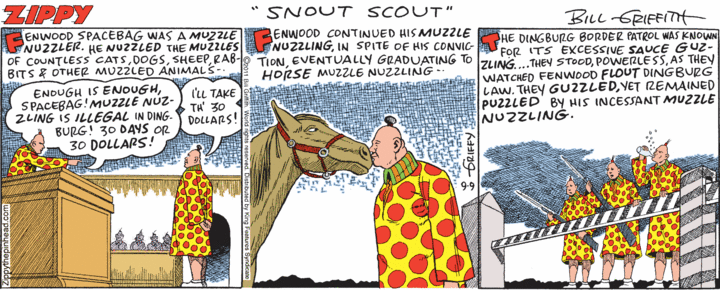
Silliness for the weekend: today’s Zippy plays with -uzzle:

Muzzle nuzzling has a great sound to it.

Fenwood Spacebag looks like one of Bill Griffith’s absurd invented names, combining a brand name (in this case, Space Bag vacuum-seal storage packs) with a personal name that he finds entertaining.

actually

September 8, 2011

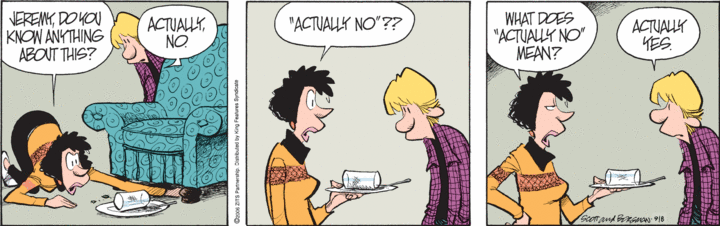
Today’s Zits, with a semantic/pragmatic puzzle about the adverb actually:

I’m not sure where in the second (sentence-adverbial) part of this NOAD2 entry for actually this usage comes, but ‘contrary to expectation’ is wrapped up somewhere in there:

1 as the truth or facts of a situation; really : we must pay attention to what young people are actually doing | the time actually worked on a job.

2 [as sentence adverb ] used to emphasize that something someone has said or done is surprising : he actually expected me to be pleased about it!

• used when expressing an opinion, typically one that is not expected : “Actually,” she said icily, “I don’t care who you go out with.”

• used when expressing a contradictory opinion or correcting someone : “Tom seems to be happy.” “He isn’t, actually, not any more.”

• used to introduce a new topic or to add information to a previous statement : he had a thick Brooklyn accent—he sounded like my grandfather actually.

Maybe Jeremy supposes that his mother is expecting the answer “Yes” — her question is rhetorical; she assumes that Jeremy does know something about the situation — so that he provides the contrary answer, signalling the contrast with apparently. But that’s just a stab.

Maternal qudgments

September 8, 2011

Today’s Rhymes With Orange takes up indirect speech acts, in particular the complex case of interrogatives in the form of declaratives (with interrogative intonation), but in fact serving the function of exclamations (with imperative force):

It starts with the declarative You’re really going out dressed like that, with really signalling emphasis, surprise, or disbelief, and rising final intonation signalling a question. So, roughly, ‘Is it really true that you’re going out dressed like that?’

Then this question — like yes-no questions in general — can function as a “rhetorical question”, conveying an assertion with the opposite polarity (‘You’re not going out dressed like that’), having judgmental or directive force (‘You shouldn’t go out dressed like that; don’t go out dressed like that’).

All these steps are conventionalized in English, so that the recipient of the original can move seamlessly from question to judgment. Compare the title of Deborah Tannen’s 2006 book You’re Wearing that?: Understanding Mothers and Daughters in Conversation.

Then of course there’s the portmanteau qudgment (question + judgment). The literature on indirect speech acts includes discussions of the whimperative (wh-question + imperative –Why don’t you kiss me? ‘Kiss me!’) and queclarative (question + declarative — Is that necessary? ‘That isn’t necessary’), from Jerry Sadock in 1970 and 1971, respectively.
What are pockets for?

September 8, 2011

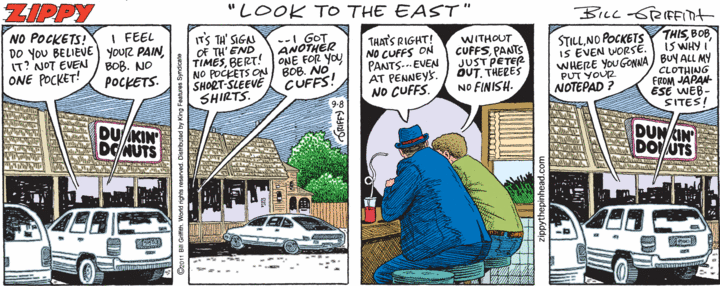
Today’s Zippy, on pockets:

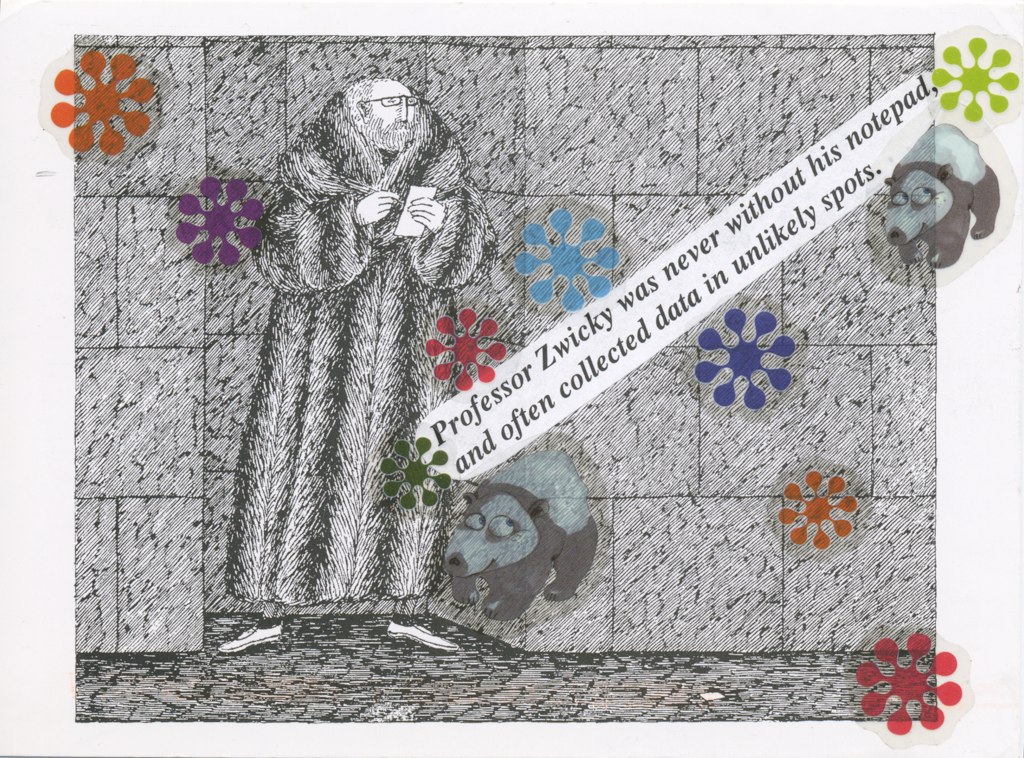
Yes, yes, where would you put your notebook if you didn’t have pockets? They’re crucial for me, as you can see in this academic collage of mine:

(Apologies to Edward Gorey.)

News of the World

September 2, 2011

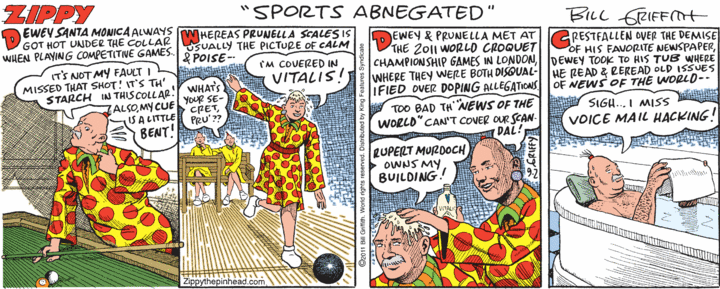
Today’s Zippy, with two new characters:

What caught my eye was the names: Dewey Santa Monica and Prunella Scales. Prunella Scales I recognized immediately: British actress who played, among other things, Sybil Fawlty in the British tv comedy Fawlty Towers. All I can say about Dewey Santa Monica is that there’s a Dewey St. in Santa Monica CA. And, of course, people with the (first or last) name Dewey in Santa Monica.

Disjunctive syllogism

August 31, 2011

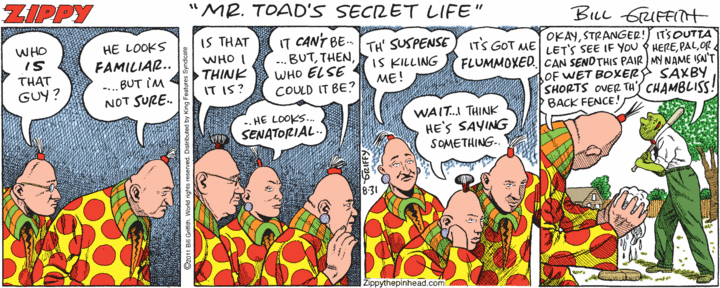
Today’s Zippy:

“It’s outta here … or my name isn’t Saxby Chambliss.” A disjunction, with the logical form P ∨ Q. (P in this case is something like “I’ll hit it out of the park”, expressed colloquially as “It’s outta here”.)

(more…)

The martyrdom of St. Jeremy

August 26, 2011

The trials of adolescence, as depicted in Zits:

Another playful allusion to Saint Sebastian in art (examples both serious and playful here), minus the homoerotic tones.

Cartoon POP

August 24, 2011

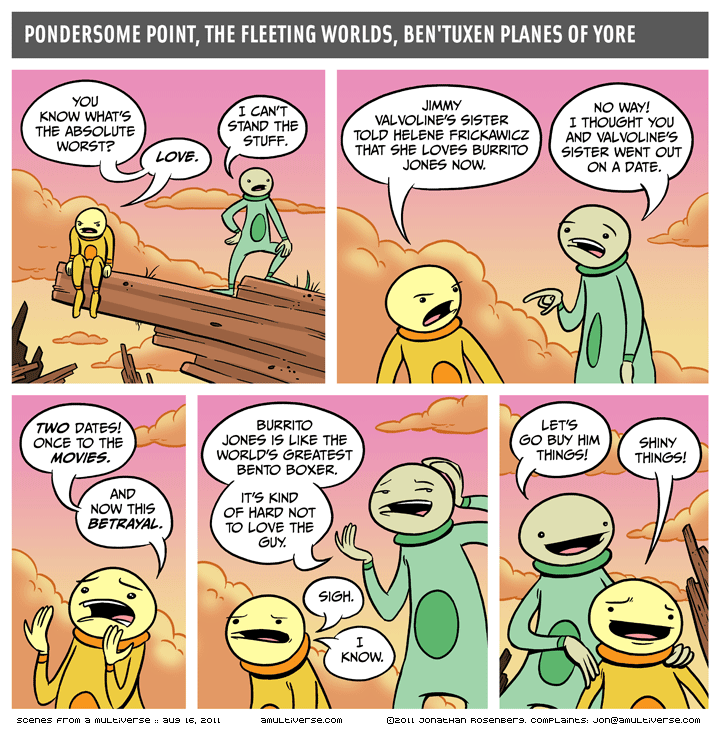
From a recent Scenes from a Multiverse:

The linguistic point is the cute POP (phrasal overlap portmanteau) bento boxer: bento box + boxer.

On bento box, from the Wikipedia page:

Bento (弁当 bentō) is a single-portion takeout or home-packed meal common in Japanese cuisine. A traditional bento consists of rice, fish or meat, and one or more pickled or cooked vegetables, usually in a box-shaped container. Containers range from disposable mass produced to hand crafted lacquerware. Although bento are readily available in many places throughout Japan, including convenience stores, bento shops (弁当屋 bentō-ya), train stations, and department stores, it is still common for Japanese homemakers to spend time and energy for their spouse, child, or themselves producing a carefully prepared lunch box.

Bento boxes are widely available as lunch specials in Japanese restaurants outside Japan (for instance, in several restaurants within a mile or two of my house in Palo Alto).

I’m still trying to imagine the sport of bento boxing.

Think of the children

August 24, 2011

It’s hard to talk about taboo vocabulary without someone explaining that children need to be protected from “adult” language, because it’s intrinsically damaging to them. So with “adult” imagery — at least (in the United States) if it’s sexual in character, but not (in the United States) if it’s violent. Ruben Bolling’s Tom the Dancing Bug on the subject:

For those of you outside the Americas, Cheez E. Chainsaw’s is a play on Chuck E. Cheese’s (Wikipedia page here). (Local note: The first Chuck E. Cheese’s was located right here in Santa Clara County, in San Jose, in 1977.)

Zippy subs, take 2

August 24, 2011

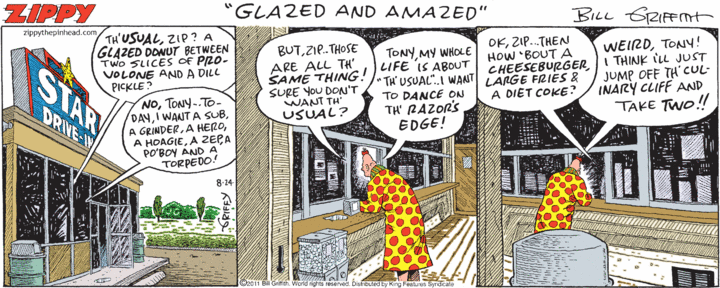
Zippy continues on his quest for something different to eat:

(more…)