Archive for the ‘Linguistics in the comics’ Category

The decade of no skateboarding

March 18, 2024

An old One Big Happy strip that’s been hanging around on my desktop for a couple of years. When you go to explain why it’s so weirdly funny, it turns out to be a complex exercise in what’s known in the linguistics trade as quantity implicature: someone uses a quantity expression, like 6 people or 18 years old, and we understand the speaker’s intentions to be to suggest exactly that quantity, or at least that quantity, or no more than that quantity — in technicalese, we take the speaker’s words to implicate one of these things — depending on the context and our assessments of the speaker’s reasons for mentioning that quantity in the context.

The standard discussions of quantity implicature are about reports of states of affairs. If, for example, a well-intentioned speaker tells you that there were 6 people at their birthday party, you take them to be conveying that there were exactly 6 people. I mean, if there were 8 people at the party, it would be true that there were 6 people; but then it would be uncooperative to say that there were 6 people, because if you knew there were 8 you should and would have said so, therefore saying there were 6 implicates that there were exactly 6. (This would be a good time to take a deep breath and rest for a moment.)

(more…)

On being, turning, and wearing green

March 17, 2024

(Part of this posting will dive right into gay porn for the day, with street-talk musings on man-on-man sex that’s totally off-limits for kids and the sexually modest; I’ll hold this part off until the end, so if you need to you can bail out then)

☘️ ☘️ ☘️ It’s St. Patrick’s Day, and in my e-mail: two Bob Eckstein cartoons for the day (on turning and wearing green for the day); and a Falcon  Studios sale on gay porn, made holiday-appropriate by the mere addition of a shamrock, but which opens the topic of gay porn with actual St. Patrick’s day themes.

(more…)

Indirect speech acts on the phone

March 13, 2024

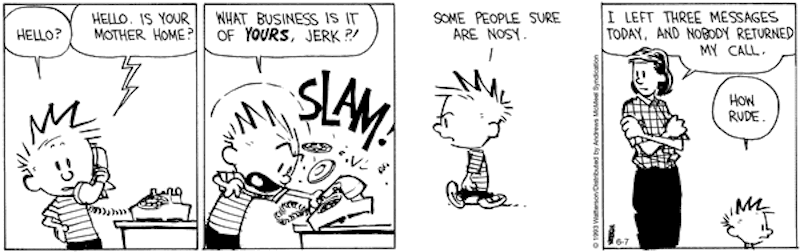
To cope with a day when I’m overwhelmed with e-mail to answer, an old Calvin and Hobbes strip salted away for just such days:


They exchange greeting hellos, and then the caller, detecting that the phone has been answered by a child, shifts to an indirect speech act designed to have the child get an adult — the caller specifically asks about their mother — to come to the phone: instead of (directly) asking Calvin to call his mother to the phone, they ask (politely) if his mother is home, assuming that Calvin will understand that they’re asking this because they assume she’s home and they want to talk to her, so they want him to turn the call over to her

The overall story here doesn’t depend on the phone being answered by a kid. It’s enough that the caller recognizes that the person answering the phone is not the one they want to talk to. In which case they could ask for them indirectly: Is Marcia home / in? (this being one big step of indirection beyond the conventionally indirect question May / Can I talk to Marcia?).

The crucial step in dealing with the yes-no question Is X home? is recognizing that because a literal understanding of it would be bizarre — why would some random caller need to know if X is home? — the caller must have some other motive in asking it. And on from there. But that’s where Calvin runs aground.

Well, that’s a lot for a little kid to work out in less than a second on the phone (and Calvin is not a patient or especially cooperative child). I actually remember being taught, explicitly, that if a phone caller, or someone at the door, asked if my mother was at home, that meant they wanted to talk to her, so I should get her. I imagine I could have worked this out eventually, but it might have taken some misfires for me to get the point.


Manual monuments

March 12, 2024

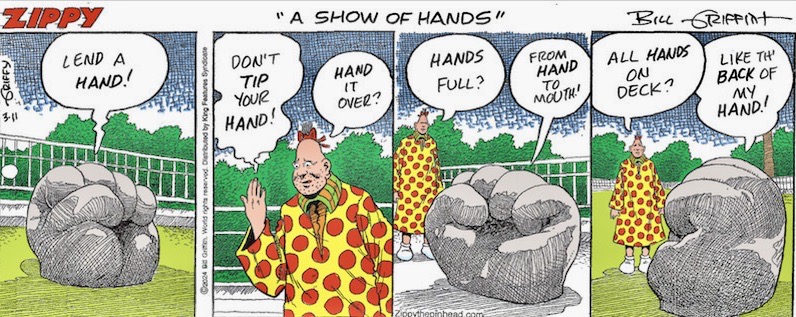
Today’s Zippy strip offers us a talkative piece of public sculpture in the shape of a hand — actually, a closed fist, upraised — that riffs together with Zippy on the manual, hand-based, lexicon of English:


The hand exclaims, Zippy questions, but their exchanges are absurd

The big topic here is the manual lexicon: lexical items that involve the noun or verb hand. The manual lexicon is enormous. embracing some fixed expressions referring to the bodypart, but mostly composed of figurative expressions etymologically traceable to the bodypart but now semantically distant from it.

The other topic is also sizable, but it’s artistic rather than linguistic: statues of hands, especially fists, especially in works of public art. I’ll start with that.

(more…)

Nobody expects a baby

March 6, 2024

A carefully composed, subtle, and surprising ambiguity-driven cartoon by Mick Stevens in the New Yorker 1/1&8/2024 issue (on-line on 12/2/23):


Were we expecting a baby?, conveying not ‘Were we pregnant?” but the surprising ‘Were we expecting a baby (to appear at the door, to visit us, to be delivered to us, etc.)?’ — compare Were we expecting a special-delivery letter? Were we expecting the Spanish Inquisition? (meanwhile, there’s a Page about MS cartoons on this blog)

From NOAD:

verb expect: … [c] believe that (someone or something) will arrive soon: Celia was expecting a visit.

verb phrase idiom be expecting (also be expecting a baby): informal be pregnant: his wife was expecting again.

(more…)

The final 5 Hot Days of Christmas

March 5, 2024

(Very heavy on gay content, with a number of raunchy allusions, so not to everyone’s taste.)

I’m well aware that Christmas was over two months ago, but this is a complex posting and  my life’s been full of, um, challenges. In any case, I’m finally finishing up Dean Allemang’s series of AI-generated Christmas-card designs for the 12 days as in the carol, all of them sent as titillating presents for me. The early ones had one hot hunk, an object of gay sexual desire (Dino and I share a sexual orientation, and in fact a sexual history), as a central figure, with multiples of the gift of the day (birds or those golden rings) as accompaniments; but from there on it’s multiple men: for days 6 and 7, in my 1/11 posting “Hot Days of Christmas: geese and swans”, the dudes are figurative birds; for days 8 (maids a-milking) and 9 (ladies dancing), Dino just switched sexes (milkmen, laddies dancing); the last three days have male gifts in the carol (10 lords a-leaping, 11 pipers piping, 12 drummers drumming), but Dino has found fresh, jokey, interpretations for all three.

(Note: once things shifted to multiple hunks, Dino’s prompts for suitable images tended to turn up clone-like variants of the same basic guy, just differently posed and dressed. So we’ll be seeing a few of these studs again and again; some people find this effect creepy, some find it really hot, I toggle back and forth between the two reactions.)

Now: for background, a look back at the turning point in this carnival of images, the geese a-laying (day 6) and swans a-swimming (day 7). With some comments from Dino about the craft of prompting for suitable images (which can then be further massaged with image-processing software); there’s a lot of art in all of this.

(more…)

Exceptional vocabulary comprehension for her age

March 5, 2024

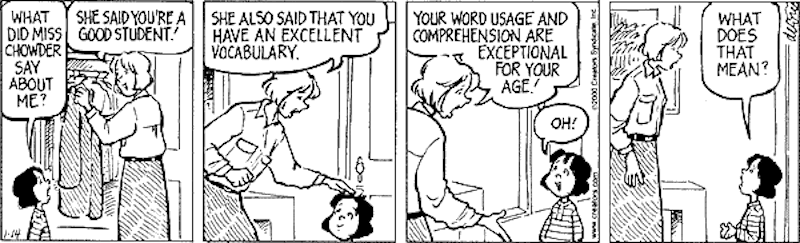
On the other hand, exceptional vocabulary comprehension is not yet within the grasp of her exceptional vocabulary comprehension; Ruthie, in this One Big Happy strip that came up in my comics feed recently, does indeed know a lot of words, just not some of the 4- and 5-syllable killer items:

But you can bet that if we had the next few panels, we would see Ruthie quizzing her mother on those 2-dollar words — though by now they’re probably 10-dollar words — and incorporating them into her exceptional vocabulary, so that she can show them off.

From GDoS on two-dollar words:

(US) any language considered ‘difficult’ or ‘intellectual’, most likely by a speaker who claims to despise such locutions [with cites from 1929 on]


The Bizarro dog park

March 3, 2024

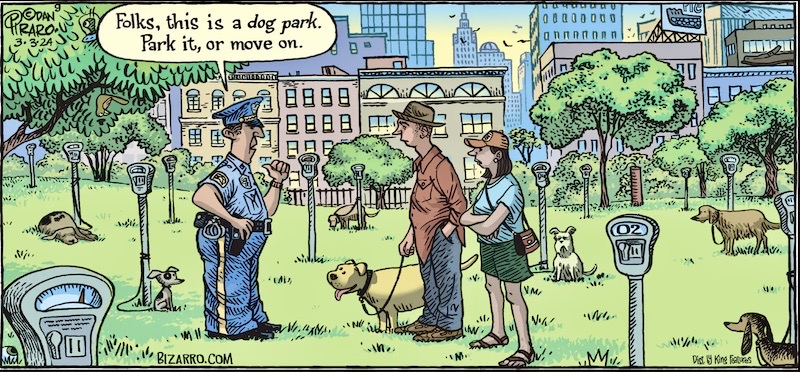
In today’s Bizarro, a dog park, with parking meters, where you can park your pooch by the hour:

Surprise! The strip exploits a possible sense of the N+N compound dog park — roughly, ‘an area or building where dogs may be left temporarily, for a fee’, the canine analogue of (largely British) car park ‘an area or building where cars or other vehicles may be left temporarily; a parking lot or parking garage’ (NOAD) — that you probably had never imagined.

Instead, you expected the everyday sense of dog park, ‘a park for dogs to exercise and play off-leash in a controlled environment under the supervision of their owners’ (Wikipedia) — a Use compound with the general meaning ‘park for dogs (to use)’, but coming with a sociocultural context that in practice conveys something considerably more specific.

Now, more details on everyday dog parks, and Bizarro dog parks too.

(more…)

It’s a mystery

March 2, 2024

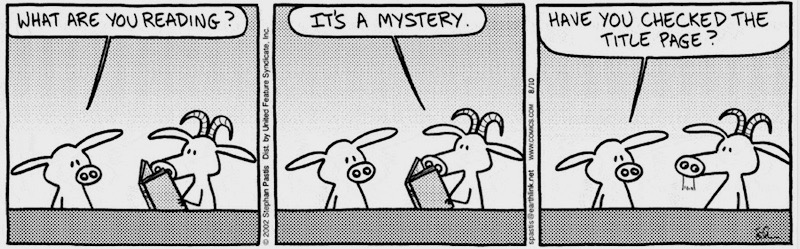
Very much a MQoS Not Dead Yet posting, as I’m barely functioning after one of those stunning drops in air pressure. Hanging around on my desktop for just just an occasion, this mystery-pun Pearls Before Swine cartoon from 2002 featuring Pig and Goat:


Pig, who has the personality of a trusting (but sometimes ignorant) child, assumes Goat doesn’t know the title of the book he’s reading — so does everything but point to the front of the book, to show that title.

Goat’s reply in panel 2, It’s a mystery, is ambiguous. Notably because mystery is ambiguous in this sentence. But so is it. And these two ambiguities are linked, by virtue of an ambiguity as to the construction they’re in. Now I’m going to cut a lot of corners in my discussion, because I’m barely able to get this posting done

(more…)

Baby foods

February 29, 2024

🐅 🐅 🐅  three tigers for ultimate February; for Leap Day, the US is having wild weather (four days of cold rain predicted here on the SF peninsula, where the first flowering fruit trees are already in bloom)

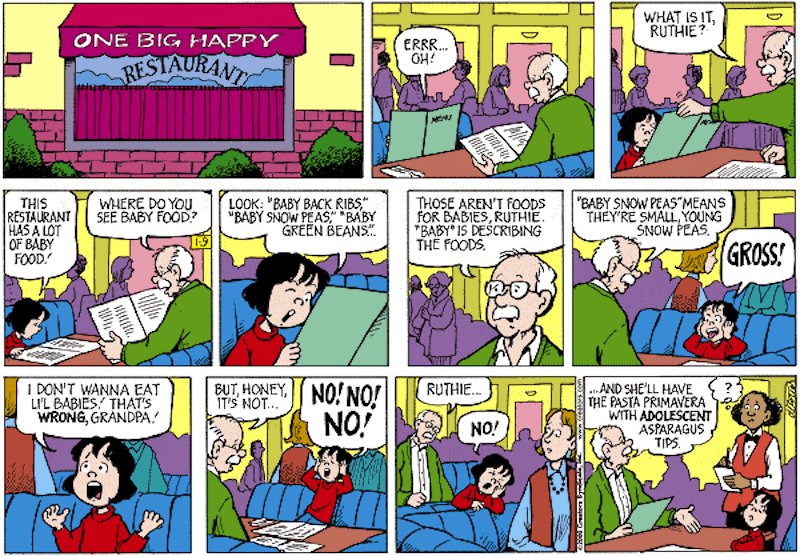
An old One Big Happy strip that turned up in my comics feed recently. The linguistic point is a familiar one on this blog, the enormous potential for ambiguity in N + N compounds in English:


(#1) baby back ribs, baby snow peas, baby green beans, with N1 baby ‘young, immature; small, insignificant (in comparison with others of its type)’ (the sense on the menu) versus baby food, baby carriage, baby book, with N1 baby ‘intended for (use by) a baby’ (the sense Ruthie understands)

The contrast is between two semantic interpretations of the relationship between the modifier N1 and the head N2 in these N1 + N2 compounds.

On the one hand, baby food ‘food for a baby’ is what I’ve called a Use compound; Use compounds (‘N2 for (use by/on/in) N1’) are very common, and sometimes present a pesky ambiguity with also very common Source compounds (‘N2 made from N1’) — some contrasts: Use compound saddle oil ‘oil for (use on) saddles’ vs. Source compound mink oil ‘oil made from minks’ (ugh, but true); Use compound snow tire ‘tire for (use in) snow’ vs. Source compound snowman ‘(simulacrum of a) man made of snow’. The snow examples come from my 1/25/23 posting “Snow tires” on Use vs. Source compounds, taking off from

a classic Don Martin Mad magazine cartoon for the winter season, illustrating the utility and flexibility of N + N compounds in English — and also their enormous potential for ambiguity, which has to be resolved in context

… [with] four examples of N1 + N2 compounds in English, all four highly conventionalized  to very culture-specific referents. In these conventionalized uses, two (snow tiresnowshoe) are use compounds …, two (snowmansnowball) are source compounds … But N + N combinations are potentially ambiguous in  multiple ways; this lack of clarity is the price you pay for the great brevity of these combinations (which lack any indications of the semantic relationship between the two elements).

So: [in the cartoon] we get snow tire and snowshoe understood as source compounds …: ‘(simulacrum of a) tire made of snow’, ‘(simulacrum of a) shoe made of snow’.

On the other hand, baby back ribs ‘back ribs (of pork) that are smaller than the usual (spareribs)’ is what I will now label an Attributive compound, in which some characteristic that’s metaphorically associated with N1 is attributed to N2. Only a few Ns have been conventionalized for use in Attributive compounds: baby for attributing relative smallness (in baby back ribs) or immaturity (in baby peas); giant and monster ‘gigantic, huge’ for attributing (relative) great size (in giant marigold and monster truck); killer ‘exceptional, impressive’ for attributing excellence (in killer abs and killer idea). Since only a few Ns have been conventionalized in this way, Attributive compounds are not very common. But there’s another compound type that’s fairly common and superficially resembles Attributives: what I’ll call the Predicative type, conveying ‘N2 that’s a N1’: baby prodigy ‘baby who’s a prodigy’, killer clown ‘clown that’s a killer’, cowboy poet ‘poet who’s a cowboy’. (The compound killer clown is then ambiguous as between Attributive and Predicative: someone who’s really good as a clown vs. a clown that kills.)

(more…)