In today’s Bizarro, a dog park, with parking meters, where you can park your pooch by the hour:
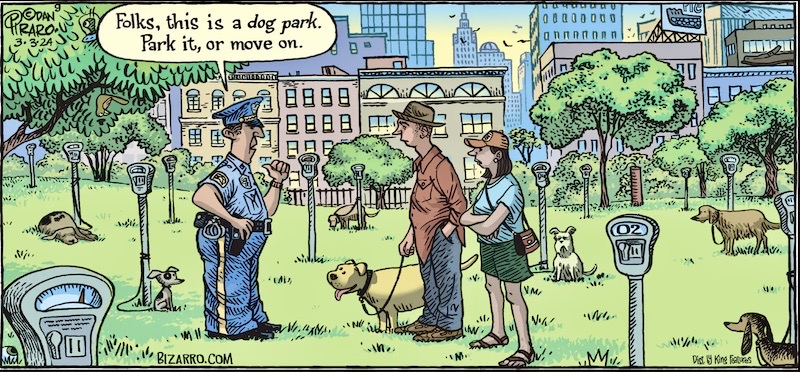
Surprise! The strip exploits a possible sense of the N+N compound dog park — roughly, ‘an area or building where dogs may be left temporarily, for a fee’, the canine analogue of (largely British) car park ‘an area or building where cars or other vehicles may be left temporarily; a parking lot or parking garage’ (NOAD) — that you probably had never imagined.
Instead, you expected the everyday sense of dog park, ‘a park for dogs to exercise and play off-leash in a controlled environment under the supervision of their owners’ (Wikipedia) — a Use compound with the general meaning ‘park for dogs (to use)’, but coming with a sociocultural context that in practice conveys something considerably more specific.
Now, more details on everyday dog parks, and Bizarro dog parks too.
Everyday dog parks. You might be surprised to learn that standard one-volume dictionaries generally don’t have an entry for dog park. It’s not in NOAD, AHD, or their ilk. This is presumably because their compilers saw the everyday compound as semantically transparent, just an ordinary Use compound (with predictable meaning), and one-volume dictionaries can’t possibly list the gigantic stock of transparent lexical items (just look at the OED). They often add some encyclopedic information for the items they do list, but that’s just user-helpful icing. The province of such information is, well, encyclopedias, like the Britannica and Wikipedia, which is why my fact-filled definition came from Wikipedia, not my usual source, NOAD.
The Wikipedia entry goes on with still more useful facts, among them:
Dog parks have varying features, although they typically offer a 4-to-6-foot fence, separate double-gated entry and exit points, adequate drainage, benches for humans, shade for hot days, parking close to the site, water, pooper-scooper to pick up and dispose of animal waste in covered trash cans, and regular maintenance and cleaning of the grounds. Dog parks may also offer wheel-chair access, a pond for swimming and a separate enclosure for small dogs.
… History: In 1979, Ohlone Dog Park in Berkeley, California opened. It is widely recognized as the world’s first dog park.
… Dog parks began as a reaction to decreased public space, urban development, and leash laws.
New establishment of dog parks in urban and suburban areas has seen significant increase since the 2000s
Though they began in the US — only about 45 years ago! — they have spread to other countries.
Bizarro dog parks. The compound dog park in the cartoon has as its head, not the ordinary noun park ‘a large public green area in a town, used for recreation’ (NOAD), but (whoa) a zero-marked deverbal nominalization, in plainer talk, a nouning of the verb park ‘leave [a vehicle] temporarily, [in a place –] typically in a parking lot or by the side of the road’ (NOAD). And this nouning denotes not an action or an event (as with the nouning walk in morning walk ‘a walk in the morning’ and river walk ‘a walk along a river’ or the nouning park in inept park ‘an inept job of parking’), but, somewhat astonishingly, a place (the nouning walk in river walk ‘a path along a river for walking’ — San Antonio TX has a famous River Walk — and, yes, the nouning park in Bizarro‘s dog park ‘an area or building where dogs may be left temporarily, figuratively parked, for a fee’.
Place nounings like river walk (in the path sense) and car park seem to be quite rare, so the Bizarro‘s dog park (with parking meters, and a meter cop) comes as a genuine stroke of invention.
March 3, 2024 at 7:21 pm |
I don’t think I ever came across the term “car park” in the US; I always associated it with Britain, from before the time I visited there five decades ago. “Parking lot” always seemed to be the standard reference in US English, though I wouldn’t know if Canada follows British tradition.
March 3, 2024 at 7:23 pm |
Yes, largely British, and that somehow got dropped from the posting; I will restore it.