Archive for the ‘Linguistics in the comics’ Category

The final 5 Hot Days of Christmas

March 5, 2024

(Very heavy on gay content, with a number of raunchy allusions, so not to everyone’s taste.)

I’m well aware that Christmas was over two months ago, but this is a complex posting and  my life’s been full of, um, challenges. In any case, I’m finally finishing up Dean Allemang’s series of AI-generated Christmas-card designs for the 12 days as in the carol, all of them sent as titillating presents for me. The early ones had one hot hunk, an object of gay sexual desire (Dino and I share a sexual orientation, and in fact a sexual history), as a central figure, with multiples of the gift of the day (birds or those golden rings) as accompaniments; but from there on it’s multiple men: for days 6 and 7, in my 1/11 posting “Hot Days of Christmas: geese and swans”, the dudes are figurative birds; for days 8 (maids a-milking) and 9 (ladies dancing), Dino just switched sexes (milkmen, laddies dancing); the last three days have male gifts in the carol (10 lords a-leaping, 11 pipers piping, 12 drummers drumming), but Dino has found fresh, jokey, interpretations for all three.

(Note: once things shifted to multiple hunks, Dino’s prompts for suitable images tended to turn up clone-like variants of the same basic guy, just differently posed and dressed. So we’ll be seeing a few of these studs again and again; some people find this effect creepy, some find it really hot, I toggle back and forth between the two reactions.)

Now: for background, a look back at the turning point in this carnival of images, the geese a-laying (day 6) and swans a-swimming (day 7). With some comments from Dino about the craft of prompting for suitable images (which can then be further massaged with image-processing software); there’s a lot of art in all of this.
(more…)

Exceptional vocabulary comprehension for her age

March 5, 2024

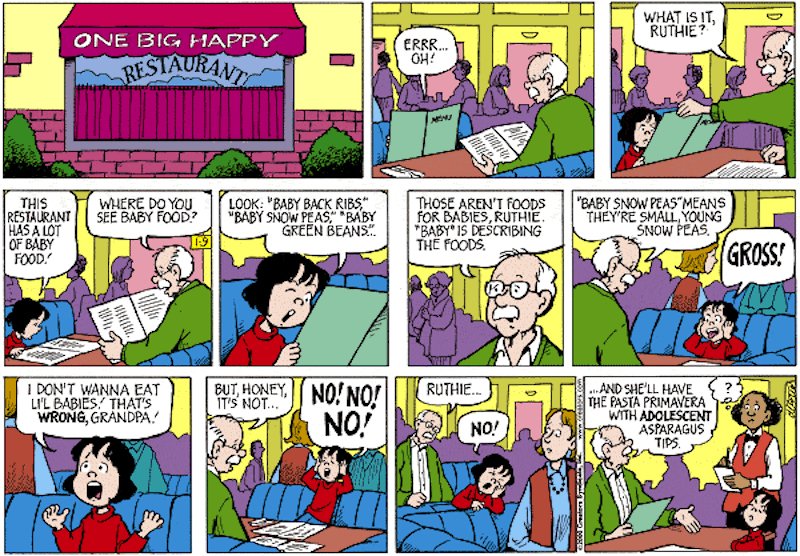
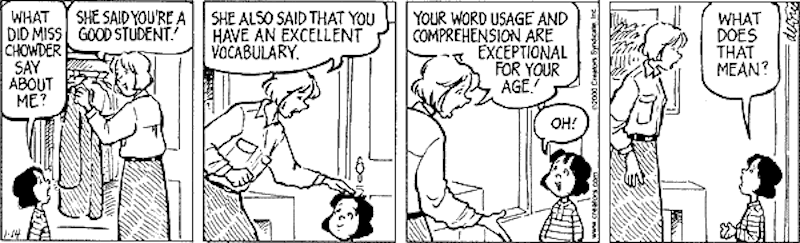
On the other hand, exceptional vocabulary comprehension is not yet within the grasp of her exceptional vocabulary comprehension; Ruthie, in this One Big Happy strip that came up in my comics feed recently, does indeed know a lot of words, just not some of the 4- and 5-syllable killer items:

But you can bet that if we had the next few panels, we would see Ruthie quizzing her mother on those 2-dollar words — though by now they’re probably 10-dollar words — and incorporating them into her exceptional vocabulary, so that she can show them off.

From GDoS on two-dollar words:

(US) any language considered ‘difficult’ or ‘intellectual’, most likely by a speaker who claims to despise such locutions [with cites from 1929 on]


The Bizarro dog park

March 3, 2024

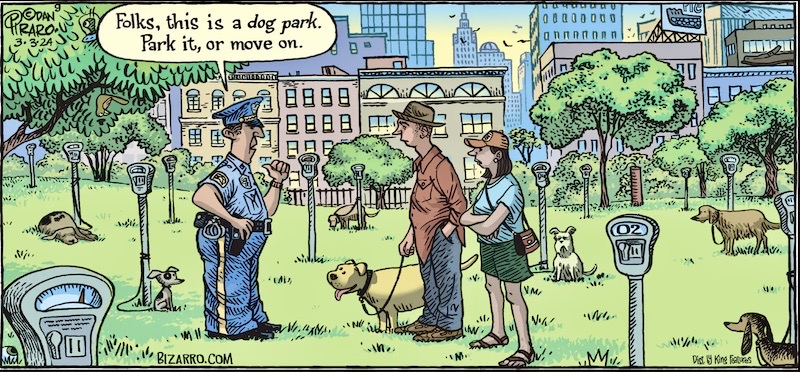
In today’s Bizarro, a dog park, with parking meters, where you can park your pooch by the hour:

Surprise! The strip exploits a possible sense of the N+N compound dog park — roughly, ‘an area or building where dogs may be left temporarily, for a fee’, the canine analogue of (largely British) car park ‘an area or building where cars or other vehicles may be left temporarily; a parking lot or parking garage’ (NOAD) — that you probably had never imagined.

Instead, you expected the everyday sense of dog park, ‘a park for dogs to exercise and play off-leash in a controlled environment under the supervision of their owners’ (Wikipedia) — a Use compound with the general meaning ‘park for dogs (to use)’, but coming with a sociocultural context that in practice conveys something considerably more specific.

Now, more details on everyday dog parks, and Bizarro dog parks too.

(more…)

It’s a mystery

March 2, 2024

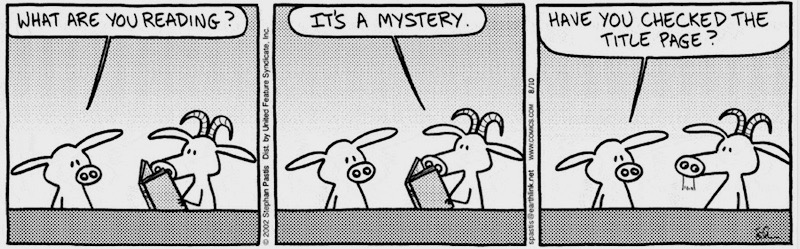
Very much a MQoS Not Dead Yet posting, as I’m barely functioning after one of those stunning drops in air pressure. Hanging around on my desktop for just just an occasion, this mystery-pun Pearls Before Swine cartoon from 2002 featuring Pig and Goat:


Pig, who has the personality of a trusting (but sometimes ignorant) child, assumes Goat doesn’t know the title of the book he’s reading — so does everything but point to the front of the book, to show that title.

Goat’s reply in panel 2, It’s a mystery, is ambiguous. Notably because mystery is ambiguous in this sentence. But so is it. And these two ambiguities are linked, by virtue of an ambiguity as to the construction they’re in. Now I’m going to cut a lot of corners in my discussion, because I’m barely able to get this posting done

(more…)

Baby foods

February 29, 2024

🐅 🐅 🐅  three tigers for ultimate February; for Leap Day, the US is having wild weather (four days of cold rain predicted here on the SF peninsula, where the first flowering fruit trees are already in bloom)

An old One Big Happy strip that turned up in my comics feed recently. The linguistic point is a familiar one on this blog, the enormous potential for ambiguity in N + N compounds in English:


(#1) baby back ribs, baby snow peas, baby green beans, with N1 baby ‘young, immature; small, insignificant (in comparison with others of its type)’ (the sense on the menu) versus baby food, baby carriage, baby book, with N1 baby ‘intended for (use by) a baby’ (the sense Ruthie understands)

The contrast is between two semantic interpretations of the relationship between the modifier N1 and the head N2 in these N1 + N2 compounds.

On the one hand, baby food ‘food for a baby’ is what I’ve called a Use compound; Use compounds (‘N2 for (use by/on/in) N1’) are very common, and sometimes present a pesky ambiguity with also very common Source compounds (‘N2 made from N1’) — some contrasts: Use compound saddle oil ‘oil for (use on) saddles’ vs. Source compound mink oil ‘oil made from minks’ (ugh, but true); Use compound snow tire ‘tire for (use in) snow’ vs. Source compound snowman ‘(simulacrum of a) man made of snow’. The snow examples come from my 1/25/23 posting “Snow tires” on Use vs. Source compounds, taking off from

a classic Don Martin Mad magazine cartoon for the winter season, illustrating the utility and flexibility of N + N compounds in English — and also their enormous potential for ambiguity, which has to be resolved in context

… [with] four examples of N1 + N2 compounds in English, all four highly conventionalized  to very culture-specific referents. In these conventionalized uses, two (snow tiresnowshoe) are use compounds …, two (snowmansnowball) are source compounds … But N + N combinations are potentially ambiguous in  multiple ways; this lack of clarity is the price you pay for the great brevity of these combinations (which lack any indications of the semantic relationship between the two elements).

So: [in the cartoon] we get snow tire and snowshoe understood as source compounds …: ‘(simulacrum of a) tire made of snow’, ‘(simulacrum of a) shoe made of snow’.

On the other hand, baby back ribs ‘back ribs (of pork) that are smaller than the usual (spareribs)’ is what I will now label an Attributive compound, in which some characteristic that’s metaphorically associated with N1 is attributed to N2. Only a few Ns have been conventionalized for use in Attributive compounds: baby for attributing relative smallness (in baby back ribs) or immaturity (in baby peas); giant and monster ‘gigantic, huge’ for attributing (relative) great size (in giant marigold and monster truck); killer ‘exceptional, impressive’ for attributing excellence (in killer abs and killer idea). Since only a few Ns have been conventionalized in this way, Attributive compounds are not very common. But there’s another compound type that’s fairly common and superficially resembles Attributives: what I’ll call the Predicative type, conveying ‘N2 that’s a N1’: baby prodigy ‘baby who’s a prodigy’, killer clown ‘clown that’s a killer’, cowboy poet ‘poet who’s a cowboy’. (The compound killer clown is then ambiguous as between Attributive and Predicative: someone who’s really good as a clown vs. a clown that kills.)

(more…)

A proto-Magritte

February 24, 2024

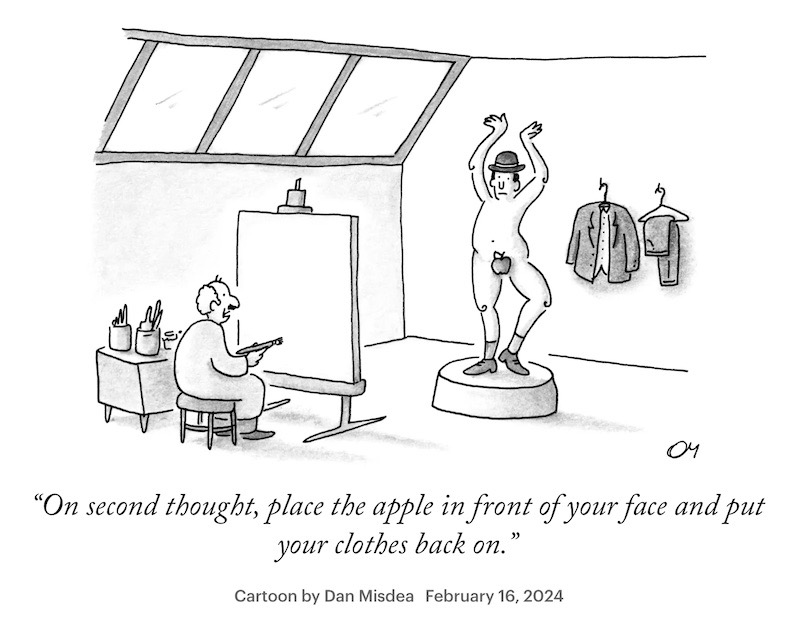
Artists — cartoonists included — rarely preserve and exhibit the drafts of their work, their proto-art. So we should be grateful to cartoonist Dan Misdea (in the latest, 2/26/24, New Yorker) for showing us René Magritte’s first approach to what became his surrealist painting The Son of Man:


(#1) And so the world lost the opportunity for a surrealist soft-porn masterpiece Adam in a Bowler

No doubt the model’s plaintive whining about having an apple glued to his dick encouraged Magritte to reconceptualize the work.

(more…)

Infidelity Day on the planet UFO

February 13, 2024

ma in Ispagna son già mille e tre
— Leporello cataloguing Don Giovanni’s sexual conquests

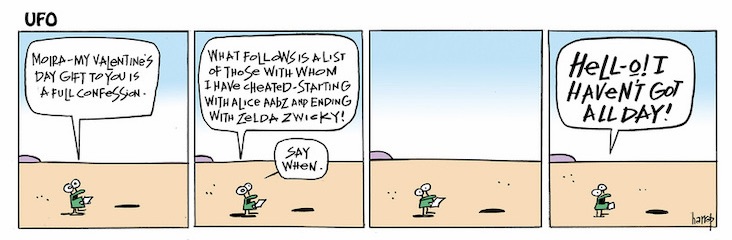
Mitch Marks has sent me a comic strip appropriate for the day (which drips with sex) and personally meaningful to me (it has a Zwicky in it, though only for alphabetical purposes): the 2/13 strip in Graham Harrop’s comic UFO, in which a character I’ll call John (for Don Juan / Don Giovanni) prepares to catalogue his infidelities, not by country as in the Mozart / Da Ponte opera (but in Spain there are already a thousand and three), but by letter of the alphabet, from Alice Aabz to Zelda Zwicky:


(#1) John’s Valentine’s Day gift to Moira

About the day. 2/13 is the day before Valentine’s Day; and also (my own invention) what I’ve called LDV Day, Lincoln Darwin Valentine Day, an occasion for rampant man-on-man sexual excess; and also (this year) Mardi Gras (whoop whoop) — so it’ s pretty much drenched in sex.

(more…)

Let’s dance

February 8, 2024

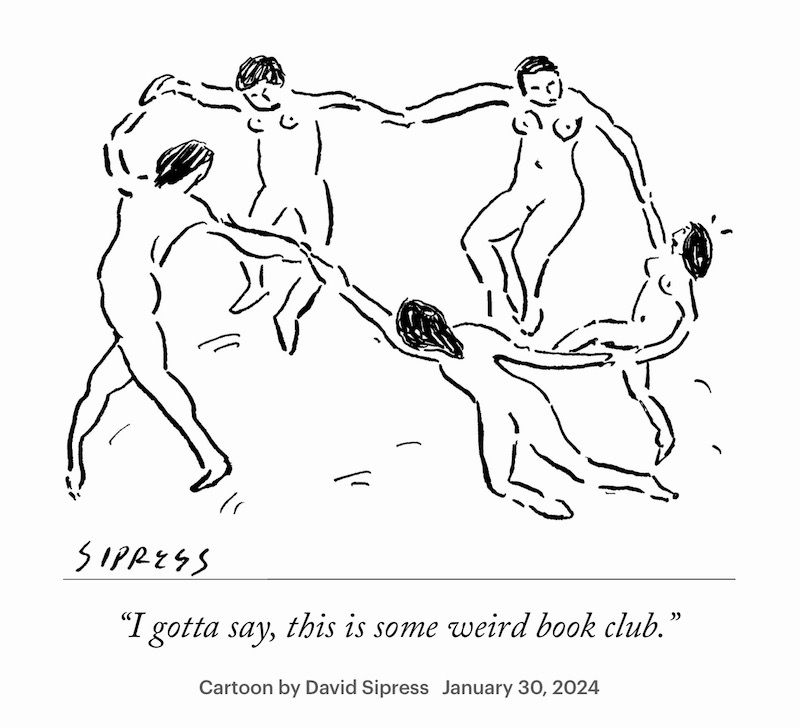
From the annals of visual allusion (bordering on parody or burlesque), this David Sipress cartoon in the 2/12&19/24 New Yorker:


(#1) A stripped-down, cartoonized, goofy reinterpretation of a key work of modern art, Matisse’s 1910 painting La Dance (the cartoonist is an old acquaintance on this blog; there is a Page here about my postings on his work)

(more…)

Palilogia, we adore ya

February 3, 2024

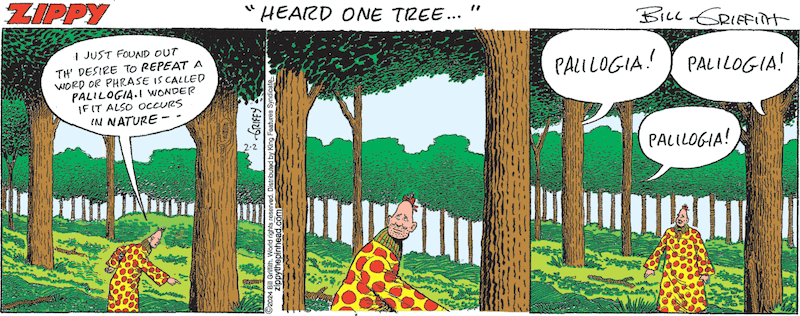
Yesterday’s Zippy strip shows our Pinhead submitting to (in his words) ‘the desire to repeat a word or phrase’, a condition that (borrowing from literature on rhetoric) he calls palilogia:


Here the palilogic impulse is to repeat the word palilogia itself — even by trees

Earlier Zippy strips referred to the clinical affliction phrase repetition disorder and the mantric or chanting practice onomatomania (there’s a Page on this blog about my postings on “Chants, cheers, mantras, onomatomania”). The rhetorical term — with Greek initial element pali(n) ‘again’ plus the ‘word’ stem log — merely refers to repetition; what Zippy’s usage adds is a note of impulse or compulsion that ties the term to phrase repetition disorder and onomatomania.

(more…)

You’ve been seeing other fish

February 1, 2024

🐇 🐇 🐇 trois lapins to inaugurate the little month of February (which stretches this year to 29 days), beginning unfortunately in these parts in cold rains that will last for a week, and (this morning) in low air pressure that makes my joints so painful that I can barely get this posting typed and has depressed my vital signs (blood pressure, pulse rate, body temperature) so much that I’m light-headed, unsteady on my feet, and muzzy-minded (the upside is that low air pressure inevitably goes on to rise, so that if I can hang on a while things will get better)

But I’m not dead yet, and (for reasons I don’t understand) I’m not at all depressed — low air pressure often causes me to break into weeping in despair at the slightest provocation, and the unbroken gloom of these days would test anyone — just pissed off at being so incapacitated.

My morning has been cheered by today’s Rhymes With Orange comic strip (involving a talking pet fish and its keeper), which plays in a surprising way with two of the many verb senses of see:

Minimal lexicographic facts about the senses of see involved in this strip, from NOAD:

verb see: 1 [a] perceive with the eyes; discern visually … 4 [a] meet (someone one knows) socially or by chance … [c] meet regularly as a boyfriend or girlfriend

On hearing “You’ve been seeing other fish”, most people would understand it to be conveying sense 4c (for reasons I’ll explore below); what’s funny is that the strip sets things up — via three pieces of evidence that the keeper has just been to an aquarium, a place people go to to watch fish — so that we will take the fish to be using the unexpected sense 1a: surprise!

(more…)