Archive for the ‘Linguistics in the comics’ Category

Meatmen 1989-2004

April 29, 2016

(The X-rated images are on AZBlogX, here, but let’s face it, the posting is about comics depicting man-man sex, and there’s plenty of explicit talk, so this is not for kids or the sexually modest.)

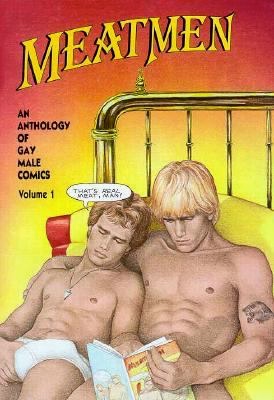
In between the Gay Comics compendium of 1989 and the recent Strippers compendium (2009), both discussed on this blog, there was 1989-2004, filled for comic-fan gay men by 26 issues of the book series Meatmen. Today, issue #1. Front and back:

(#1)

(#2)

(more…)

Gay comics in the 21st century

April 28, 2016

(No actually X-rated images, but still not for kids or the sexually modest.)

A few days ago I looked at gay comics in the 70s and 80s, especially as represented in Robert Triptow’s volume:

The series [Gay Comix, begun by Howard Cruse] was continued by Robert Triptow, who edited the 1989 compilation Gay Comics: The Smartest and Wittiest Gay and Lesbian Cartoonists, with a broad coverage of relatively conventional single-panel and strip cartoons focused on humor or story-telling (leaving out material that is mostly visual and material that’s significantly lubricious.)

(So Tom of Finland doesn’t make this volume.) The contributors are both male and female, but all are North Americans writing in English.

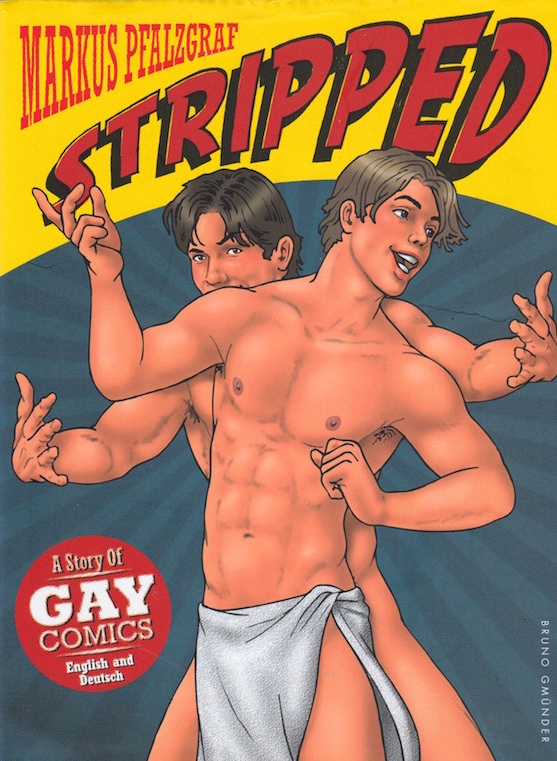
Now comes the 2009 volume Stripped: A Story of Gay Comics, by Markus Pfalzgraf, with 13 cartoonists featured, plus a series of essays (in parallel English and German) on aspects of gay cartooning. The artists are all male, working in English, German, Dutch, and Japanese, and the subject matter is much more varied than in the earlier volume, taking in bondage, S&M, and other kinks, and indulging in piles of mansex for its own sake:

(#1)

(more…)

Bad bro days

April 28, 2016

The story of the address term bro in relatively recent years begins with its use by black men to black men, roughly (but not exactly) like the widely used American buddy — a term of male affiliation. It then spread into the wider culture, serving as a mark of male solidarity. This is what I called in a 4/12/16 posting “good”, positive, bro. But male solidarity tends to come with a dark side: rejection of anything perceived as feminine, played out as sturdy misogyny and homo-hatred in general; and the elevation of boys’ clubs (formed for whatever reasons) to boys-only clubs, aggressively hostile to women and to men perceived as inferior. When these guys use bro to address (or refer to) one another, then we’ve got what I called “bad”, negative, bro.

Regular use of bad bro between men in groups, for instance by fraternity boys and so-called brogrammers, has led to a steady pejoration of the term for people outside those male groups; bro is now a tainted term for many people, calling up unpleasant images of aggressive masculinity.

A brief review of these matters on this blog, then two recent entries in the conversation. And a cartoon too!

(more…)

Sex comics: the kinksters

April 27, 2016

Continuing the sex comic theme from earlier postings (for instance, here and here), I turn to the raunchier side of the genre, where sexual fetishes play a significant role. As in gay porn films, this is the territory of serious leather, BDSM, watersports, domination and submission, etc. I won’t be actually depicting any of this here, but still the topic is not for kids or the sexually modest.

Four practitioners: Josman, who does some simple boy-on-boy sex, but specializes in intergenerational sex, with a lot of piss; the major daddy of rough graphic sex, Tom of Finland (Touko Laaksonen); and two seriously nasty dudes, Etienne (Dom Orejudos) and The Hun (Bill Schmeling). All have appeared on this blog or AZBlogX before.

(more…)

sg /u/, pl /i/

April 27, 2016

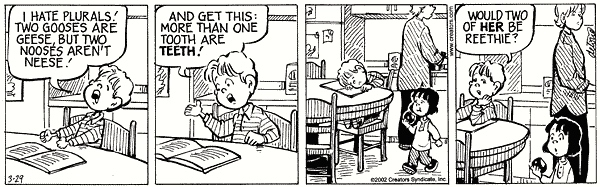
Recent One Big Happy, with Joe bedeviled by irregular plurals in English, especially in the sg /u/, pl /i/ pattern in goose – geese and tooth – teeth:

The morphophonological alternation has an interesting history, but from the point of view of modern speakers, it just is. One booth, two booths (not beeth), but one tooth, two teeth; one noose, two nooses (not neese), but one goose, two geese. And one Ruthie, two Ruthies (not Reethie).

Ding Dong Deli

April 27, 2016

Today’s Zippy, which takes us to woodsy northern New Jersey (west of New York, east of Pennsylvania, south of Connecticut):

This is the alliterative Ding Dong Deli, a diner and shop, in Oak Ridge NJ (there is aso a Ding Dong Deli in Mahopac NY), naturally attractive to Zippy, who’s from Dingburg and who’s an enthusiast of Hostess snack products, especially Ding Dongs (see my 4/4/13 posting), as well as Ding Dong School and the song “Rama Lama Ding Dong”, both of which have been covered here.

icing

April 26, 2016

A Speed Bump cartoon from a little while ago, found on Pinterest:

The patient in the doctor’s office is — remember, this is Cartoon World — a gingerbread man, complaining of a sore knee. This sets things up for a play on the ambiguity of the verb form icing, related to either one of two verbs ice; one of them is related to the mass noun icing (in the U.S., parallel to frosting). From NOAD2 on this mass noun:

a mixture of sugar with liquid or butter, typically flavored and colored, and used as a coating for cakes or cookies

This substance mass noun icing and the verb ice ‘to decorate a cake with icing’ are in a very close synchronic relationship, so close that it’s hard to say which is basic and which derived (note: the verb could be back-derived from the noun); the history looks equally unclear, and the same relationships hold (in the U.S.) between the mass noun frosting and the verb frost (as in frost the cake). Somewhere in all of this is a metaphor relating the appearance of the cake-decorating substance to the appearance of accumulations of ice or frost.

The other verb ice, not well covered in the dictionaries I’ve looked at, is a at root a simple verbing of the noun ice referring to frozen water and meaning roughly ‘chill with ice’, but specialized in reference to ice therapy for sore muscles or joints. (I have joint problems all over the place, and so have cold packs to use for icing these joints.)

Perry Bible Fellowship

April 26, 2016

It’s been a long time — about 11 years — since I posted about Nicholas Gurewitch’s comic strip The Perry Bible Fellowship (in 5/17/05, “Ending with a preposition”), and now I come finally to Gurewitch’s big compendium of 2009, Almanack (published in Wilwaukie OR — note the spelling — by Dark Horse Comics).

PBF is often grotesque, sometimes coarse, sometimes violent, but never dull. The human figures are mostly white globe-faced creatures, as in this unfortunate pun:

(#1)

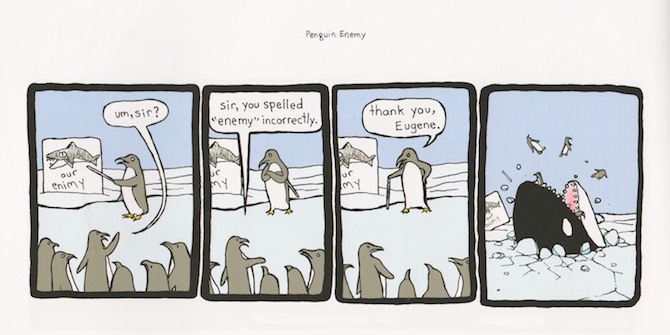
And occasionally there are penguins, sometimes mortally pursued by killer whales:

(#2)

SMBC 2011

April 26, 2016

Assimilating books into my collection. Just now, two Saturday Morning Breakfast Cereal collections from 2011, when Zach Weiner put out two volumes of his webcomic under his Breadpig imprint: Save Yourself, Mammal! in July, The Most Dangerous Game in December. Handsome volumes, on glossy paper with excellent color reproduction. But a venture not repeated.

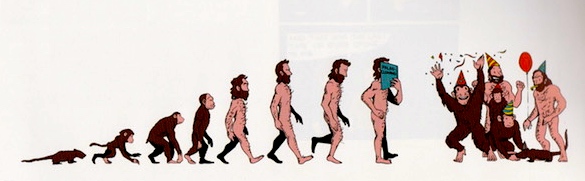
I mention them here because the second has, at the very end, on (unnumbered) p. 74, this entertaining Ascent of Man cartoon:

Paleo cloning!

William Hamilton

April 26, 2016

In the latest (April 25th) New Yorker, a brief appreciation (by Bob Mankoff) of the cartoonist William Hamilton, who died on the 8th

William Hamilton had a lot to say about the nation’s country-club class and how it viewed itself. His cartoons were peopled by ladies and gentlemen of the Park Avenue variety, speaking confidently about their place in the upper crust, even as that crust was crumbling. Hamilton first found a place at this magazine in 1965, when he was only twenty-six. At the time of his death, last week, at seventy-six, he had published more than nine hundred and fifty drawings that lampooned sophisticates and pseudo-sophisticates with dry, incisive jabs. He was that rare artist whose style suits his humor perfectly

(Mankoff had a longer on-line appreciation on the 11th.)

(more…)