Archive for the ‘Linguistics in the comics’ Category

Donelan

April 24, 2016

Continuing my theme of gay cartoons, I turn to a figure from the 70s and 80s, a commentator on gay male life of the time. From Wikipedia:

Gerard P. Donelan (born 1949), known primarily as just Donelan, is an openly-gay cartoonist. He drew “It’s a Gay Life”, a regular single-panel cartoon feature in The Advocate, for 15 years.

… “It’s a Gay Life” gently lampooned gay culture of the time, focusing primarily on young and middle-aged gay men. He continued to work in retailing while producing the series, which also yielded two paperback reprints: Drawing on the Gay Experience (1987) and Donelan’s Back (1988).

(I have both of the volumes in my library.)

(more…)

Two gay graphic novels

April 24, 2016

Not that these are the only two, but I have them both in my library and they make a startling contrast:

Howard Cruse’s 1995 novel Stuck Rubber Baby

(#1)

And Peter Milligan & Duncan Fregredo’s 1995 compilation volume Enigma of their superhero comic book series

(#2)

(text by Milligan, drawings by Fegredo, coloring by van Valkenburgh)

(more…)

The gigantic metaphor

April 24, 2016

Today’s Zippy, with a gigantic metaphor wheeling on the streets:

The Wienermobile is, of course, a real thing, considered on this blog in a 8/11/12 posting “Annals of phallicity: Wienermobile, banana slug split”.

Dr. Sauerkraut! Calling Dr. Sauerkraut!

Joe Orlando: a cartoonist and his sea-monkeys

April 22, 2016

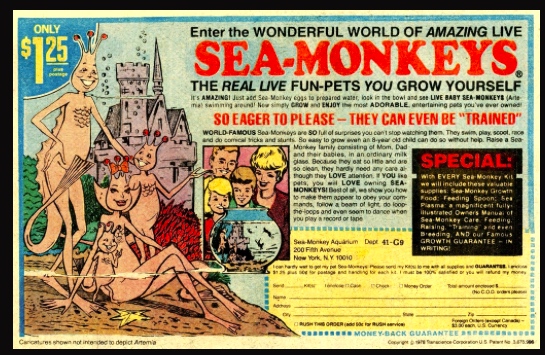
The cartoonist’s art in a somewhat unexpected place: an ad for Sea-Monkeys from the 1960s, showing a Sea-Monkey family of three:

The ad turned up in the midst of a fascinating, intricate NYT Magazine piece by Jack Hitt on Sunday the 17th, “The Battle Over the Sea-Monkey Fortune: A former 1960s bondage-film actress is waging legal combat with a toy company for ownership of her husband’s mail-order aquatic-pet empire”. There’s a lot here, but some highlights:

(more…)

Briefly: bloodletting

April 19, 2016

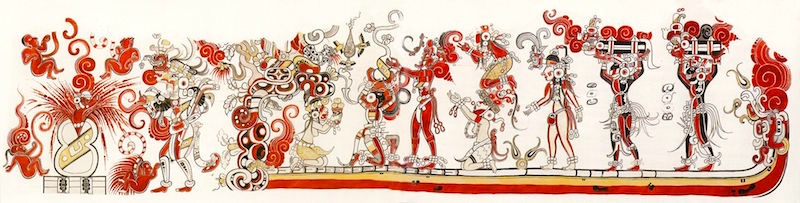
From Mike McKinley, who reports that he is currently studying with noted Mayanist David Stuart at Texas – Austin, on the San Bartolo Murals, which he says

have images of men doing bloodletting on their … rather enormous and erect penises. This is very rare in Mayan (or any Mesoamerican pre-contact) art. Though it was commonly done, it was NOT shown. This is almost Mapplethorpian to my eyes.

Well, certainly, wildly kinky, at least to modern eyes. A sample (read the images from right to left):

These Mayan murals tell stories in a series of images and so serve as precursors of the graphic novel (some discussion here).

Briefly: Hellboy

April 19, 2016

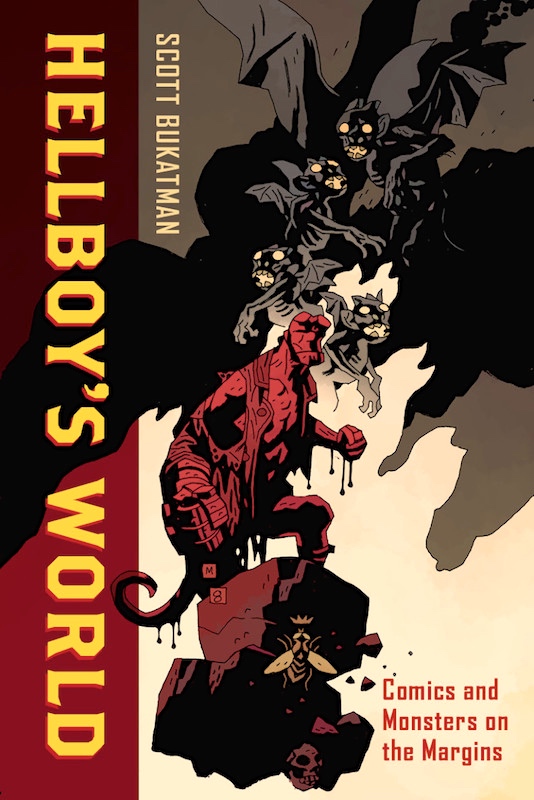
From Stanford’s news service yesterday, “Comics like Hellboy produce a heightened adventure of reading, Stanford scholar says: Using the Hellboy series as a touchstone, Professor Scott Bukatman has discovered new ways to talk about comics while offering a heightened “adventure of reading.”” by Leah Stark, beginning:

The Hellboy comics – about a demon who tries to resist his predestined role to destroy our world – provide a powerful vantage point from which to view the extraordinary and unique powers of the comic book medium, a Stanford scholar suggests.

That is the viewpoint of Scott Bukatman, a Stanford professor of film and media studies. He researched the Hellboy series by creator Mike Mignola and found that the pleasures of reading a comic book can reveal something about contemporary visual culture and even the act of reading itself.

… Bukatman … details his findings in a new book, Hellboy’s World: Comics and Monsters on the Margins [Univ. of California Press, 2016].

Many different genres are juggled in the Hellboy comics and, as a result, the stories themselves have different tonalities, Bukatman said.

“Some are really funny, some are melancholy. Some are cosmic in scope, others are local and small. There’s a lot of variety within this strange story world that Mignola has come up with,” he said.

Extended discussion in the piece

The fish are biting

April 17, 2016

(Vex, vex. I had almost all of this posting put together when — despite automatic saving in WordPress — most of the file vanished, so I had to reconstruct almost everything, including the links, from scratch. Sigh.)

Yesterday’s Calvin and Hobbes from the past:

Two different intransitive verbs bite here: one in panels 2 and 3, another in Hobbes’s question in panel 4. The first is straightforward transitive bite with omitted direct object (yielding one type of intransitive). The second — “[no obj.] (of a fish) take the bait or lure on the end of a fishing line into the mouth” (NOAD2) — seems to be more complicated, but its historical source seems pretty clearly to involve a semantic extension, from a verb referring to using the teeth to cut into something in order to eat it to one referring merely to taking something into the mouth in order to eat it.

(more…)

Daniel Clowes

April 16, 2016

The cartoonist and graphic novelist, with special reference to his “comic-strip novel” Ice Haven:

(#1)

Among the large cast of characters in the book is Harry Naybors, Comic Book Critic (a jab at, yes, comic book critics). (The central character on the cover is Random Wilder, the narrator.)

(more…)

Surreal mud in CT

April 14, 2016

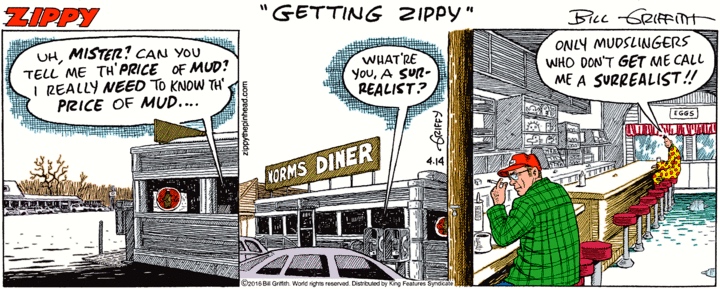
Today’s Zippy takes us to Groton CT:

(#1)

(more…)

Reciting formulas

April 13, 2016

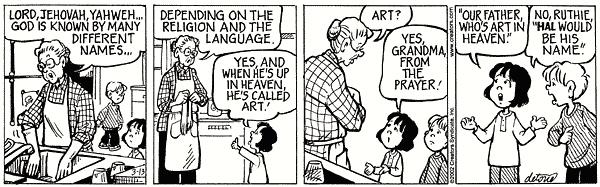
The 3/13 One Big Happy, recently in my cartoon feed:

Ruthie and Joe are both mishearing parts of the Lord’s Prayer (in one of its many variants). Ruthie, line 1: “Our Father, who art in heaven”. Joe, line 2: “Hallowed be His name”.  This is a highly formulaic text, in a strange variety of English, most often heard recited by groups of people mumbling out of synch with one other. The text is odd, and hard to make out: a perfect breeding place for mishearings.

About as good as texts sung to music. Songs often have remarkable words — poetic, allusive, dialectal, archaic, idiosyncratic, whatever — and singing itself and musical accompaniment deform and conceal wording. Hence classic mondegreens. Rote recitation of texts nurtures something very similar to mondegreens (often classed with them).