On the heels of my little note on “Manly Deeds, Womanly Words” (a comment from John Baker notes that this is “the motto of the Calvert family “Fatti maschii parole femine” loosely translated [from Italian] as “Manly deeds, womanly words” ”) came two more items on male/female differences: a piece in the NYT Sunday Review on the 21st (“The Tangle of the Sexes” by Bobbi Carothers and Harry Reis); and an Alex cartoon in the London Telegraph on men as rational, women as emotional.
Archive for the ‘Language and gender’ Category
On the sex / gender watch
April 24, 2013Brief mention: men and women in Maryland
April 22, 2013On a postcard (with a pile of images of and information about the state of Maryland) from Chris Ambidge on Saturday, the news that the state motto is
Manly Deeds, Womanly Words
Sigh: men act, women talk. At least in Maryland.
Side note: the Pinhead town of Dingburg is in Maryland.
Sex/gender symbols
April 13, 2013From Kim Darnell on Facebook, a story from a year ago (4/17/12) about the adoption of a gender-neutral pronoun in Swedish, with this handsome accompanying graphic:
 (#1)
(#1)
The graphic has three interlinked components: The “female symbol” (or “mirror of Venus”), a circle (representing a body) with a cross below it (♀ in biological literature); the “male symbol” (or “spear of Mars”), a circle with an arrow at the upper right (♂ in biological literature); and a plain circle in the center, representing a body unspecified as to sex. Turning to grammatical gender rather than biological sex, the mirror of Venus represents feminine gender (as in the Swedish pronoun hon ‘she’), the spear of Mars the masculine gender (as in the Swedish pronoun han ‘he), and the plain circle the new gender-neutral 3sg Swedish pronoun hen).
A complexity here is that this symbol is sometimes taken to be a transgender symbol, the central circle represeting someone who in some sense is *both* female and male. And for this purpose there are a number of competing symbols.
Listening
April 6, 2013Today’s Zits, once again on male/female differences:

The teenage predecessor to cartoon and sitcom husbands who don’t listen at all to what their wives are saying.
Finger talk
April 5, 2013Today’s Zits, with Jeremy communicating with his fingers but not with his voice, to his mother’s dismay:

This could be about teenagers and their parents, or about the fabled laconic nature of boys (and men), or of course about both.
Gossip
April 1, 2013Today’s Zits:
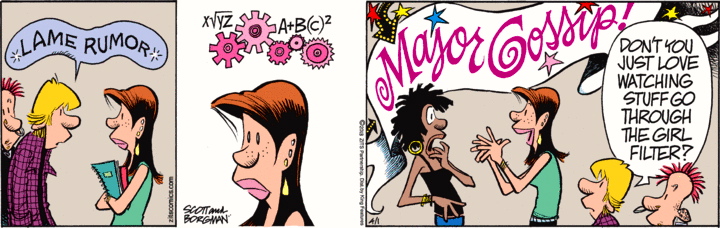
The stereotype is that women (especially girls) gossip about other people and their lives, but men (and boys) talk about weightier and more objective things, like politics and sports. Studies of talk among men in groups, as in college fraternities, don’t fully support the stereotype (google {gossip gender differences}: at least in some studies, women in groups do spend more time gossiping than men in groups, but men in groups gossip quite a lot.
Men’s and women’s brains in Dingburg
March 20, 2013Today’s Zippy takes on differences between the sexes (at least in Dingburg):
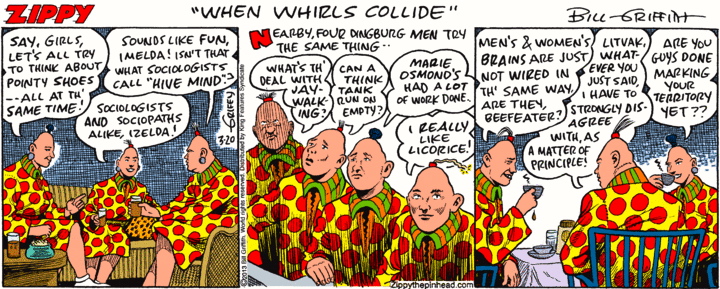
Women affiliative, men competitive. (On telling the men from the women: the women wear earrings, the men do not.)
An assortment of names: Imelda as in Imelda Marcos; Izelda possibly a play on that, or an allusion to iZelda (an iPhone version of the game Zelda); Litvak ‘Lithuanian Jew’; beefeater ‘guard at the Tower of London’ (or Beefeater gin).
Chattiness again
March 5, 2013A recurrent theme in the cartoon Zits is the replication of gender stereotypes saying that girls are chatty, boys are laconic. Postings on the subject (using Zits in particular) go back at least as far as Mark Liberman’s Language Log posting of 4/26/05 (“Language and gender: The cartoon version”); meanwhile, Mark has been attacking the stereotypes directly with data. But Zits rolls on; here’s today’s strip:
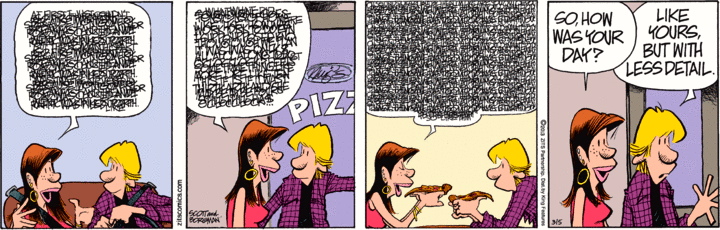
A dense block of wordage is a Zits convention for indicating overwhelming amounts of speech.
Fixing things
November 22, 2012This morning’s Zits, in which Jeremy responds to his mother’s call for help:
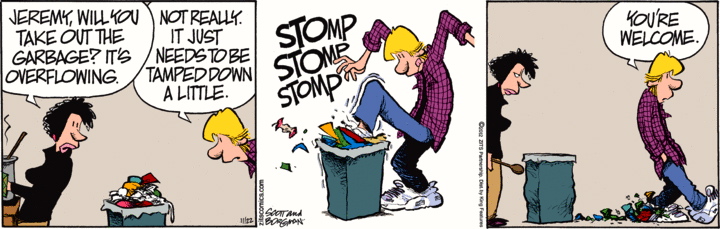
Note the facial gestures, and the subversion of the mother’s request, in which Jeremy does not in fact take out the garbage, but does what strikes him as less work — though it makes a major mess.
Sylvia
November 13, 2012More adventures on the comics pages, this time in Nicole Hollander’s Sylvia, from the 2010 retrospective on 30 years of the strip, The Sylvia Chronicles: 30 Years of Graphic Misbehavior from Reagan to Obama (with pointed commentary by Hollander on the already pointed cartoons).
From Jules Feiffer’s foreward:
For thirty years, long before Jon Stewart or Stephen Colbert, my friend Nicole Hollander has been one of our nations’s leading satirists. Than mean that she is in the business of telling the truth and making it funny. She is right about almost anything. And because she is right, and she is funny, she has no power whatsoever.