From Steven Levine, this remarkable advertising image:

Elsie the Cow, in a maid’s apron and nothing else — yielding a racy image — offering a very substantial breakfast. Smiling and dancing.
More on Elsie here.
From Steven Levine, this remarkable advertising image:
Elsie the Cow, in a maid’s apron and nothing else — yielding a racy image — offering a very substantial breakfast. Smiling and dancing.
More on Elsie here.
Posted in Language and food, Language and gender, Language in advertising, Silliness | Leave a Comment »
I’ve posted this on Elizabeth Zwicky’s Facebook timeline, where it’s been appreciated. Now to give it a somewhat more permanent home, on this blog.
From the website One Last Blog on Nothing of 12/18/13, “One Weird Old Trick to Undermine the Patriarchy” by Michelle Nijhuis, beginning:
My five-year-old insists that Bilbo Baggins is a girl.
The first time she made this claim, I protested. Part of the fun of reading to your kids, after all, is in sharing the stories you loved as a child. And in the story I knew, Bilbo was a boy. A boy hobbit. (Whatever that entails.)
Posted in Language and gender | Leave a Comment »
On Facebook, Ann Burlingham has passed on this posting (from February 1st), “Why Are We Referring to Women as Girls?” by Yashar Ali, about men referring to women in the workplace as girls. (Note: Yashar Ali is a man.)
Posted in Language and gender, Language and society | 6 Comments »
In the NYT Magazine on the 6th, a “Who Made This?” piece by Pagan Kennedy on movie popcorn, with this accompanying note on a metaphor:
The industry term for unpopped kernels: spinsters
One commenter disputed this claim, saying that the correct term was old maids. Other sources:
What I do not care for is all those unpopped kernels at the bottom of the bag. Incidentally, these kernels are referred to as “spinsters” among popcorn aficionados. (link)
Unpopped popcorn kernels have been dubbed “old maids” in popular slang, since just as unmarried women that never had children, they do not “pop”. (link)
Apparently there are alternative usages.
From NOAD2 on spinster (originally ‘a woman who spins’):
an unmarried woman, typically an older woman beyond the usual age for marriage.
The word has a derogatory tone that goes beyond an unmarried woman. NOAD2 treats old maid as explicitly derogatory:
derogatory a single woman regarded as too old for marriage.
Posted in Language and food, Language and gender, Metaphor | 5 Comments »
In the NYT yesterday, “Rutgers Updates Its Anthem to Include Women” by Ariel Kaminer:
No one song could ever capture all the motivations that bring students to a college campus, all the experiences they have there or all the ways those experiences changed their lives.
But “On the Banks of the Old Raritan,” the alma mater of Rutgers University, is particularly inadequate. “My father sent me to old Rutgers,” the song proudly began, “And resolved that I should be a man.”
Women were first enrolled in Rutgers in 1972 and now make up half the student body. It was time for fresh words.
Posted in Language and gender, Music | 2 Comments »
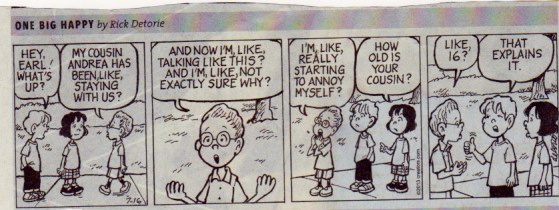
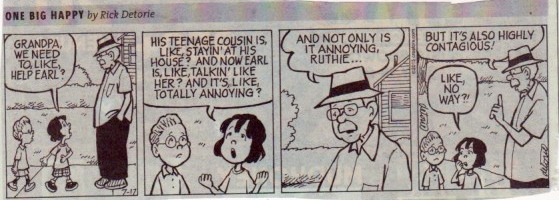
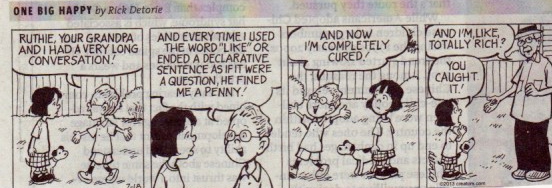
I’ll start with a three-strip series from One Big Happy:
 (#1)
(#1)
 (#2)
(#2)
 (#3)
(#3)
The two features at issue here — the discourse particle like and “uptalk” (a high rising intonation at the end of declaratives) — have been much discussed in the linguistic literature. The popular, but inaccurate, perception is that both are characteristic of young people, especially teenagers, especially girls, and both features are the object of much popular complaint.
Posted in Dialects, Language and gender, Language of teenagers, Linguistics in the comics, Peeving, Phonology, Usage attitudes, Variation | 5 Comments »
Item 1, royal names. On NPR’s Morning Edition this morning, people discussing names for the forthcoming British royal baby.
Item 2, unisex names, in particular Taylor.
Item 3, fashions in naming, especially for American Jews.
Posted in Language and gender, Names | 6 Comments »
Today’s Dilbert:
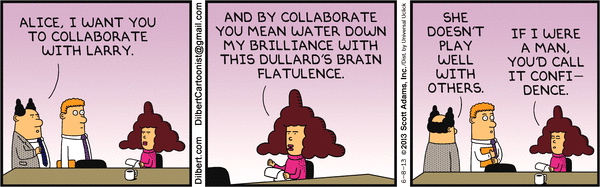
Alice gives a witheringly sarcastic response to the pointy-headed boss, supplying a definition of collaborate that unpacks some of the connotations of the word for her. The boss then puts her down by maintaining that she is uncooperative (she ought to “play well with others” by collaborating with Larry), and she counters by pulling out the gender assumptions in the boss’s observation (women are supposed to be cooperative and collaborative, men are supposed to be assertive and confident).
Posted in Connotation, Language and gender, Linguistics in the comics, Sarcasm and irony, Semantics | 1 Comment »
Today’s Zippy:
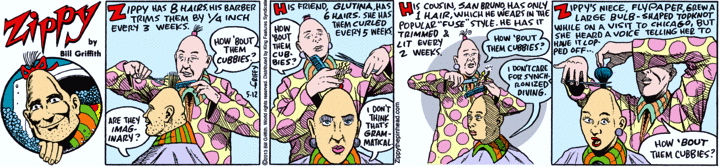
So the strip is “about” hair(s), but it’s also “about” How ’bout them Cubbies?
(On a personal hair and holiday note: I’m watching Hairspray for Mothers Day.)
Posted in Clipping, Language and gender, Language and society, Linguistics in the comics, Pragmatics, Pronoun case, Speech acts, Syntax, Usage | 1 Comment »
… in today’s Zits:
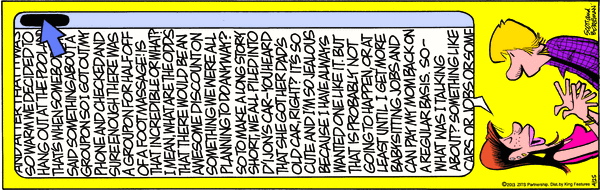
This is a topic that Scott and Borgman (somewhat wearisomely) just can’t leave alone. I do like the economical communication of Jeremy’s nonplussed state of mind, though.
Posted in Facial expression and gesture, Language and gender, Linguistics in the comics | Leave a Comment »
You are currently browsing the archives for the Language and gender category.