Archive for the ‘Awards’ Category

PAW days

March 31, 2024

🐅 🐅 🐅 three tigers for ultimate March (3/31) and for Princeton University (from the 19th century, the Princeton locomotive cheer “Rah rah rah! Tiger, tiger, tiger! Sis, sis, sis, boom, boom, boom, ah!”), plus 🐇 a rabbit for Easter (no doubt soon to be devoured by the tigers — though it will be succeeded tomorrow by a tougher trio of rabbits inaugurating the month of April, who might be foolish but have the power of three)

And so I turn to the Princeton Alumni Weekly (which is a monthly publication, but try not to dwell on that) — PAW, from now on — and my relations to it in recent years. While noting that when I die, PAW is the only place where I’m sure to get an obituary, though my Stanford department’s weekly newsletter, the Sesquipedalian, will have a notice, as will the news bulletin from the Linguistic Society of America (the LSA), and friends will say something on Facebook; otherwise, I expect my death to go publicly unremarked (and I encourage my daughter and grandchild not to spend their money on paid announcements), so at least in the death department, PAW looms large.

Now: I’ll re-play (with little further commentary) some history from the past three years in which PAW has been involved, ending with a section from my class notes in the issue that arrived in the mail yesterday (with rather more commentary).

(more…)

Dynamic semantics wins a prize

March 19, 2024

🧨 🧨 🧨 Firecrackers! For a prize from the Swedish royal academies, something  you might think of as a Nobel Prize’s little brother, awarded to two colleagues in linguistics and philosophy, one an old friend (and exact contemporary) of mine. From the website of the Swedish royal academies, “Science, art and music meet in the Rolf Schock Prizes 2024”, a press release of 3/14/24:

2024 Rolf Schock Prize in Logic and Philosophy is jointly awarded Hans Kamp, University of Stuttgart, Germany and Irene Heim, Massachusetts Institute of Technology, Cambridge, USA

“for (mutually independent) conception and early development of dynamic semantics for natural language.”

Natural languages are highly context-dependent – how a sentence is interpreted often depends on the situation, but also on what has been uttered before. In one type of case, a pronoun depends on an earlier phrase in a separate clause. In the mid-1970s, some constructions of this type posed a hard problem for formal semantic theory.

Around 1980, Hans Kamp and Irene Heim each separately developed very similar solutions to this problem. Their theories brought far-reaching changes in the field. Both introduced a new level of representation between the linguistic expression and its worldly interpretation and, in both, this level has a new type of linguistic meaning. Instead of the traditional idea that a clause describes a worldly condition, meaning at this level consists in the way it contributes to updating information. Based on these fundamentally new ideas, the theories provide adequate interpretations of the problematic constructions.

Kamp was born in the Netherlands in 1940. He received his PhD from University of California, Los Angeles, in 1968 and has been a professor at University of Stuttgart, Germany, since 1988.


(#1) Hans Kamp (photo: Kerstin Sänger)

Heim was born in Germany in 1954. She received her PhD from the University of Massachusetts, Amherst, in 1982 and has been a professor at the Massachusetts Institute of Technology (MIT), Cambridge, USA since 1997.


(#2) Irene Heim (photo: Philipp Heim-Antolin)

(more…)

Jack Spicer’s California summers

February 24, 2024

Yesterday, in my posting “Poet to poet”, I gave you extracts from a Billy Collins poem on the poet Jack Spicer and promised a posting on the poets Spicer and Frank O’Hara. I’ve posted a good bit of O’Hara on this blog over the years, but Spicer has gone unsampled. Looking ahead to the next posting, Spicer and O’Hara share four notable things, beyond their being extraordinary poets: they were almost exact contemporaries (and at one point in their lives went out drinking and dancing together); both their lives were cut off early (at the age of 40; Spicer drank himself to death, O’Hara was killed in a freak accident); they were both openly, defiantly gay (in the 1940s to 1960s, yet); and they both pursued their craft doggedly, compulsively, as if it was something they couldn’t not do.

Their poetry came to me together through the same route, my first male lover, and it was a great gift, but the two men could hardly have been less similar. O’Hara was ebullient, gregarious, self-assured; Spicer was unsure of himself, inclined to depression, a natural loner (who also, however, craved social connections of many kinds). O’Hara’s poetry is famously spontaneous, improvised in the moment, while many of Spicer’s poems were reworked and elaborated over time, though he also longed for poetry that would just come to him through the air, like radio waves. Yes, a bundle of contradictions.

Spicer’s life history is so restless, complex, and fascinating that I’m posting most of the Wikipedia article on him, below. After that I offer you just one, fairly long, poem, “Psychoanalysis: An Elegy” (from the late 1940s), framed as a session between a (maximally laconic) therapist and a patient who’s spinning out a shimmering sensuous vision of California summers that just might never end.

(more…)

The discouragements of old age

February 21, 2024

As regular readers will have noticed, things have not been good for me in recent days — physically just hanging on, barely getting through the days; spirits so low I’m almost frozen in discouragement. Many things have no doubt contributed to the fix I’m in, but one part of the story has to do with the late-career recognitions that sum up the accomplishments of the most significant academics: publication of their collected works; a Festschrift from colleagues and students celebrating the influence of their works; honorary degrees; and prizes or awards. I travel in circles where such recognitions are common, but never expected to get them myself: I have genuine talents, with teaching and research ranging over a huge array of topics, and I can pull off an engaging style of presentation, but my achievements are modest.

I’ve had plenty of career recognitions  — a University Professorship at Ohio State; election to the American Academy of Arts and Sciences; the presidency of my learned society, the Linguistic Society of America (LSA); the Sapir Professorship at an LSA Linguistic Institute; an assortment of  grants and fellowships — but these are, as a Stanford dean once explained to me, more than a little haughtily, in what I think of as Harvard Talk — merely what Stanford expects of its faculty members, nothing at all special.

(more…)

The 2024 Arnold Zwicky Award

November 22, 2023

From the Linguistic Society of America’s Secretariat this morning:

Arnold Zwicky Award: This award, given for the first time in 2021 [as the 2022 AZ Award], is intended to recognize the contributions of LGBTQ+ scholars in Linguistics and is named for Arnold Zwicky, the first [openly] LGBTQ+ President of the LSA. The Committee on LGBTQ+ [Z] Issues in Linguistics (COZIL) is pleased to announce that Professor Lal Zimman is the LSA’s 2024 Arnold Zwicky Award recipient [AZ: to be formally awarded at the 2024 LSA meeting in early January in New York City].

Lal Zimman, an Associate Professor of Linguistics at UC Santa Barbara, is recognized as a global leader in the area of trans linguistics. His research on trans language has had a significant impact on sociocultural linguistics, sociophonetics, inclusive pedagogy, and social justice- and community-based linguistics. Zimman has also been active in advocating for trans inclusion in the discipline and the academy, and he has been a mentor to many trans students. He now directs the Trans Research in Linguistics Lab (TRILL) at UCSB, which is dedicated not only to studying trans linguistics but also holistically supporting trans students and scholars.

Yes — a Z to a Z!

(more…)

Hail to Heidi Harley

June 27, 2023

Old news, but then I’ve been out of the world at SUMC for some time and didn’t get this posted before the cascade of disasters:

Heidi Harley (Univ. of Arizona) has been nominated as president of the Linguistic Society of America (which means three years of service to the society, each year with its own responsibilities: as vice-president, president, and immediate past president).

I note further that Heidi (born 9/26/69) is now only 53, not some elder of the discipline, so this is an especially signal recognition of her achievements.

Facebookers will know HH especially from her postings about the linguistic and social development of her two young sons.

(more…)

Houcks at WHS

June 10, 2023

… as some of the AMZ Fan Club (as Eleanor put it), in, omigod, October 2021, how could I have failed to post about this for almost two years? (note that everyone has a mask, temporarily off for the photo):


(#1) My cousin Eleanor (the youngest of my first-cousin cohort: Eleanor Severin Houck, daughter of Bertha Zwicky Severin); my cousin-in-law Dick Houck; and their son, my first cousin once removed Rich Houck — at Wilson High School in West Lawn PA

They are standing in front of my Distinguished Alumni plaque in the WHS Hall of Academic Fame — from, oh dear, almost 20 years ago; I gave a little talk then at the National Honor Society induction, a talk that included a brief encomium to my dad and how he coped with having such a “different” kid.

(more…)

Just elected to the American Academy

April 19, 2023

… of Arts and Sciences, (at least) 7 scholars in linguistics and the language sciences — 6 women and one man:

— in Psychological Sciences, Leda Cosmides (UC Santa Barbara) and Virginia Valian (CUNY)

— in Education, Ofelia Garcia (CUNY)

— in Literature and Language Studies, Claire Bowern (Yale), Salikoko Mufwene (Chicago), Hazel Simmons-McDonald (Univ. of the West Indies), and Elizabeth Traugott (Stanford)

(more…)

A toast to Liana Finck

April 8, 2023

… on the occasion of her being among the winners of 2023 fellowships from the John Simon Guggenheim Memorial Foundation, announced on 4/5. From the list:

in General Nonfiction: Liana Finck, Writer, Brooklyn, New York; Adjunct Associate Professor, Department of English, Barnard College

LF came to me first as the creator of extraordinary cartoons for The New Yorker magazine; there is a Page on this blog devoted to my postings about these cartoons. But there’s lots more, some of which I’ll cover below, in a somewhat haphazard look at her career. I’ll start with an appreciation of one of her NYer cartoons, in one of these postings, from 10/31/17: “Three kinds of cartoon”:


(#1) Liana Finck in the 5/8/17 New Yorker: two worlds intersect on the street

Christian evangelism meets recycling. To understand Finck’s cartoon … , you need to recognize the formula “Have you heard the good news?” as part of a routine of public evangelism, especially by Mormons and Jehovah’s Witnesses, going door to door or appealing to people in public places, including on the street. In an expanded form:

Have you heard the good news (about (our Lord) Jesus Christ)? (He is/has risen (from the grave).)

You also need to recognize the two characters in the cartoon as plastic water bottles — not at all difficult — and — more difficult — also recognize the symbol

(#2)

as a symbol of recycling, and in addition understand that “recycling is the process of converting waste materials into new materials and objects” (Wikipedia). That is, in recycling, material metaphorically dies (when it is discarded) and then, if recycled, is reborn — metaphorically rises from the dead.

If you’ve got all that, you can appreciate the cleverness in having evangelical water bottles spreading the good news about how water bottles have been resurrected (via the miracle of recycling).

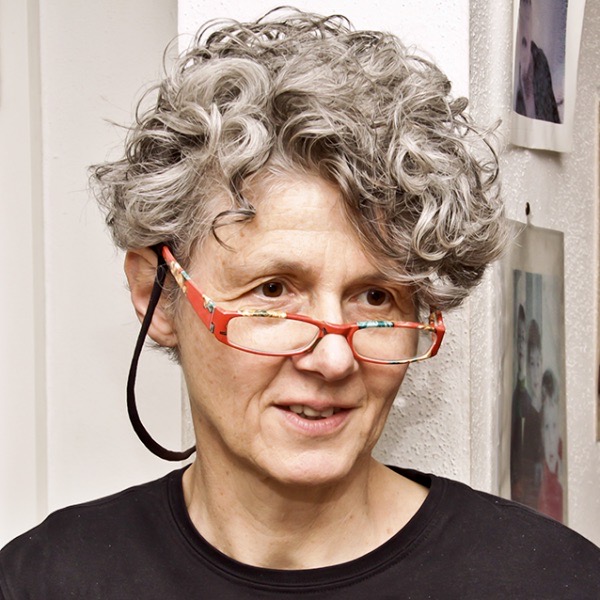
About LF. A portrait of the artist (born 1986):


(#3) photo: Ilya S. Savenok

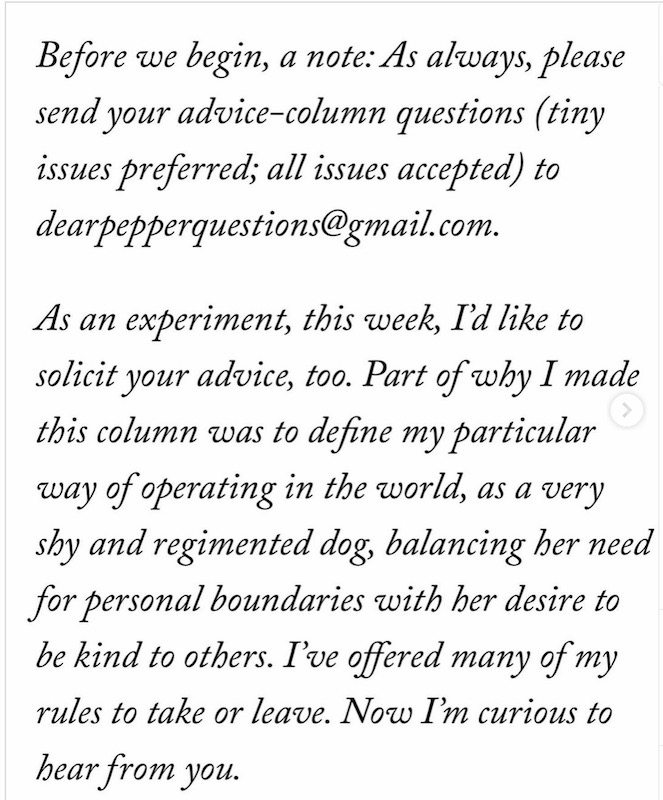
Meanwhile, some details of her work on her home page. Among her projects is an advice column, Dear Pepper, maintained on her Instagram page. A recent notice from her there:

(#4)

And then the books.

— from Amazon.com on A Bintel Brief: Love and Longing in Old New York by Liana Finck (Ecco paperback, 2014); publisher’s blurb:

In an illustrative style that is a thrilling mash-up of Art Spiegelman’s deft emotionality, Roz Chast’s hilarious neuroses, and the magical spirit of Marc Chagall, A Bintel Brief is Liana Finck’s evocative, elegiac love letter to the turn-of-the-century Jewish immigrants who transformed New York City and America itself.

A Bintel Brief “A Bundle of Letters” — was the enormously popular advice column of The Forward, the widely read Yiddish language newspaper begun in 1906 New York. Written by a diverse community of Eastern European Jewish immigrants, these letters spoke to the daily heartbreaks and comedies of their new lives, capturing the hope, isolation, and confusion of assimilation.

Drawn from these letters — selected and adapted by Liana Finck and brought to life in her appealing two-color illustrations — A Bintel Brief is a tour of Lower East Side New York, and includes an imaginative conversation with the Yiddish “Dear Abby,” Abraham Cahan, The Forward’s legendary editor and creator of the Bintel Brief column.

From premarital sex to family politics to struggles with jobs and money, A Bintel Brief is an enlightening look at a segment of America’s rich cultural past that offers fresh insights for our own lives as well.

— on Passing for Human: A Graphic Memoir by Liana Finck (Penguin Random House, 2018), the publisher’s blurb from their site:

In this achingly beautiful graphic memoir, Liana Finck goes in search of that thing she has lost — her shadow, she calls it, but one might also think of it as the “otherness” or “strangeness” that has defined her since birth, that part of her that has always made her feel as though she is living in exile from the world. In Passing for Human, Finck is on a quest for self-understanding and self-acceptance, and along the way she seeks to answer some eternal questions: What makes us whole? What parts of ourselves do we hide or ignore or chase away — because they’re embarrassing, or inconvenient, or just plain weird — and at what cost?

Passing for Human is what Finck calls “a neurological coming-of-age story” — one in which, through her childhood, human connection proved elusive and her most enduring relationships were with plants and rocks and imaginary friends; in which her mother was an artist whose creative life had been stifled by an unhappy first marriage and a deeply sexist society that seemed expressly designed to snuff out creativity in women; in which her father was a doctor who struggled in secret with the guilt of having passed his own form of otherness on to his daughter; and in which, as an adult, Finck finally finds her shadow again — and, with it, her true self.

Melancholy and funny, personal and surreal, Passing for Human is a profound exploration of identity by one of the most talented young comic artists working today. Part magical odyssey, part feminist creation myth, this memoir is, most of all, an extraordinary, moving meditation on what it means to be an artist and a woman grappling with the desire to pass for human.

— Excuse Me: Cartoons, Complaints, and Notes to Self  by Liana Finck (Penguin Random House, 2019): over 500 cartoons from Instagram and The New Yorker

— on Let There Be Light: The Real Story of Her Creation by Liana Finck (Penguin Random House, 2022), the publisher’s blurb from their site:


(#5) The book cover

In this ambitious and transcendent graphic novel, Liana Finck turns her keen eye to none other than the Old Testament, reimagining the story of Genesis with God as a woman, Abraham as a resident of New York City, and Rebekah as a robot, among many other delightful twists. In Finck’s retelling, the millennia-old stories of Adam and Eve, Abraham and Isaac, and Jacob and Esau haunt the pages like familiar but partially forgotten nursery rhymes ― transmuted by time but still deeply resonant. With her trademark insightfulness, wry humor, and supple, moving visual style, Finck accentuates the latent sweetness and timeless wisdom of the original text, infusing it with wit and whimsy while retaining every ounce of its spiritual heft.

Let There Be Light is proof that old stories can live forever, whether as ancient scripture or as a series of profound and enchanting cartoons. The Book of Genesis is about some of the most fundamental, eternally pertinent questions that we can ask: What does it mean to be human? What is the purpose of our lives? And how should we treat one another? The stories that attempt to answer these questions are an immediate link with the people who first told them. Unable to fathom the holiness and preciousness of that notion, or put it into words, Finck set out to depict it. The result is a true story of creation, rendered by one of our most innovative creators.

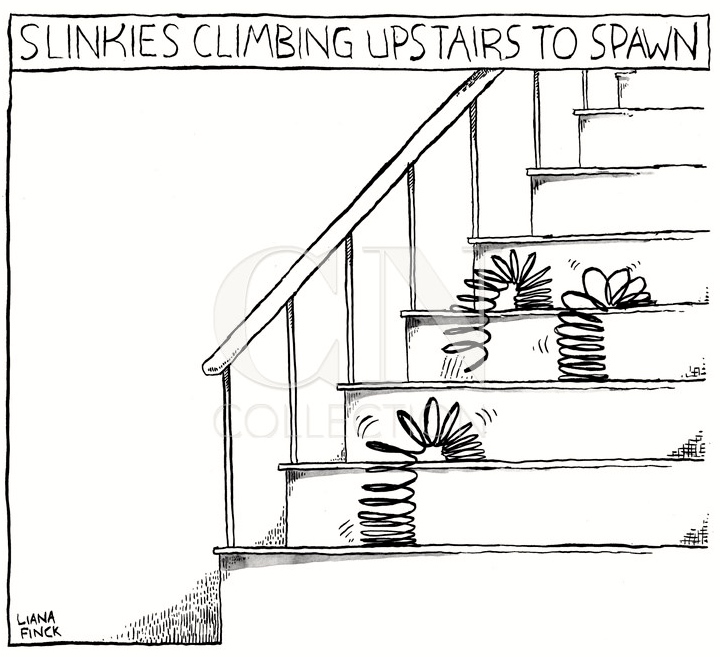
Finale. Finck’s quirky sense of humor on display in a NYer cartoon from 2/25/13 exploiting the characteristics of the Slinky toy and the habits of the salmon:

(#6)

The LSA handbook ad caper

January 10, 2023

This is, again, supremely, a Mary, Queen of Scots Not Dead Yet posting, coming after several days of wildly painful and deeply unpleasant afflictions (I had some yogurt for breakfast, a few crackers with hummus for lunch, and will probably do the same for dinner tonight; I have hopes for better tomorrow); the details involve a stomach ulcer, body-wracking chills, industrial-strength narcolepsy, severe dyspnea on exertion, and flaming-sword osteoarthritis, all at once, and you really don’t want to hear about them. In the midst of all this, the LSA handbook ad caper.

It’s about this ad:

(more…)