Archive for the ‘Art/lit/music/film’ Category

More on writing and memory

October 15, 2010

Back in June, I wrote some here on “Memory and fictobiography”, including a section of quotes on memory and writing. An addition to this bank of quotes, from an “Up Front” column (New York Times Book Review of September 12) interviewing novelist and memoirist Dani Shapiro:

Readers [Shapiro says] … “often think that writing a memoir must be cathartic, But, if anything, I found [in writing the memoir Slow Motion] that it embeds the story more deeply in the writer. The story becomes frozen, in a way, by the crafting of it. Memory is mutable, and the relationship between writer and the story at the particular moment the story is written becomes the story.”

The story becomes frozen by the crafting of it. So in writing pieces of Reflections on a Sexual Life (which I’m beginning to think of as a set of episodes, fictobiographical short stories, rather than as a sustained novel-like narrative), I found that the act of writing fixed my memories: the way I fashioned the stories became my memory for the events and feelings of the past, even when I understood that I was shaping the telling for artistic purposes. Increasingly, I could no longer access alternative, more “immediate”, recollections.

Unsurprisingly, this freezing effect held for stories told at considerable remove from the real-world events they purport to describe (like the first three gay-baths stories linked to here). But it happened even when my first drafts came very soon after those events, as for the last two gay-baths tales. And then as I rewrote, edited, and polished, I was not so much recovering more details from the past as improving and elaborating the material using details that came from god knows where (memories of different events, stories I’d been told, things I’d read or seen in movies, dreams, fantasies, sheer invention).

It’s like a family story that improves over time, eventually to settle into a canonical version that displaces all the earlier versions — and, very often, gets retold virtually verbatim after that. (Sometimes people can’t even recall whose story it was in the first place; it’s become everybody’s story to tell.)


Kol Nidre

September 18, 2010

It’s Yom Kippur, the Day of Atonement, and the evening service is preceded by Kol Nidre(i), the renunciation of vows. Only a few days ago did I discover (through NPR) that there’s a rich vein of versions of the Kol Nidre chant, including one by Johnny Mathis.

Of course, as a collector of unusual musical juxtapositions — I especially prize the Marlene Dietrich German sleigh-ride version (“Schlittenfahrt”) of “Surrey with a Fringe on Top”, and only this morning was introduced, via Facebook friends, to the Cleverlys’ bluegrass rendition of the Bangles’ old hit “Walk Like an Egyptian” — I had to check these things out.

So now I have a Kol Nidre sung by a legendary cantor, Manfred Lewandowsky, plus a version sung by cantor Theodore Katchko with his cantor daughter Deborah Katchko-Gray; a whole Kol Nidre service sung by cantor Richard Tucker (I think this is the version, powerful and intense, I remember from my childhood, heard on the radio); the moving Johnny Mathis version (with orchestral accompaniment); a klezmer version (I could have predicted that — but not the version on Johnny Mathis’s Good Night, Dear Lord album); a respectful and passionate, but (to my mind) deeply misguided surf-guitar version on the Chosen Surfers’ album Meshugga Beach Party (I swear on this holy day that I am not making this up); and of course the Electric Prunes’ celebrated English-language rock version (also intended to be respectful, but tending to the theatrically unhinged) on their Release of An Oath album.

And how, you ask, does Gracenote categorize these pieces? Cantor Lewandowsky’s chanting is Classical, and so of course is Richard Tucker’s (the man was, after all, a celebrated opera singer in his alternative career). Johnny Mathis’s version is Pop, since he’s a pop singer. The Chosen Surfers count as Rock.

And that brings us to the Elie Rosenblatt and Pete Rushefsky klezmer version and the Klatchkos’ version. At some point someone decided that these had to be recognized as pieces of religious music, and, alas, put them into the Christian & Gospel genre. Maybe Religious & Gospel wasn’t available at the time (it certainly is now), but Christian & Gospel is a singularly inept piece of categorization; we can only hope that the people who chose this classification didn’t think that Christian meant ‘religious’, and I suppose we can be a tiny bit thankful that Lewandowsky and Tucker didn’t get swept under the cross of Christ as well.

The 4:33 project

September 8, 2010

From Ned Deily’s Facebook page:

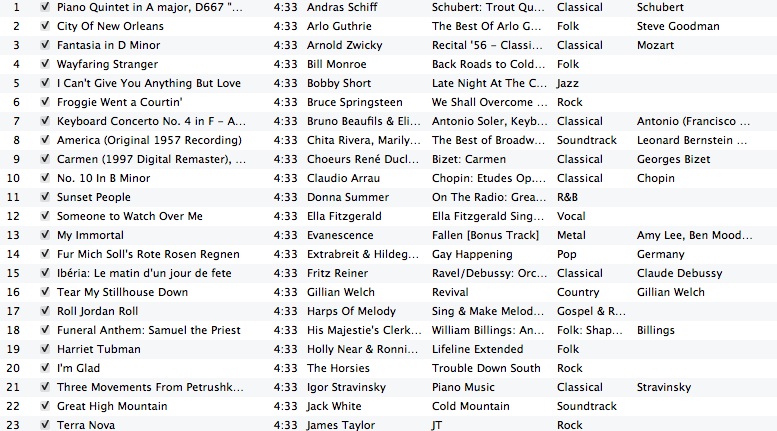
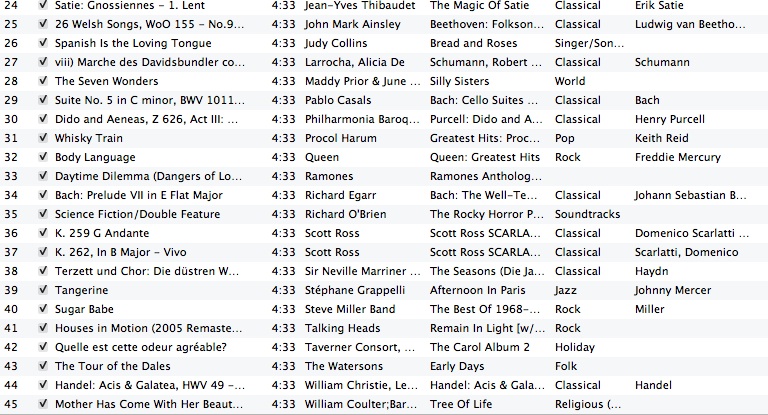
Alex Ross [“The Rest Is Noise: 4’33” playlist (Rabbit Fur Coat Berceuse)”, here] passes along a suggestion to celebrate John Cage’s birth by making a 4’33” playlist from one’s music collection. His has 23 items. I find 46 in mine. We have 3 tracks in common: the Donovan, the Elgar cello concerto movement, and the Verdi “Otello” excerpt – all from classic recordings.

I have 45 in mine, seen here in two screen shots, part 1 and part 2 (click on each image to embiggen it):

I haven’t yet played them as a set, though it looks like I have an entertaining 3.4 hours in store for me.

(Mostly I’m posting this as a test of my new-found ability to create these screen shots, so I can now post the iTunes playlists I talk about on occasion.)

Search for Cee

August 31, 2010

Unsure of how the song title was entered in my  iTunes — “Fuck You”, “F**k You”, or “Forget You” (the answer turns out to be “Fuck You [Explicit]”) — I searched for it under the artist’s name, and got only as far as the “Cee” of “Cee Lo Green” when five items popped up:

The Continental
Fuck You
The King shall rejoice
Les Contes D’Hoffmann
Pretty Please (Love Me)

What a wonderful melange! I will explain. But you might find it entertaining to try to figure out where “Cee” comes in (other than for my target song “Fuck You”). Remember that these searches are case- and diacritic-insensitive.

(more…)

More Zippy names (and things)

August 26, 2010

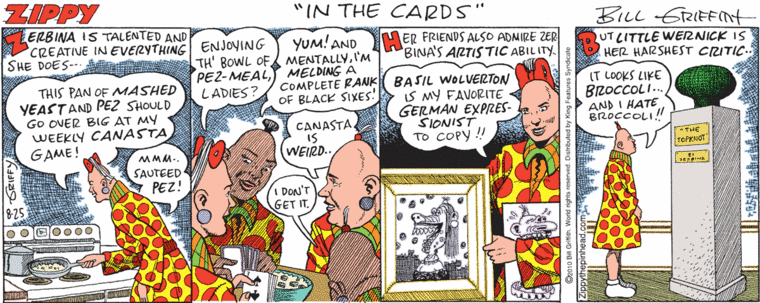
Zerbina takes up art, as well as Pez cuisine — to little Wernick (I say it’s broccoli and I say the hell with it)’s disgust:

Bill Griffith is famous in these parts for his fascination with words, especially names, and for re-using existing names rather than make up new ones from scratch. This time it’s Basil Wolverton, who was not in fact a German expressionist, though he was an artist, a comic book writer and artist, known for his grotesque images of people:

Despite the man’s very British-sounding name (which no doubt tickled Griffith), he was solidly American. But, oh, that wonderful name!

I’m guessing that Zerbina’s sculpture (or Chia Pet construction?) of a Pinhead topknot is entirely Griffith’s invention. But, knowing Griffith’s inclination to use real art objects as well as real names in his strips, it’s also possible that Topknot has some artistic reality (which I have yet to discover) outside of the Dingburgish lands.

Writing like a fag

August 24, 2010

… or, more genteelly, using a distinctly gay male writing style. Or more allusively, writing with a lavender quill.

This has come up in passing in my mention of “embeddedness”, in a thicket of parentheses here, and I’m going to return to the topic soon in a piece on Jeremy Denk’s blogging style, so here’s some background: a section from my 1997 article “Two lavender issues for linguists”, in Kira Hall & Anna Livia (eds.), Queerly Phrased (Oxford Univ. Press), 21-34.

From p. 28:

Discourse and pragmatics.

Let me briefly traverse the middle ground between grammar and rhetoric.  Staying close to home, I inventory some of the discourse-organizing and pragmatic strategies that have been suggested (in one place or another in the literature or by colleagues) as characteristic of gay male talk and writing:

  • subjective stance;
  • irony, sarcasm (distancing, saying and not saying, “not taking seriously”);
  • resistance, subversiveness;
  • double/triple/etc. vision, metacommentary;
  • embeddedness, discursiveness;
  • open aggression;
  • seductiveness;
  • reversal, inversion.

Some of these are stereotypically “feminine” (subjective stance, resistance and subversiveness, seductiveness), some stereotypically “masculine” (distancing, open aggression).  Some–resistance and subversiveness, multiple vision, reversal–are associated with powerlessness and marginality.  Some–resistance and subversiveness–hint at hidden or stigmatized identities.5 Many are simply the common coin of postmodern discourse–most of the characteristics in the list above are to be found in the writing of Donald Barthelme, for instance, as well as in the writing of Robert Glück–and are scarcely to be directly connected to gender, sexuality, marginality, or stigma. [for those of you who don’t keep track of these things: Barthelme straight, Glück gay gay gay]

Again, there is much of interest here, and linguistics can certainly provide indispensable conceptual tools for analysis, but as in poetics (Zwicky 1986) the methods that linguists use in their ordinary practice will not provide an analysis of the phenomena.  Subjectivity, reversal, multiple vision, etc. are realized (in part) in speech and writing, but they are not themselves properties of speech or writing, in the way that having only front vowels and being an instance of the agentless passive construction and containing a cataphoric pronoun and presupposing the truth of some proposition are.

Footnote 5 is on p. 32:

Here is a typical observation, by Morris Dickstein, writing in a New York Times Book Review (23 July 1995, p. 6) review of Edmund White’s Skinned Alive:  “Before the 1970’s , when direct professions of homosexuality were taboo, writers from Oscar Wilde to Cocteau to Genet made their mark with works that were often theatrical, oblique, florid and artificial.  The strategies of concealment many gay people used in their lives were turned into richly layered artistic strategies by gifted writers, choreographers, directors and set designers.  For the writers, wit and paradox became more important than sincerity, since sincerity meant self-acceptance (which could be difficult) and self-exposure (which could be dangerous); style, baroque fantasy and sensuous detail were disguises that suited them far better than verisimilitude or realism.”

Zwicky (1986) is my 1986 article “Linguistics and the study of folk poetry”, in Peter Bjarkman & Victor Raskin (eds.),  The Real-World Linguist: Linguistic Applications in the 1980s, Ablex, 57-73. Not yet available on-line, alas.

[But that was last week, and now (9/2) it’s on my Stanford website, here.]

The Library Train to Sauk Centre

August 19, 2010

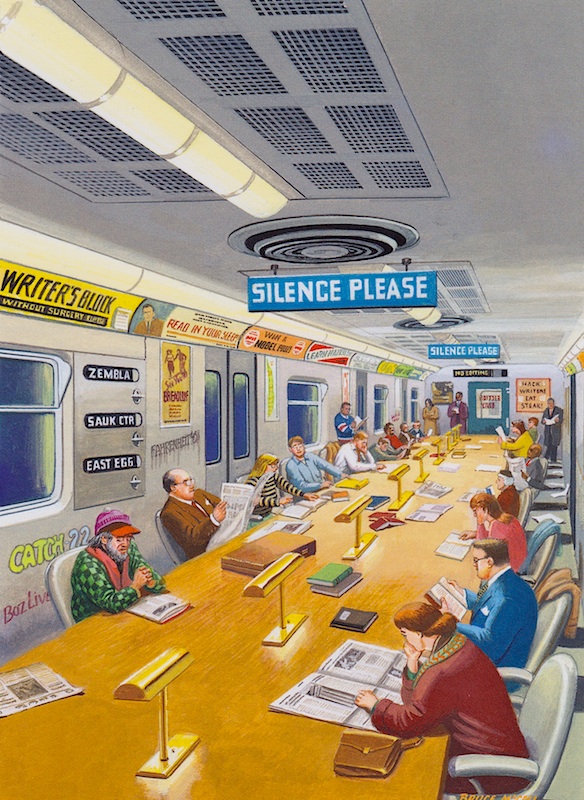
Bruce McCall’s fantasy train:

This bears a family resemblance to the Reading Room of the New York Public Library, but with different lamps and with various amendments. And without the computer connections.

The illustration is entitled:

Silence (Screech, Ka-Bang, Yudda-Yudda-Yudda), Please

[Added 8/23/10: Note that Sauk Centre is the name of the real Minnesota town that corresponds to the fictional Gopher Prairie of Sinclair Lewis’s Main Street. It’s left as an exercise to the reader to identify the other two destinations.]

Grownup performances for children

August 3, 2010

[Not about language. But not about gay life or Gayland, either.]

Following up on the splendid response my grand-daughter Opal had to a performance of the Mikado (see here), her mother and I have been surveying other possibilities in the line of grownup performances (including movies) that might appeal to her.

(more…)

The Gasoline Prize

July 29, 2010

A little while back, I offered a modest prize — a copy of Gregory Corso’s Gasoline (1958), which has marrying the pig’s daughter in it — to the first person to identify the composer of a piece of Mystery Music.

It wouldn’t have been a lot of help if I’d told you that the name of the piece was “Spanish Dance #2”. On Facebook, Michael Palmer admitted that he’d listened to the recording but hadn’t tried to guess the composer, since (he said droll-ly) his acquaintance with classical music pretty much ends with Gottschalk. I replied:

Most people would probably guess Albeniz (1860-1909) or Granados (1867-1916), which means you’re excused, since Gottschalk’s dates are 1829-1869.

In fact, very few people seem to have listened to Spanish Dance #2 (well, this blog doesn’t have all that many readers, and many of them aren’t musically inclined; this is, after all, a blog mostly about language, though recently I’ve been inclined to stray), and no one even took a shot. So the Gasoline Prize goes, for the moment, unclaimed. (more…)

Splitting up: the enjambment connection

July 28, 2010

Once again, it started with something that came up on a random iTunes playlist — this time, the song “My Home Town” from the Best of the Foremen album (comic songs) in which one of the Foremen sings

Mý hóme tówn
Is Chicágo, Íllinóis,
Which ónly góes to shów
Why Í’m a bróad [long pause] shouldered gúy.

(The accent marks indicate where accents fall in the performance. So this is four trimeter lines.)

The line division is mine, and could be wrong from the Foremen’s point of view, but what’s important here is that pause, which splits a (compound) word, broad-shouldered, into two parts, leading to a temporary potential ambiguity in which “I’m a broad” will be parsed, garden-path style, as a clause on its own — a comic result, since the singer is a guy, not a broad. The comic misparsing is then dissipated, to the listeners’ relief, by the continuation of the word.

This phenomenon, which has (so far as I know) no widely used technical label, is reminiscent of a number of other phenomena. In one direction, it’s like enjambment in verse; in another direction, it’s like “broken rhyme” or (to my mind the better term) “split rhyme” in verse, and in turn that’s like various ways of splitting up words by interposing material between the parts.

This posting topic has grown over the past two weeks, thanks in part to some very helpful discussion on the American Dialect Society mailing list — grown to such an extent that the only way I can see to get on with it is to chop it into pieces. Today’s piece is about what I’ll call As/tor Bars, after another example.

(more…)