Archive for the ‘Art/lit/music/film’ Category

Spem in alium

December 20, 2010

A few days ago, my iTunes brought me Thomas Tallis’s magificent motet Spem in alium (ca. 1570), as performed by the Choir of King’s College, Cambridge — causing me to stop what I was doing and just listen to this extraordinary 40-part masterpiece (eight choirs of five singers each) for 11 minutes. I’ve never experienced a live performance of it, much less a performance with the singers arrayed in a horseshoe around the listeners. (Understandably, it’s not often performed, because of the extraordinary demands it makes on the singers.)

I bring it up here because of the name Spem in alium — the first three words of the Latin text, which begins

Spem in alium nunquam habui praeter in te ‘I have never put (my) hope in any other but in You, I have never had hope in another beyond/besides/except in You’

That is, spem in alium ‘hope in another’. Without the context you can’t tell that this phrase is not in fact a constituent in Latin; it’s not spem in alium ‘hope in another’ functioning as a NP, but rather the sequence of the NP spem ‘hope (acc.)’ and the PP in alium ‘in another’, both functioning as complements of the perfect verb habui ‘I have had’. So it’s a part of a VP constituent but not a constituent on its own.

A while ago, Geoff Pullum collected examples of non-constituent book titles, for example Andrew Holleran’s Dancer From the Dance (like Spem in alium, a non-constituent of the form NP + PP); see Language Log postings here and here. He observed that such titles seem to be pretty rare in English. I’d imagine that the practice of referring to Latin texts by their first few words will yield many more Latin examples, especially given the famously free word order of Latin.

 

Blessed Assurance

December 14, 2010

Yesterday it was “Jesus, the Light of the world”. Today it’s another wonderful hymn that might be a good candidate for harmonization as a shapenote song: “Blessed assurance” (also known as simply Assurance).

(more…)

Jesus, the Light of the World

December 13, 2010

Yesterday a small but enthusiastic group of Sacred Harp singers (one bass, two tenors, two altos, and two trebles) got together for what was essentially our holiday singing: music from the 1991 Sacred Harp appropriate for Advent, Christmas, the Winter Solstice, and New Year’s. (Some information on shapenote singing here and here.) Afterwards we had a nice dinner together and talked of many things, some of then shapenote-related.

We had sung one version of “Hark! The herald angels sing”, a tune named Cookham (81b), which is quite different from the well-known Christmas carol tune (called Mendelssohn, after its composer). The bass [correction: it seems it was one of the tenors] then wondered about yet another song, a gospel tune that begins with the words “Hark! the herald angels sing”, but then continues with “Jesus, the Light of the world”, all to still another tune, which would sound great harmonized in Sacred Harp style, but apparently never has been.

(more…)

Today’s homoerotic pop art

December 11, 2010

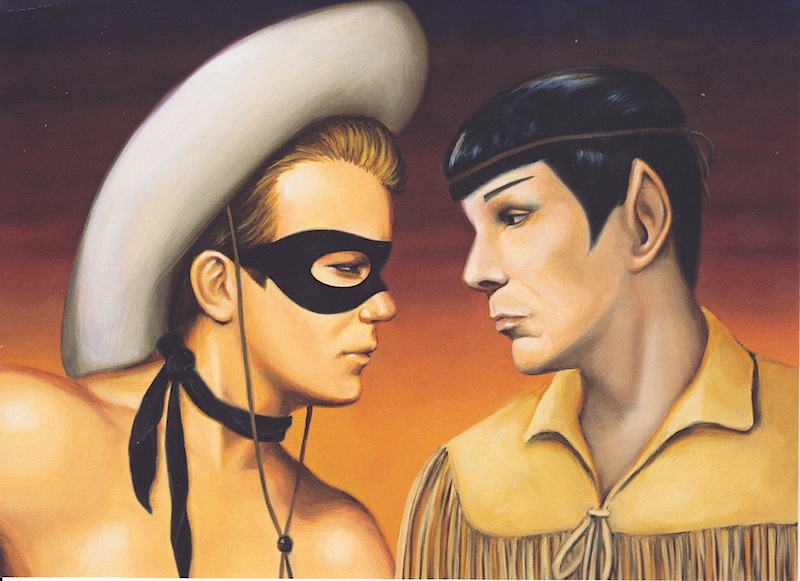
… from “lowbrow artist” Isabel Samaras‘s On Tender Hooks, a 2003 oil on wood painting “Besame Mucho”:

(Thanks to Elizabeth Daingerfield Zwicky.)

The painting is a play on the genre of slash fiction, “a genre of fan fiction that focuses on the depiction of romantic or sexual relationships between fictional characters of the same sex” (Wikipedia) — in this case a fusion of Kirk/Spock and Lone Ranger/Tonto.

Samaras’s work is loaded with references to and images from pop culture (especially television), usually combined with similar allusions to high art and popular Catholic iconography. Pee Wee Herman as Saint Sebatstian, for example. Frankenstein appears in a lot of the pieces.


More captioning as art

December 8, 2010

From Mary Ballard, a link to Dante Shepherd’s webcomic Surviving the World (“Daily Lessons in Science, Literature, Love, and Life”). Here’s Lesson 29, “Civil Unions”, from 2008:

Yet another example of a webcomic by an artist who cannot draw but can caption (and take photographs).

We might also think about the work that technically is doing in this lesson.


Captioning: more is it art?

December 6, 2010

In my last posting, I talked about Ryan North’s Dinosaur Comics, in which captioning of a piece of clip-art takes the place of drawing fresh images. I noted that I myself have used simple captioning of found images and created collages that were only a bit more complex than simple captioning. Most of these are meant to be wry or flat-out funny.

In the same vein are the Blunt Cards I posted about here and here. These appear to be images from old ads, captioned to make humorous note cards. There are many lines of these things, ranging from simple captioning to complex captioned collages. In any case, the wording of these creations is central to their effect; for Dinosaur Comics, the words are all there is, the fixed images serving entirely as a constraint on how the words can be deployed.

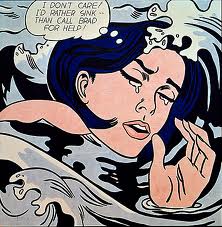
At the other end of the scale are things like Roy Lichtenstein‘s Pop Art paintings, many of which are captioned (though many are not), for instance this one:

Many of these Lichtenstein images have appeared on notecards, postcards, t-shirts, and the like, and still other cards etc. have been created in the style of Lichtenstein’s paintings.


But is it art?

December 5, 2010

Is it, in fact, even a cartoon?

I’m talking about Ryan North‘s webcomic Dinosaur Comics, on the occasion of the appearance of his second collection of strips — Dinosaur Comics: Dudes already know about chickens (TopatoCo Books, 2010) — with all the strips from 2006. [Previous book of strips: The best of Dinosaur Comics 2003-2005 A.D.: Your whole family is made out of meat (Quack!Media, 2006). An explanation for the title of the 2010 book is on North’s Wikipedia page.]

(more…)

Magic Flute libretto

November 30, 2010

Just arrived: big book (2011 copyright) of Seven Mozart Librettos, verse translations by J.D. McClatchy: Idomeneo, Abduction, Figaro, Don Giovanni, Così, Clemenza di Tito, Magic Flute. In facing pages, with the originals on the left, McClatchy’s translations on the right.

[Total digression: a few years ago, when I went back to West Lawn PA to get a distinguished alum award from my high school (incredibly gratifying), one of my hosts at the school was a woman who knew McClatchy, and talked knowledgeably and affectionately about him. She was, however, a bit surprised that McClatchy and I didn’t know one another; I suppose she thought (as my man Jacques did, all his life) that I would of course be acquainted with other gay intellectuals. (Well, Jacques at least had some reason for his belief: every so often, somebody he knew only by their reputation or their writing would turn up for dinner at our house.)]

I mention the translation of Zauberflöte because it’s the one Julie Taymor used for her fabulous Metropolitan Opera production of the opera, which I’ve posted about here.

McClatchy really gets the serious silliness / playful seriousness of Papageno (who to my mind is the central figure of the opera, no matter what anyone else says — and my grand-daughter agrees with me). Here’s Papageno in scene 29 of act 2 (close to the end of the opera), playing his panpipe:

Papagena, Papagena, Papagena!
Sweetheart! Dearest! My beloved!
Useless! She is lost forever!
I was never meant to have her.
By chattering I missed my chance.
Here’s the end to my romance.
Ever since I sipped that wine
And saw the girl that should be mine,
The fire in my heart’s severe.
It warms me there, and scorches here!
Papagena! My dove! My darling!
Papagena! My pretty starling!
She doesn’t know the way to find me.
It’s time to leave the world behind me.
Since my love was all in vain,
It’s time to end a life of pain.

He prepares to hang himself, but thinks to use his panpipes and summon the Three Boys, who tell him to use the bells and call his mate Papagena. Bliss ensues.

Fabulous renderings of the libretti into English.

o m g

November 4, 2010

Below the fold, in case people are still looking at this blog in places where others might oversee the screen, an astounding erotic (but technically entirely decorous) photo by David Vance. It’s two guys kissing, but that description scarcely does justice to the picture.

(more…)

Objects of desire

October 28, 2010

Obituary (by William Grimes)  in the NYT of 26 October for “Sylvia Sleigh, 94, Portraitist and Feminist”, characterizing Sleigh as

a British-born artist who put a feminist spin on the portrait genre by painting male nudes in poses that recalled the female subjects of Ingres, Velázquez and Titian …

“I wanted to give my perspective, portraying both sexes with dignity and humanism,” she once said. “It was very necessary to do this because women had often been painted as objects of desire in humiliating poses. I don’t mind the ‘desire’ part, it’s the ‘object’ that’s not very nice.”

Lots of Google images of the paintings, and also wonderful photographs of Sleigh.