Archive for the ‘Art/lit/music/film’ Category

Cultural contamination

February 11, 2011

(Not about language, but culture.)

On KQED’s Forum, hosted by Michael Krasny, on Wednesday: “Anthony Tommasini’s Top 10”, an engaging interview with the New York Times music critic about his personal ranking of the top 10 classical music composers in history (Bach came in first, with Beethoven narrowly edging out Mozart in the next two slots). Then came the callers with their comments — among them a woman who went on at some length about the “Ode to Joy” from Beethoven’s Ninth as an intensely moving masterwork.

But then she added that after she read that the “Ode to Joy” was Hitler’s favorite piece of music, the work lost all of its attraction for her.

It had become contaminated by the association with Hitler.

(more…)

Saturday afternoon sickroom movies

February 5, 2011

Saturday mornings I usually have breakfast with my daughter Elizabeth and her daughter Opal and (when she’s in the country) my Stanford colleague Elizabeth Traugott. Last Saturday Elizabeth and Opal backed out because they were suffering miserably with a cold/bronchitis, so Elizabeth Traugott and I chatted about things like if only and no doubt (which I hope to post about soon).

But Elizabeth then decided that she and Opal would like to get out of the house in the afternoon, so they came by to my place to watch movies suitable for the sickroom. I was hacking some myself, Elizabeth was hacking more, and Opal was barking like a seal. But we settled on two movies.

(more…)

J. C. Leyendecker

January 22, 2011

Continuing the theme of standards of male beauty in advertising, I turn now to the American artist J. C. Leyendecker (hat tip to Arne Adolfsen on Facebook). Before the Marlboro Man, before the underwear gods, Leyendecker depicted many different styles of masculinity. From the Wikipedia entry (as it was this morning):

Joseph Christian Leyendecker (March 23, 1874 – July 25, 1951) was one of the pre-eminent American illustrators of the early 20th century. He is best known for his poster, book, and advertising illustrations, the trade character known as The Arrow Collar Man, and his numerous covers for the Saturday Evening Post. Between 1896 and 1950, Leyendecker painted more than 400 magazine covers. During ‘The Golden Age of American Illustration’, for the Saturday Evening Post alone, J. C. Leyendecker produced 322 covers, as well as many advertisement illustrations for its interior pages.

… Many biographers have speculated on J. C. Leyendecker’s sexuality, often attributing the apparent homoerotic aesthetic of his work to a homosexual identity. Without question, Leyendecker excelled at depicting male homosocial spaces (locker rooms, clubhouses, tailoring shops) and extraordinarily handsome young men in curious poses or exchanging inexplicable glances. Moreover, Leyendecker never married and lived with another man, Charles Beach, for much of his adult life, who is assumed to have been his lover and the original model of the Arrow Collar Man.

Here’s an Arrow Shirt ad, with a “dandy” image:

And then the “classical” beauty of the male nude:

Then two images of rugged shirtless masculinity, complete with phallic symbols:

Finally, a Leyendecker with homoerotic overtones, repurposed in an explicitly gay context:


A famous pinhead

January 7, 2011

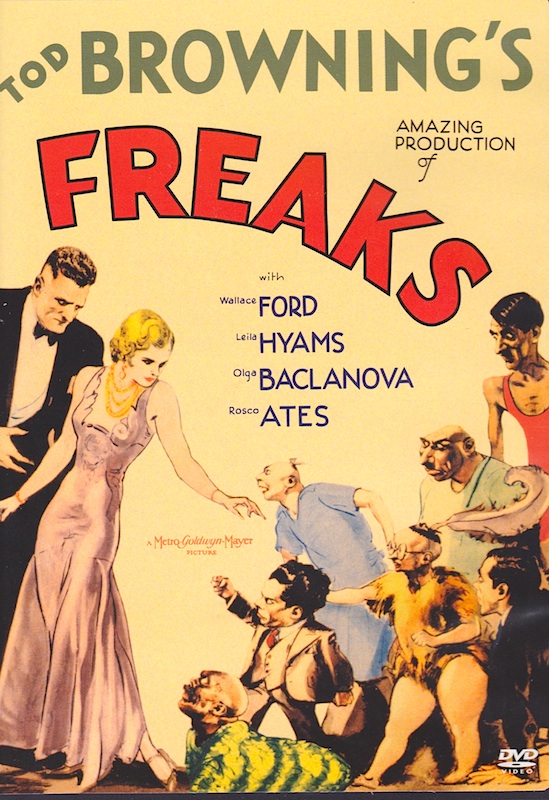
Recently arrived: a dvd of Tod Browning’s Freaks (1932), now a cult horror classic (which I’d previously seen on tv as a late-night movie). Cover art:
From the Wikipedia page on the movie:

Director Browning took the exceptional step of casting real people with deformities as the eponymous sideshow “freaks,” rather than using costumes and makeup.

… In the film, the physically deformed “freaks” are inherently trusting and honorable people, while the real monsters are two of the “normal” members of the circus who conspire to murder one of the performers to obtain his large inheritance.

And the freaks exact their revenge.

Among the freaks is a microcephalic called Schlitzie, in the center in the cover art, and in a photo here:

Schlitzie was possibly born Simon Metz, in the 1890s or early 1900s, and died (then under the name Schlitzie Surtees) in 1971. His parents hid him from the world in shame until they could sell him to a traveling sideshow, and he spent most of his life in sideshows, circuses, funhouses, and carnivals, exhibited in a muumuu and presented as a female (or left androgynous), and billed variously as a Pinhead, The Missing Link, the Last of the Aztecs, the Monkey Girl, or What Is It? In Freaks, Schlitzie and two other microcephalics are referred to as pinheads. (The connection to Zippy the Pinhead is pretty clear.)

Schlitzie’s complex life story is summarized in his Wikipedia entry. Child-like and affectionate (sometimes described as a charming three-year-old), he found a home for himself in the circus.


Crossbreed

December 30, 2010

In Harper’s Magazine for January 2011 (p. 17)

a September 2010 open letter to French president Nicolas Sarkozy by the Committee for the Defense of Versailles concerning an exhibition of work by the Japanese artist Takashi Murakami at the palace last fall.

signed by Pierre Charie-Marsaines, Honorary President, and Arnauld-Aaron Upinsky, President. A piece of hysterical outrage,

(more…)

Ari in gold

December 25, 2010

In the mail yesterday from Max Vasilatos, a postcard version of this portrait of singer and songwriter Ari Gold by Joe Phillips:

Gold has been openly gay from the beginning of his career, often weaving themes about relationships and sex between gay men into his music (usually in various “black” styles). He’s also enormously sexy and enjoys displaying his body. In the work above, Phillips has chosen to depict Gold, in gold (a little visual pun), doing a Pits ‘n’ Tits display, one type of sexualized presentation of the male body in the mass media and in male photography (some links here).

Phillips does mainstream comic art and also depictions (often comic and sometimes over the top) of gay male life, featuring enthusiastically sexy young men. Max has been sending me postcard versions of his stuff for some time now.

Happy/Merry Christmas

December 25, 2010

The seasonal discussion of Happy Christmas vs. Merry Christmas has sprung up again on the American Dialect Society mailing list. The facts, in brief, are that Merry Christmas is now the standard greeting in the U.S. and is far from unknown in the U.K., though Happy Christmas has some history in the U.S. (in “A Visit from St. Nicholas” — “‘Twas the night before Christmas” — the jolly old elf wishes “Happy Christmas to all, and to all a good night”) and seems still to predominate in the U.K.

David Daniel has now offered this link to an enormously affecting performance, by John Lennon and the Plastic Ono Band with the Harlem Community Choir, of “Happy Christmas (War is Over)“, in which Lennon sings “happy” — and the billboards have “happy” on them, as here:

John Lennon’s 70th birthday went by back in October (on the 9th) — he was just a bit younger than I am — and then his 30th deathday came up earlier this month (on the 8th), a moment of great sorrow for me. Back in 2003, while my man was dying, I wrote a poem (included in a posting here) on Yoko Ono’s 70th birthday that was in fact an act of mourning for John (“You damned / Earnest angry / Boy who / Sang for me”), a man who finally found delight and a kind of peace in his partnership with Yoko (they looked ridiculously happy together) and in caring for their son Sean, but then was murdered at the age of 40.

Death is with us. And war is very much not over. Here we weep.

But in an hour my little family will appear, we will exchange a very few presents (mostly for my grand-daughter), and then have our now-customary Christmas meal, dim sum lunch at a local Hong Kong restaurant, enjoying a happy Chinese-Jewish moment.

Christmas stories and music

December 24, 2010

Continuing the Christmas theme, a recollection of the Christmas recordings of my childhood: just two, both on 78s. There’s the sentimental celebration of secular Christmas, Dickens’s A Christmas Carol, in a recording with Lionel Barrymore playing Ebenezer Scrooge. And a sentimental celebration of the religious holiday, Charles Tazewell’s The Littlest Angel, in a version read by Loretta Young. Both originally from radio performances.

On the music front, I have a ton of Christmas music on my iTunes (a surprising amount for someone whose celebrations of the holiday have been minimal for some years):

folk, shapenote, and early American music: the Chieftains, the McGarrigle Family, the Columbus Consort, the Boston Camerata (2 albums)

choral settings of (mostly) carols: Andrew Parrott/Taverner Consort (2 albums), the King’s Singers

varied traditions: Anonymous 4 (3 albums), Chanticleer (4 albums)

hard to classify: Inner Voices, the Roches, Patty Loveless

impossible to classify: Brave Combo’s “It’s Christmas, Man!” (polka, samba, cha cha, and more)


On the culture beat

December 22, 2010

Two recent items, starting with one that arrived in the mail along with Stephen Sondheim’s Finishing the Hat: a DVD of  the 1966 ABC Stage 67 production of Evening Primrose, a tv musical, a tragic love story, with music and lyrics by Sondheim (starring Anthony Perkins, Charmian Carr, Larry Gates, and Dorothy Stickney).

So this is now added to the Sondheim material on my iTunes: Company, Follies, Gypsy, A Little Night Music, Sweeney Todd, West Side Story (some in several versions), plus Barbara Cook Sings Mostly Sondheim and the cast recording of Sondheim on Sondheim. Fabulous stuff, all with a dark side and amazing lyrics.

And then, in the book department, a gift from two friends, a copy (signed by the author) of David Chu’s new Frozen Music: A Literary Exploration of California Architecture — a fascinating collection of writing on the subject from the beginnings (George Vancouver’s Early Days) through recent times. Including a selection from Helen Hunt Jackson’s 1884 novel Ramona (special to me since I live on Ramona St. in Palo Alto, one of the many literarily named city streets; the immediately parallel streets are Emerson on one side, Bryant on the other).


Mondegreens

December 22, 2010

From Stephen Sondheim’s fabulous new book Finishing the Hat (“Collected Lyrics (1954-1981) with Attendant Comments, Principles, Heresies, Grudges, Whines and Anecdotes”), p. 202, a comment on the song “Beautiful Girls” from Follies:

A crtic named Arlene Croce, in her enraged review of Follies, called this lyric “disgusting” in its comparison of middle-aged ladies to beasts, as evidenced by “Beauty celestial / The bestial agree.” [The actual lines go “Beauty celestial / The best you’ll / Agree.”] This kind of aural confusion crops up more often than you might think. When an eight-year-old Linda Rodgers, Richard’s younger daughter, attended Annie Get Your Gun and was asked what she thought of it by her father, a producer of the show, she told her father that she loved “the hurricane song.” The show being hurricaneless, Rodgers asked her which song she was referring to. “Mighty Fences Are Down,” she replied. (The title, for those who don’t know the score, is “My Defenses Are Down.”) I myself had a similar experience when I saw Carousel for the first time, I was startled at the daring openness of hearing Nellie, the hearty café owner, celebrating Julie Jordan’s pregnancy with “Julie’s Busting Out All Over.” (The soprano playing the part was operetta-trained and pronounced “June is” as “June ease.”) These were certainly confusions that neither Berlin nor Hammerstein could foresee, just as “bestial” was one that never occurred to me, but Linda had the excuse of being only eight years old, and in the case of “June is Bustin’ Out All Over,” my confusion at least made sense. Ms. Croce’s confusion makes no sense at all–if the ladies are “bestial,” what are they agreeing on? Nevertheless, whether it can be attributed to willful bitchery or natural stupidity on her part, her tirade encouraged me to be careful about aural ambiguities.

[I had to quote the whole thing to get in “willful bitchery or natural stupidity”.]

Mondegreens came up in a serious way on this blog most recently in “The ants are my friends”, here. Before you write in with your favorites, let me remind you that there are many published and on-line collections of the things, and of course a Wikipedia entry. Mondegreen is in OED3 (2002), with nice quotes from Bill Safire and Steve Pinker.