Some playful conceptual art by David Byrne (yes, the multifaceted Byrne of Talking Heads): “Hutcheston’s Moral Senses” (2004), in McSweeney’s:
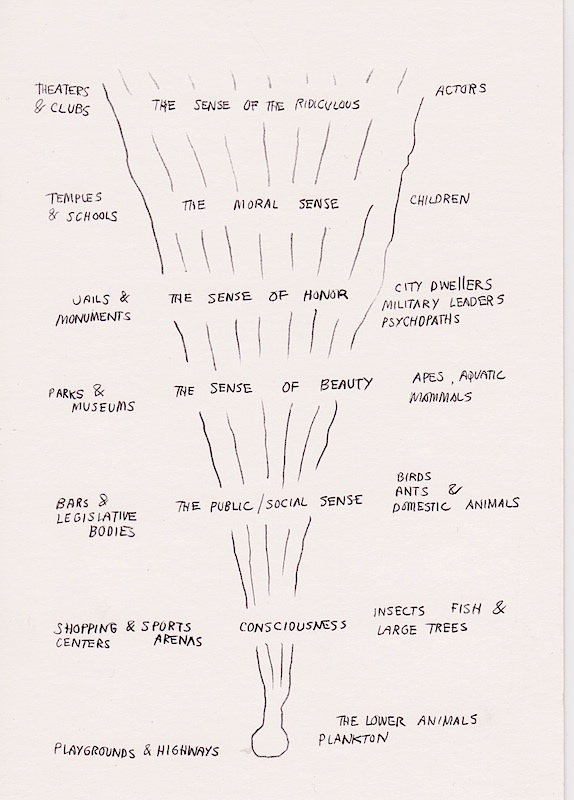
No, I don’t have an interpretation.
Some playful conceptual art by David Byrne (yes, the multifaceted Byrne of Talking Heads): “Hutcheston’s Moral Senses” (2004), in McSweeney’s:
No, I don’t have an interpretation.
Over on Facebook, Tané Tachyon has posted this engaging graphic for San Francisco Queer Contra Dance (here):

This is a Swiss Army knife with three sex/gender symbols added to the typical tools in such a knife: male/masculine (upper left), female/feminine (bottom), and a composite of the two (upper right).
Over on ADS-L, Neil Crawford asked about “to wear the ruby slippers”, as here:
“Love is just a chemical reaction designed to encourage propagation of the species,” James [who is gay] declares […].
“Really?” Callie says. If it’s all about propagation of the species, then how do you explain homosexuality, honey-love? Those of you who wear the ruby slippers?” (Cody McFayden, Abandoned)
Clearly a reference to homosexuality, via the ruby slippers, red slippers, ruby red slippers, or ruby red pumps Dorothy wore in The Wizard of Oz. Dorothy and her slippers have become icons of homosexuality. In fact, the newsgroup soc.motss (members of the same sex), now in an incarnation as a Facebook group, ran a fund drive about twenty years ago on behalf of the Lambda Legal and Defense Fund, under the name RRP (for Ruby Red Pumps), and now the pumps serve as the Facebook icon for the group. Here’s a somewhat different version of the icon:

Sometimes you just have to be fabulous.
In the NYT New York section today, a delightful story about public art and gender politics (“For Unloved Queens Statue, Brooklyn Cemetery May Be the Last Stop” by Jay Maeder), with some entertaining writing as a bonus.
Yesterday’s viewing: the 2010 movie Howl, an evocation of an era and a celebration of Allen Ginsberg, with stunning performances, notably by James Franco as Ginsberg. The film interleaves three stories: a dramatization of the 1957 U.S. trial of Lawrence Ferlinghetti (of City Lights Books) for publishing obscenity; the story of Ginsberg’s life up to that point (especially the episodes that are transformed in the poem); and an animation of the poem.
From Facebook friends Dennis Lewis and Jess Anderson, this poignant editorial cartoon by Mike Luckovich:

This not long after Jeff Shaumeyer provided a link to an appalling scapegoat story in the Central Telegraph (of Australia):
In the NYT recently (in my print edition yesterday, on line earlier), Holland Cotter’s review of a show by Luis Camnitzer:
The show, at El Museo del Barrio, is terse, almost to the vanishing point in places, as might be expected from one of the pioneers of 1960s Conceptualism. Much of what’s here is based on printed language: cryptic propositions, random lists of words and descriptive phrases — unmoored from, or very loosely tethered to, other spare-to-barely-there visual matter.
Another inventive euphemism (see discussion of these in my Jeezum crow posting), which came up in a re-reading of Nicholson Baker’s U and I (see here), twice — first in writing about an imagined dialogue with John Updike on the golf course, then in a comment about his own writing style:
[about Updike’s anti-bookchat rule on the course] “Yup, we’re going to pretend we’re two regular guys,” is how I interpreted [the rule]. Imagine having a rule of conversation. Jeezamarooni! If I were out there with Updike on the fairway right now, and he had laid down that rule, I would, between bogeys, be coming out with nervous snickering references to Richard Yates and Patrick Suskind and Julian Barnes, just to test his tolerance of me as a golf partner — just to see if he would make an exception for me. (pp. 52-3)
… the betrayal takes the form of smirks and smartass falsifications, such as when I spoke earlier of trying to “hustle” Updike on the golf course into thinking I was less perceptive than I was, or when I used faux-naif expletives like “Jeezamarooni!” or called myself a writer “on the make.” (pp. 108-9)
From e-mail from me to Nicholson Baker back in November:
… my John Updike story.
When I graduated from high school in 1958 (and was going on to Princeton), I went looking for a job, and tried the Reading Eagle newspaper (in Reading PA), since I’d been a hot high school newspaper kid. Turns out they had a copyboy position open and sent me around to interview for it.
I was interviewed by every fuckin senior editor, at some length. Then got the job, and quickly was shifted to being a reporter (a “floater”, as in Calvin Trillin’s comic novel of the same name). Eventually I asked one of the editors why everybody had interviewed me and was told that they’d passed me on from one to another because I struck them all as being so much like John Updike, who’d been their copyboy when he was an undergrad at Harvard.
So in a way John Updike got me my first job. (Updike grew up in Shillington, a couple of miles away from where I grew up, in West Lawn and Wyomissing.)
(Did write Updike about this, but of course he didn’t answer.)
Baker and I were exchanging mail (and talking on the phone) about which as a restrictive relativizer. So why was I telling him my John Updike story?
Because Baker is the author of the remarkable U and I, described back in November in Wikipedia this way:
• U and I: A True Story (1991) is a non-fiction study of how a reader engages with an author’s work: partly an appreciation of John Updike, and partly a kind of self-exploration. Rather than giving a traditional literary analysis, Baker begins the book by stating that he will read no more Updike than he already has up to that point. All of the Updike quotations used are presented as coming from memory alone, and many are inaccurate, with correct versions and Baker’s (later) commentary on the inaccuracy given in brackets.
From the publisher’s copy:
Baker has constructed a remarkable edifice that is at once a tribute to Updike and a disarmingly, often hilariously frank self-examination — a work that lays bare both the pettiest and the most exalted transactions between writers and their readers.
Yesterday, my iTunes, on random selection, brought me variation 25 of Brahms’s Variations and Fugue on a Theme by Handel, as performed by Emanuel Ax: 35 seconds of what I think of as unhinged joy (I have several playlists of music of joy, with this Brahms variation in the first). It made my morning; I went back and played the whole Brahms set, in two versions (by Ax and by András Schiff).
This was day 2 of my beginning to come out of two afflictions, a long-standing bronchitis that got quite nasty about ten days ago and banged up fingers (the two fingers that were already damaged), which were badly bruised but not broken (though they had to be velcro’d to each other to make typing possible).
Day 1, Saturday, had a lot of joy in it too, supplied by Gilbert & Sullivan.