Author Archive

A Swiss philological moment

October 20, 2024

Wayles Browne writes from Cornell:

you might spare a posting for Jacob Wackernagel, the Swiss philologist, who was the first to make sense of second-position clitics (https://langsci-press.org/catalog/book/270), born 11 December 1852; and for Jost Winteler, the other Swiss philologist and author of Die Kerenzer Mundart des Kantons Glarus in ihren Grundzügen dargestellt (1876), who may or may not have been a predecessor of phonemic theory, but who definitely was a mentor to young Albert Einstein after the latter moved to Switzerland. Winteler was born 21 November 1846.

This is that posting, First, I have added Wackernagel (12/11/1852) and Winteler (11/21/1846) to my e-calendar.

Then, from my reply to WB:

I used to be an authority on second-position clitics, even have a t-shirt that says PUT YOUR CLITICS IN SECOND POSITION.
As for Winteler, Canton Glarus is where the Zwickys come from — mostly from Mollis.
Meanwhile, I happen to be wearing my Swiss-flag gym shorts. Hail, Helvetica! and all that.

(more…)

“I have a ##”

October 20, 2024

So my caregiver León Hernández Alvarez said to me last Tuesday; ## represents a word I totally failed to recognize, at the most elemental level; I didn’t recognize any of the sounds in the word, though I thought it was probably of the form CV. L then came closer to me and said it again, more slowly: “I have a n#”. Ah, an initial n — a Spanish n (distinct from an English n), but clearly something in the [n] zone, and followed by a vowel.  On the third repetition, I was able to identify the vowel: u — a Spanish u (distinct from an English u), but clearly something in the [u] zone. Apparently, L was telling me that he had a [nu].

I recognized the word phonetically, but still totally failed to recognize the lexical item he was talking about. Surely he didn’t have a GNU. Is there such a thing as a NOO? Ah, finally it dawned on me: L was telling me he had a NEW. Hmm, a new what? And then, finally, the realization that he was telling me that he had a piece of news, that he had reconstructed a singular NEW ‘report of a recent event’ from the word NEWS ‘report of recent events’.  This is clever, but alas mistaken.

(more…)

Eugene Daniels

October 19, 2024

A panel discussion about the elections on MSNBC. Among the panelists, the regular contributor Eugene Daniels, the White House correspondent for Politico: amiable, funny, sharp, passionate — a smart, impressive black guy, with an Afro that’s clearly meant as a political statement but is, somehow, actually adorable. (He is, in appearance and demeanor and attitude, one of my “types” — though I’ve come to understand that that just means he resembles, physically and in his projection of himself, someone I once had a satisfying sexual and affectional encounter with; it’s a kind of imprinting, it’s entirely in my head and not my actions, there are no real-world consequences, but it gives me a moment of pleasure, like visiting an old friend.)

Over time I’ve listened to his reporting and opinions a lot — tv goes on while I work — and occasionally I’ve glanced at him while he was speaking, but for the first time I focused on him full-bore. Ten seconds in, I said to myself, “Wow, this guy is gay!”, and then realized I hadn’t the slightest clue why I thought this. I watched him for some time then, without catching anything I could identify as a tell. I still don’t know what I was reading, but it turns out that in addition to his other sterling qualities listed above, and in addition to his being literally a great team player (including on an NCAA Division I football team), a leader of groups, and a conspicuous role model for young black guys, he is also way gay, wonderfully, flamboyantly gay — a presentation achieved by his clothing and adornment (so it can easily be adjusted for the context; he moves through a lot of worlds).

(more…)

striking language

October 19, 2024

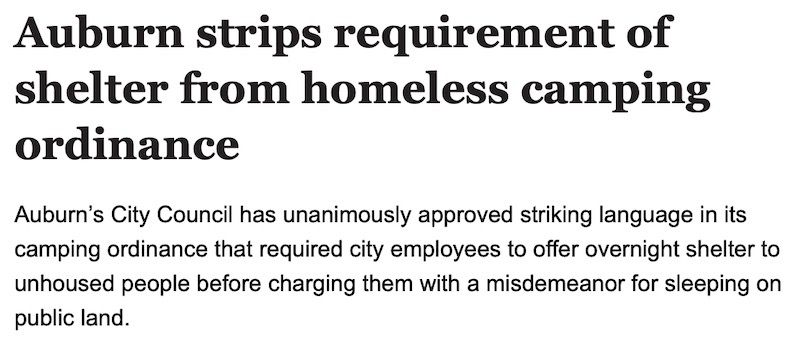
From Ellen Kaisse in e-mail to me on 10/4 (yes, the blog mill grinds very very slowly on Ramona St.): a nice ambiguity from the Seattle Times, in the first sentence of the story:
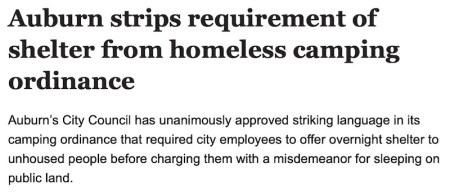

[what EK wrote, with some bracketed amendments by me:] I read striking as an adjective meaning ‘notable’ and modifying language rather than the intended reading where striking is [the nominalization of] a verb with language as its direct object [AZ: the nominalization (together with language and a very long relative clause modifying language) is itself the direct object of the verb approved]. It was only the headline that alerted me that my first reading was the opposite of what was actually approved.

Now if you ask an ordinary person what’s gong on with that sentence, they’ll tell you that it’s ambiguous, and they’ll provide some attempt at a paraphrase (as a sufficient account of the ambiguity), but they’ll simplify things somewhat by disregarding that long relative cause and, in effect, localizing the source of the ambiguity in the expression striking language, telling you that in the Auburn City Council sentence this expression means two different things, ‘notable language’ or ‘removing language’ (from something), and maybe they’ll go on to localize the source even further in the word striking, saying that striking in striking language can mean either ‘notable’ or ‘removing’ (from something).

Ask a linguist, like Ellen or me, and even our briefest answer will go immediately to localizing the ambiguity in specific words that are the crux of the matter. We’ll identify the lexical items involved and supply some relevant properties of the words — what syntactic category they belong to (EK refers explicitly to adjective (Adj) and verb (V) and implicitly to noun (N)); perhaps what derivational and inflectional categories they belong to (implicit in our references to nominalization). And then, especially, we’ll tell you something about the syntactic constructions in which the words are related to one another (we’ll refer to modifying / attributive adjectives, to verbs with direct objects, and so on). Our very brief comments are laden with allusions to the structure of English — its morphology and syntax — as well as to its lexicon.

The linguists’ view is that the lexicon, morphology, and syntax of the language work together in such a way that a stretch of phonological material can convey two different meanings; when we confront an ambiguous expression, we see it not as a brute fact (as if people somehow memorize how phonological substance and semantics are paired with one another, expression by expression), but as the consequence of the system of the language. Surprise! There are two ways you can end up with striking language, two ways the expression can be analyzed. (There are, in fact, more than two; but there are at least the two EK told us about.)

Now I’m going to wade hip-deep into the system of English involved in striking language (and some similar expressions). Not to tell you everything, but to tell you just enough to show you that the system is both big and complex. Therefore, challenging. And therefore, wonderful to figure out. Contemplating stuff like this makes me happy.

(more…)
An underwater Psychiatrist cartoon

October 17, 2024

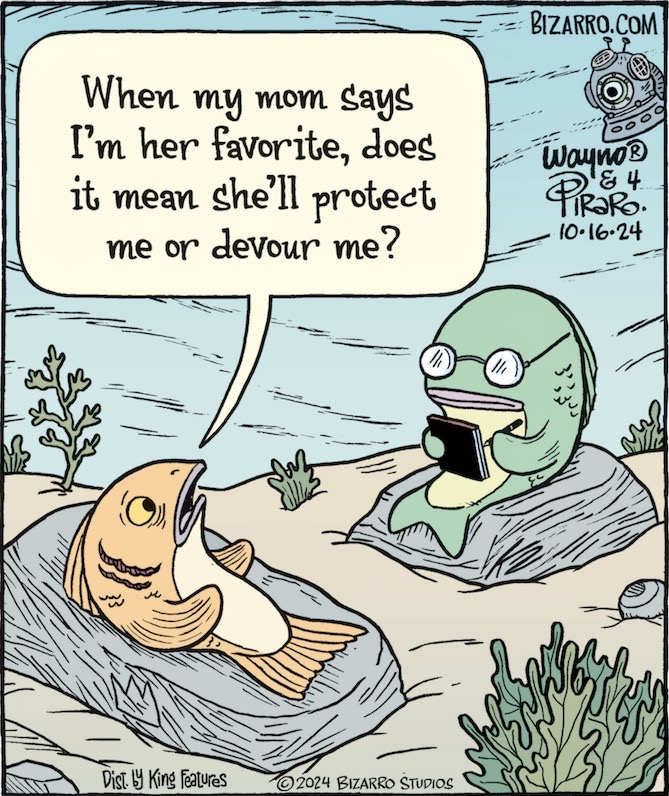
… in yesterday’s (10/16) Bizarro (Wayno’s title: “Subaquatic Psychology Session”):


All about the noun favorite: an implicit superlative, denoting a top-ranking element in some comparison set, but it’s way more complex than that, and the joke turns on one of those complexities (if you’re puzzled by the odd symbols in the cartoon — Wayno says there are 4 in this strip — see this Page)

The relevant complexity becomes clear when you look at some explicit superlatives, in questions like these:

Who is the biggest? What is the best?

These are baffling out of context. Because they are consistent with so many different contexts. But these aren’t differences in what the questions mean; dictionaries wouldn’t have different entries for the many kinds of being the biggest or the best. In technical talk, the questions aren’t many-ways ambiguous, but are instead, neutral, or unspecified, with regard to the different kinds of being biggest or best.

It’s much the same for the implicit superlatives, in questions like:

Who is your favorite? What is my favorite?

There are so many kinds of favorite things (try not to think of The Sound of Music). Favorite places, favorite friends, favorite songs, and on and on. Favorite children and favorite foods, in the case of the cartoon. If your mom tells you you’re her favorite, and you’re a fish (of a race of talking fish, from CartoonWorld), then either of those is a genuine possibility — but of course maybe she’s saying you’re her favorite tennis partner or her favorite artistic swimmer or whatever. Neutrality all the way. (Though the more you know about the context, the narrower the range of understandings becomes.)

(more…)

Anchovy and Cleopatra

October 17, 2024

Yes, I’ve given the punchline away. It’s the delicious pun on Antony and Cleopatra in this Wayno Bizarro strip from 6/21/23, which has recently been reproduced on Facebook:


(#1) A fish-headed suitor — Mark Anchovy — offers anchovies to the Queen of the Nile (if you’re puzzled by the odd symbols in the cartoon — Wayno says there are, wow, 9 in this strip (well, there are plenty of Egyptian hieroglyphs to subvert)— see this Page)

Wayno returned to the Antony and Cleopatra theme recently, so I’ll start my discussion in Roman-occupied Egypt. Then it turns out that though I’ve often mentioned anchovies in culinary contexts on this blog, I seem not to have actually posted about them, so I’ll remedy that; there will be tiny salted fishes.

(more…)

Hunky Halloween Hamlet

October 15, 2024

From Tim Evanson, on Facebook this morning, his image for 16 days to Halloween:


(#1) Hunky Halloween Hamlet, let’s call him Hunklet, contemplating Peter Pumpkin (who really should have a grinning face carved in him) instead of Yorick’s grinning skull

The Shakespearean context (written as connected text rather than as poetic lines):


(#2) “Here hung those lips that I have kissed” — so Hamlet cries in iambs dread

(though I note that #1 could be read as God — or Zeus / Jupiter — surveying the Earth; everybody sing: “He’s got the whole world in His hands”)

(more…)

Dirty Words

October 14, 2024

(About gay porn, with rapt attention to men’s bodies and sex between men, in street language, so entirely inappropriate for kids and the sexually modest)

Dirty Words is a new release from NakedSword Originals (in the Falcon family of gay porn studios). Not about dirty words ‘taboo vocabulary, offensive or indecent words’, but about dirty writing ‘sex writing’ (erotic fiction, sexual memoirs, sexual advice). The synopsis from the studio (divided into paragraphs for easier reading):

New York City has long been the playground of sex writer Zachary Zane, author of Boyslut: A Memoir and Manifesto. Threesomes, anonymous hook-ups, and sex parties are all in a day’s research, not to mention questions from blog fans who happen to spot him out and about at his favorite Manhattan haunts.

Even power-bottom stud Michael Boston stops him on the street for some advice on his relationship with fuck buddy Alexander Müller before Zachary finally heads to Fire Island for a few days of rest and relaxation. Quickly, though, Zachary learns that the summer getaway hotspot is packed with inquisitive readers, all of whom want a piece of him – for counsel, of course. What started as an escape from writing deadlines quickly becomes a crash course in better sex for Oliver Hunt, Harold Lopez, Matty West, Beaux Banks, and Axel Rockham.

By the time Zachary returns to his NYC stomping grounds, he’s ready for a vacation from his vacation – but not before weighing in on a kinky threeway that new pal Michael Boston is planning to have with buddies Braxton Cruz and Travis Connor. Never one to say no to a friend, Zachary dispenses wisdom and encouragement in his signature no-nonsense style, proving that he’s always willing to provide more than just the tips.

(more…)

The 2025 Arnold Zwicky Award

October 13, 2024

It is my annual November pleasure to discourse some on the just-revealed winner of the AZ Award from the Linguistic Society of America; the minimal announcement from the LSA:

This award … is intended to recognize the contributions of LGBTQ+ scholars in linguistics and is named for Arnold Zwicky, the first LGBTQ+ president of the LSA.

Join the Committee on LGBTQ+ [Z] Issues in Linguistics in congratulating Robert J. Podesva on receiving this prestigious award! A Stanford Associate Professor, he researches phonetic variation and identity while actively mentoring LGBTQ+ students to promote inclusivity in academia.

Rob is the fourth awardee — preceded by Kirby Conrod for 2022, Rusty Barrett for 2023, and Lal Zimman for 2024 — and will be officially feted at the LSA’s annual meetings in January. I always provide some encomium material for the awardees on this blog, but this year is special, because Rob is an old friend; a former student of mine (his PhD dissertation committee was Penny Eckert (chair), John Rickford, and me, which is about as socioculturally diverse a committee of three as you could concoct in the academic world); and a valued colleague of mine at Stanford. So there are four reasons for me to write this posting, and I will take some liberties in digressing into personal remarks along the way.

(more…)

You’ve gotta eat your Froot Loops, kid

October 13, 2024

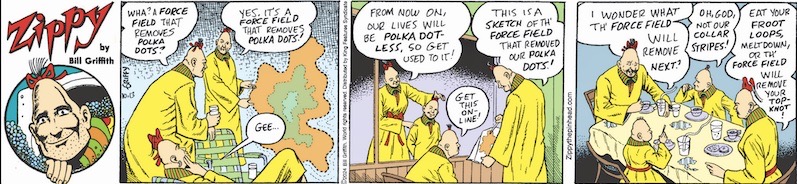
The cartoon. Today’s Zippy strip is a translation of an everyday family drama into a surreal Dingburg version, in the household of Zippy and Zerbina and their children, the boy Fuelrod and the girl Meltdown:


“Eat your Froot Loops, Meltdown, or th’ force field will remove your topknot”

Just think of that as how Dingburgers say “Eat your spinach, kid, or the lack of iron will make you weak” — but much much more dramatically. Or as the song “You’ve Gotta Eat Your Spinach, Baby” (from the 1936 movie Poor Little Rich Girl) puts it:

You’ve gotta eat your spinach, baby
That′s the proper thing to do
It’ll keep you kind of healthy too
And what it did for Popeye it’ll do for you

(more…)