Archive for October, 2017

The pizza boy as cultural figure

October 12, 2017

(Mostly cultural analysis, focused on gay porn. But plenty of very plain talk about men’s bodies and mansex, so this is not for kids or the sexually modest.)

(#1)

The pizza boy archetype, as depicted by young Melbourne artist Allain de Leon in DNA Magazine, April 2013

The figure is a package of symbolic content and associations, among them: the desirable youth; the delivery figure, someone who comes to your door bearing pleasurable goods for money; pizza as an American cultural emblem of warm informal social associations; and a cluster of associations of food with sex, some more general, others specific to pizza slices and whole pizza pies

The trigger for this posting is a recent ad for C1R/Catalina Video, with a sale on a new release — Pizza Boy 4 – Slice of Pie — and the three earlier films in the series, starting with Pizza Boy: He Delivers (William Higgins, 1986). The ads, which are way XXX-rated, are available in a posting on AZBlogX (“Another slice of pizza boy”). But here: a salacious image of pizza boy Steve Henson from the first film, a classic of gay porn:

(more…)

Pizza Boy outtakes

October 12, 2017

(About English, but in the context of a gay porn flick, with plain-language discussions of men’s bodies and mansex, so not for kids or the sexually modest.)

Two items of linguistic interest that came up in preparing a posting (soon to appear) on pizza boys as cultural figures, especially in gay porn, the great work of the genre being William Higgins’s 1986 The Pizza Boy: He Delivers. From scene 5 of the movie, the sexual slang canyon yodeling ‘anilingus’ and an occurrence of underwear as a plural count N.

(more…)

Performance ambiguity

October 10, 2017

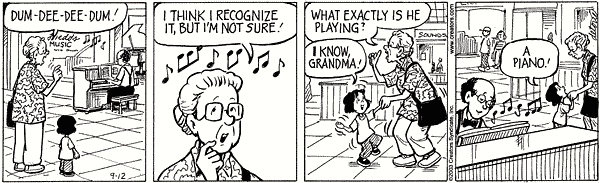
A recent One Big Happy plays on play:

Play the Moonlight Sonata. Play the piano. Play the Moonlight Sonata on the piano.

(more…)

The perils of parallelism

October 9, 2017

Passed on to me by Ben Zimmer, a tweet, entitled “To Whom Is Responsible for This”, from author Colin Dickey (most recent book: Ghostland: An American History in Haunted Places) with this photo of extraordinary whom on the hoof:

I see three contributing factors here: (A) a preference for fronting rather than stranding Ps in extraction constructions; (B) a mechanical application of a principle calling for (formal) parallelism in coordination; and (C) an irrational reverence for the case form whom (rather than who) of the (relative or interrogative) pronoun WHOM.

(more…)

Focus on the dal

October 9, 2017

Today is my second lens day, my second cataract surgery (for the left eye), my second adventure with an AcrySof IQ Aspheric Natural IOL (intraocular lens), from Alcon Laboratories. Since this is a medical device, it comes with a user’s manual / product information booklet, which is printed in incredibly tiny print in a 3×5 booklet. But is not without linguistic interest.

That will take us to Texas and Switzerland. It will all end in food, specifically a type of dried, split legume seeds. Which will take us to South Asia.

Never complain that I don’t take you out.

(more…)

He had an American name

October 8, 2017

Yesterday, on the Our Bastard Language group on Facebook, this entertaining item passed on by two members of the group from Thunder Dungeon’s page:

(#1)

Despite the fact that many Americans are accustomed to confronting, almost every day, names they don’t recall ever having heard before — well, most of us have ancestries from elsewhere, a lot of different elsewheres — there are still many names we recognize as “American”, even if we have some sense of the ethnic heritage of the bearers of those names. They might be perceived as English, Scots, Dutch, Irish, German, Jewish, Italian, Mexican-American, French, or whatever, but for us they count as American. And we are keenly aware of divergences from the set of typically American names, as above: Steve is an American personal name, Sleve is not; Dwight is an American personal or family name, Dwigt is not; Hudnutt is an American family name, Dugnutt is not; Gonzalez is an American family name, Bonzalez is not.

(more…)

Noodling with formulaic language

October 6, 2017

Today is National Noodle Day. Yes, an event fabricated by people in the food indusry to showcase their products and sell them, on a date no doubt chosen only because it hadn’t already been claimed by any other food. But noodles are delicious, they’re multicultural, and they’re fun.

I celebrated the occasion at lunch with some porcini mushroom and truffle triangoli (stuffed ravioli, but triangular rather than square) from Trader Joe’s, with arrabiatta sauce (a spicy tomato sauce). Pasta in English food talk for Italian food, but  noodles in English food talk for Chinese (and other East Asian and Southeast Asian) food — so today they’re noodles to me. (I recommend a broadminded view on what counts as noodles.)

I also recommend that we adopt a symbolic figure for the occasion, something like the Easter Bunny, Santa Claus, Halloween pumpkins and witches, Pilgrims for Thanksgiving, the New Year baby, and so on. I suggest the Flying Spaghetti Monster, with his noodly appendages.

But first let’s get down to some recent noodling with formulaic expressions in the comics: One Big Happy (an idiom), Rhymes With Orange (a frequent collocation or an idiom, depending on who you read), and Mother Goose and Grimm (a proverb):

(more…)

He opened his mouth

October 5, 2017

… and a/his purse dropped / fell out.

Meaning: and he revealed himself to be a flaming faggot. Said by someone (usually a gay man) who is distancing himself from flaming faggots and (usually) expressing disdain for them. A variant of the formula in an ecard:

    (#1)

(Eventually there will be a bit of sex talk, from Dan Savage, but otherwise this material shouldn’t be problematic.)

(more…)

The news for musical chameleons

October 5, 2017

Through a Facebook connection, this .NAF. cartoon:

Yet another play on an antic song title.

(more…)

The Amelioration formula

October 5, 2017

A recent instance, from Baltimore Sun copyeditor John McIntyre on Facebook today:

At the desk. Converting defective prose into the merely mediocre since 1980.

An earlier parallel, from Sigmund Freud’s Studies on Hysteria (1895) (co-written with Josef Breuer), as translated by Nicola Luckhurst (2004):

But you will see for yourself that much has been gained if we succeed in turning your hysterical misery into common unhappiness.

A snowclonic figure of speech, Amelioration of Awful to Ordinary (Amelioration, for short), of the form:

Transformation-Verb Awful (in)to Ordinary

(with transformation verb transform, turn, change, convert, make, rework, etc.)

(more…)