The latest news in the Kountze TX Bible banner story, in the NYT on the 18th: “Cheerleaders Gain Ally in Free Speech Fight” by Manny Fernandez. The ally is Gov. Rick Perry of Texas.
Archive for October, 2012
Bible banner news
October 21, 2012Marc Bessange
October 21, 2012(Not about language, but about male photography.)
It’s been a while since I posted on male photography — we all have our side interests, outside of linguistics — back in February and March, on Howard Roffman (on AZBlogX here, this blog here), and in the interim, Max Vasilatos has been sending me several series of postcards by male photographers (‘photographers of the male body’). Many already familiar to me, but Marc Bessange was new.
Possessive controller for SPAR
October 20, 2012From NPR’s Morning Edition on the 17th, in the story “Farmers Cautious of Drought-Resistant Seeds”:
Z4.72. Like many Iowa farmers, [Gary] Plunkett’s corn harvest numbers have gyrated …
Some usage critics (like Philip B. Corbett, the NYT‘s associate managing editor for standards, in charge of the paper’s style manual) would reject the initial like-phrase out of hand as a “dangling modifier” — see below — but people not under the sway of an explicit rule about these things tend not to see anything at all notable in examples like this one, which are very common, even in careful writing.
Punctuation marks
October 20, 2012From Jonathan Lundell, a pointer to a posting on the Canadian Design Resource site yesterday:
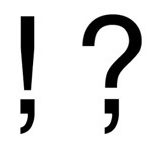
According to The Week [of October 8th], in 1992 a patent was filed here in Canada for these two alt punctuation marks: the “Exclamation Comma” and “Question Comma”. Presumably, each mark would express enthusiasm or inquiry respectively at a time when the user was not yet prepared to end the sentence.
Mistaken identity
October 20, 2012Today’s Mother Goose and Grimm:
The name’s the same.
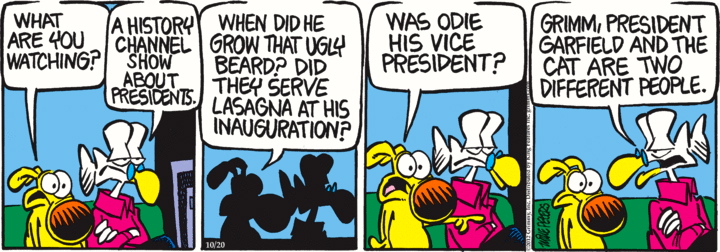
The yellow dog is Grimm; the bird is Grimm’s owner, Mother Goose. The strips often make reference to other fictional characters, including those from other strips, like Garfield. It’s Garfield the cat, not James Garfield the president, who’s fond of lasagna:
Garfield is an orange, fuzzy, tabby cat born in the kitchen of an Italian restaurant (later revealed in the television special Garfield: His 9 Lives to be Mama Leoni’s Italian Restaurant) and immediately ate all the pasta and lasagna in sight, thus developing his love and obsession for lasagna and pizza. (link)
Odie is the dog in Garfield’s household.
Public slogans
October 19, 2012Today’s Zits:
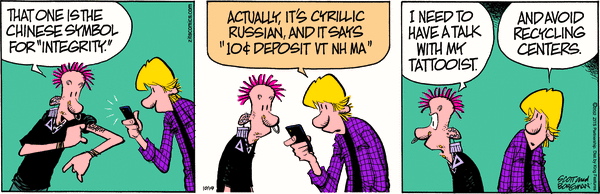
People choose pieces of clothing with bits of other languages printed on them — because of the “exotic” look of the script or because the language the script is used for is in some way fashionable. Such t-shirts and the like are rich sources of (unintentional) crosslinguistic humor.
Similarly for tattoos, except that tattoos are not so easily taken off, and the graphics sometimes come recommended by the tattoo artists or well-meaning friends. But once again the design might not be at all what you intended, or at least hoped for.
Windmills and giants
October 19, 2012In a comment on my “Sign of the times” posting yesterday, The Ridger described a Partially Clips cartoon on the theme of windmills and giants. The cartoon itself, from 2/10/09:
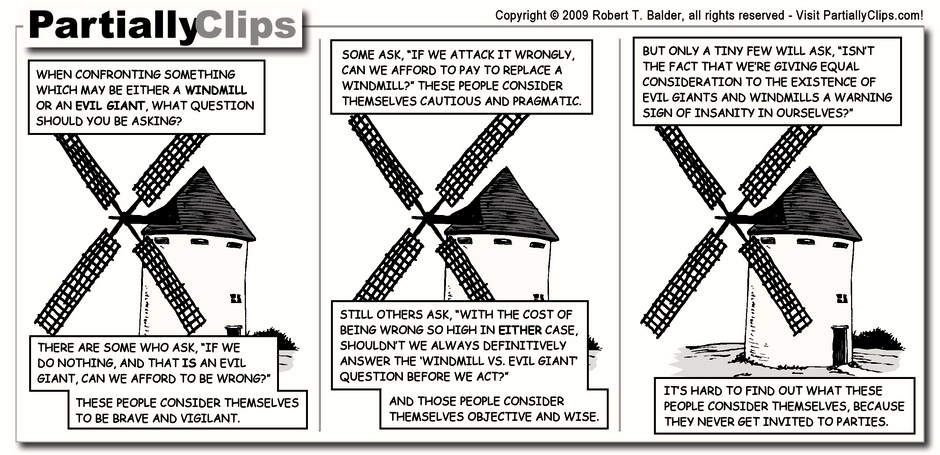
This can be read as illustrating a contrast in personality types, or in political stances, or both.
As is usual with this strip, the background image is the same in each panel. What differs is the text and how it’s placed.
Taboo avoidance trio
October 18, 2012Three recent examples of taboo avoidance in the media, each with its own points of interest: (1) a thoroughly avoidable use of “[expletive]” in the NYT, which generally avoids such things; (2) the ostentatious denominal derived verb un-four-letter-Anglo-Saxon-word, on the RedState site; and (3) the playful noun-that-I-can’t-print-in-this-newspaper, from a NYT columnist.
For short
October 18, 2012From an appointment on October 2nd with an orthopedist, the clipping nec fac /nɛk fæk/ for necrotizing fasciitis (from the doctor). This was a new abbreviation of the disease name for me; I was accustomed to the initialism NF /ɛn ɛf/ (from other doctors). And I wondered about the /fæk/ piece of the clipping, where I would have expected /fæʃ/ or /fæs/, given the full pronunciation of fasciitis, with one or the other of these as the first syllable.
Sign of the times
October 18, 2012An image from Andrew Stein yesterday, passed on by Dean Calbreath on Facebook:
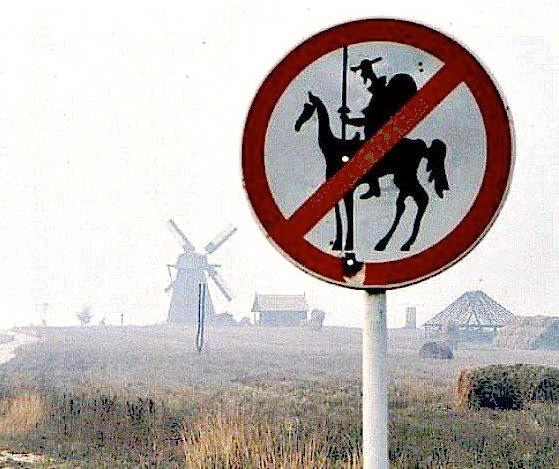
A sign of the times — specifically, of the early 17th century. The windmills depicted here are no doubt from the Netherlands, rather than the Spain of Cervantes’s Don Quixote (1605/1615), but that’s the source of the idiom tilt at windmills ‘attack imaginary enemies or evils’ (from Don Quixote’s seeing the windmills as long-armed giants).