Archive for October, 2012

gypsum weed etc.

October 17, 2012

A few days ago the ADS-Lers were discussing the initially puzzling expression gypsum weed for a plant mentioned in the Gene Autry faux-cowboy song “Back in the Saddle Again” (and elsewhere). Gypsum here was quickly established to be a folk etymology, a demi-eggorn in which in an unfamiliar part of an expression — here, the jimson of jimson weed — is replaced by something familiar, without necessarily making the whole expression more comprehensible (what does the plant have to do with the mineral gypsum?). As Charlie Doyle noted, DARE gives both gypsum weed and gypsyweed as folk-etymologizing variants of jimson weed.

But that’s just the beginning of the complexities. Along with jimson ~ gypsum, there’s lowly ~ lonely. And more.

(more…)

Looking modern(e)

October 17, 2012

Passed on by Dean Calbreath on Facebook, this image of the 1948 Buick Streamliner:

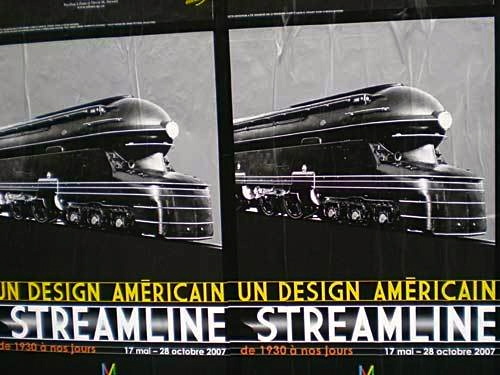
Dean’s comment: “I’ve never seen a car this beautiful – and it’s more than 60 years old.” It might seem surprisingly old, but it comes close to the end of the great age of streamlining as the image of fashionable modernity in design. Here’s a train design from almost two decades earlier:

(more…)

subtexting

October 16, 2012

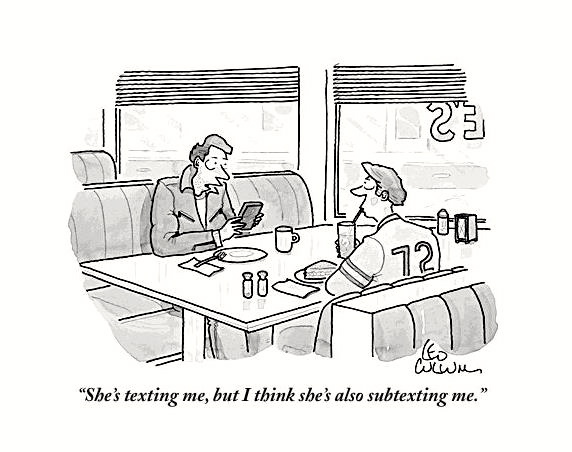
A Leo Cullum cartoon from the New Yorker a while back, passed on by Christina Zable on Facebook:

That’s subtext as a verbing of the noun, parallel to the verbing text.

(more…)

Inference

October 16, 2012

Today’s Zits:

Jeremy figures that “I lost my wallet again today” should have led his mother to infer that he did something to avoid the consequences of losing his wallet, in particular, that he no longer kept anything in it (but then why carry a wallet at all? an easier solution would be to give up carrying the wallet entirely). This comes close to assuming that other people have access to the reasoning in your head, or possibly to assuming that any reasonable person would respond to repeated wallet loss the way you did.


Annals of cataphora

October 15, 2012

From the Economist of 12/3/11, p. 43, in “Marijuana in California and Colorado: Highs and laws” [the magazine is fond of jokey titles], after a long first paragraph about medical marijuana boom in Colorado:

While it is allowed in some form in 16 states and Washington, DC, Colorado is the leader in trying to make medicinal pot a legitimate business.

Now, (medical) marijuana is highly topical when this sentence comes along in the discourse. so that’s almost surely the referent of the subject pronoun it in the initial subordinate clause. Nevertheless, I expected this pronoun to be cataphoric, preferably with its referent picked up by the subject of the main clause — but that’s Colorado (where Colorado is paired with 16 states and the District of Columbia), and not a NP referring to marijuana. So I had a brief moment of unfulfilled expectation that wasn’t ironed out until medicinal pot came along, embedded within the main clause.

My reaction to this explicit pronoun subject it is much like many people’s reaction to zero subjects in initial sentence adverbials, in initial SPARs (subjectless predcative adjuncts requiring a referent for the missing subject). Sometimes the referent is given right there in the preceding context, but still we expect the zero to be cataphoric, preferably to the subject of the main clause.

(more…)

Twittering

October 15, 2012

(Mostly about art.)

My recent posting on tweeting (in a Zippy cartoon) reminded me that I haven’t posted about Paul Klee’s drawing Die Zwitscher-Maschine:

Twittering Machine (Die Zwitscher-Maschine) is a 1922 watercolor and pen and ink oil transfer on paper by Swiss-German painter Paul Klee. Like other artworks by Klee, it blends biology and machinery, depicting a loosely sketched group of birds on a wire or branch connected to a hand-crank. Interpretations of the work vary widely: it has been perceived as a nightmarish lure for the viewer or a depiction of the helplessness of the artist, but also as a triumph of nature over mechanical pursuits. It has been seen as a visual representation of the mechanics of sound. (link)

(more…)

Detroit Industry

October 15, 2012

(About art rather than language.)

From the Atlantic of July/August 2012, p. 14, James Bennet’s “Idea Factories”, about Detroit:

Among Edsel Ford’s ideas to improve his city was to commission to Mexican artist Diego Rivera to paint murals, depicting auto production, in a sunlit court in the Detroit Institute of Arts. Around the same time – the early 1930s – Nelson Rockefeller also commissioned murals from Rivera, for Rockefeller Center. In both cases, Rivera, a Marxist, embedded socialist imagery in his work. In New York, Rockefeller had the paintings destroyed. In Detroit, clergy attacked Rivera’s murals as blasphemous, and The Detroit News called them un-American. Edsel protected Rivera’s art.

(more…)

Pronouncing names

October 15, 2012

In the NYT on Saturday, a front-page piece (“Missouree? Missouruh? To Be Politic, Say Both”, by Sarah Wheaton) about the pronunciation of names, with a political connection.

(more…)

Ink on paper vs. paint on canvas

October 15, 2012

(Not about language, though there’s a connection to comics.)

In Friday’s NYT, a review by Holland Cotter in the Arts section of a collection of drawings, beginning:

If “Dürer to de Kooning: 100 Master Drawings From Munich” were an exhibition of paintings, not drawings, the Morgan Library & Museum would have to be thinking about crowd control. A show of little-seen pictures by Michelangelo, Rembrandt, Rubens and Pontormo, with Picasso and Sigmar Polke tossed in? Issue timed tickets. Extend your hours.

But when it comes to box office pull, work on paper and work on canvas don’t carry equal weight. There are exceptions. “Leonardo da Vinci, Master Draftsman” brought throngs to the Met in 2003. But that was Leonardo, the elusive Elvis of art, always just leaving the building, a special case.

(more…)

Posting tweets

October 15, 2012

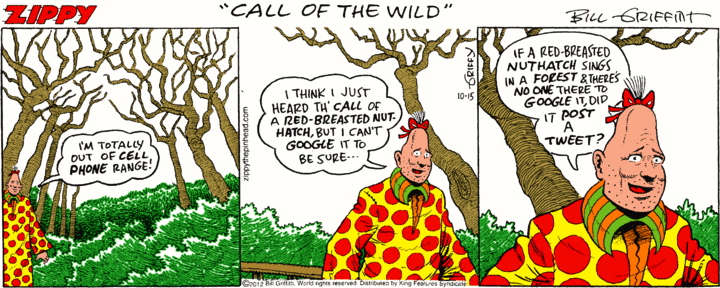
Today’s Zippy, with birds and software:

A pun on tweet, bird song vs. Twitter message, with an old philosophical conundrum as the vehicle.

(more…)