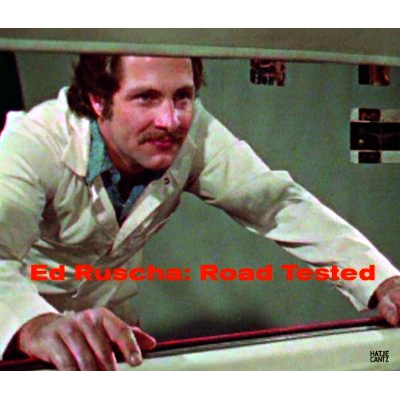
It’s been a little while since I posted on “language artists”, visual artists who incorporate elements of language into their work; see “Conceptual art” (here), with links to earlier postings. Time now to say a few words about Ed Ruscha, on the occasion of a new book of his paintings of life on the road and on the street, Road Tested, cover photo here:
Archive for 2011
Ed Ruscha
May 4, 2011Power bottoms
May 4, 2011(Warning: There will be some very plain talk about gay sex in this posting.)
Every so often, I realize that an expression or construction so familiar to me that I don’t think about its analysis presents some interesting feature. So it is with the compound power bottom, which I know from the gay male world, as in this banner ad from the Falcon gay porn studio, offering videos featuring men who really like to get fucked:
pedantry
May 4, 2011My posting on argument structure in porn (with a link to my posting on “Brads”) got picked up by Boing Boing, which brought me an enormous number of site views (7,201 on Friday, 3,225 on Saturday, 2,066 on Sunday, 1,075 on Monday, 717 on Tuesday; an ordinary day gets 200-300 views) and some new regular readers (and, so far, no vacuous or trash-talking comments on this blog).
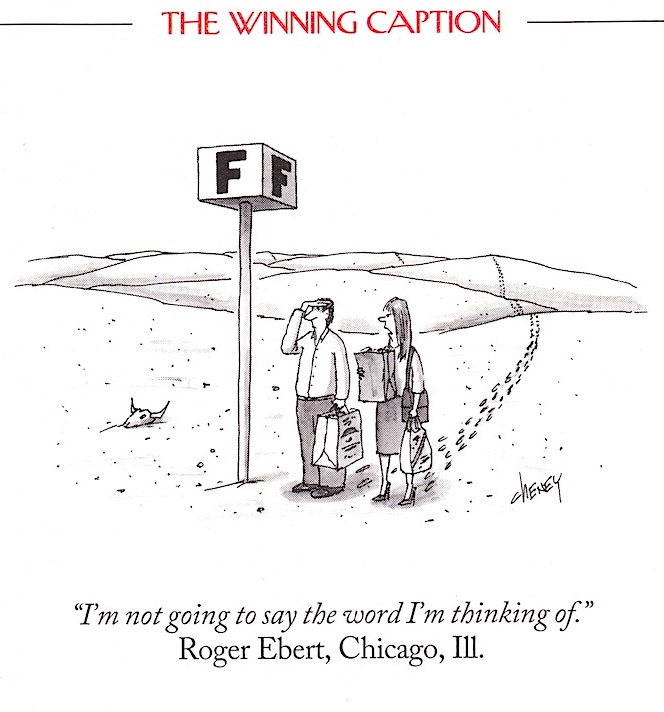
On the F-bomb watch
May 3, 2011To set the scene, a winning caption in the May 2 issue of The New Yorker:
Meanwhile, Donald Trump hasn’t been reluctant to say the word in public, and media outlets are struggling to cope with how to report it.
Kisses
May 3, 2011(Not about language, but about intimacy between men and about male photography.)
A while back, I posted here on men kissing men, with a stunning photograph by David Vance and a few notes on the power of such images. Then a couple days ago I posted six images of male intimacy on my X blog, including two more of men kissing men.
And I remembered the book Kissed: Sensuality in Gay Art (ed. by Stephan Niederweiser, Bruno Gmünder, 2010) — gay here means ‘gay male’ — 260 pages of images from over 40 photographers showing male-male kisses of all sorts, from sweet to sensual to urgently passionate to aggressive.
Our apostrophized holidays
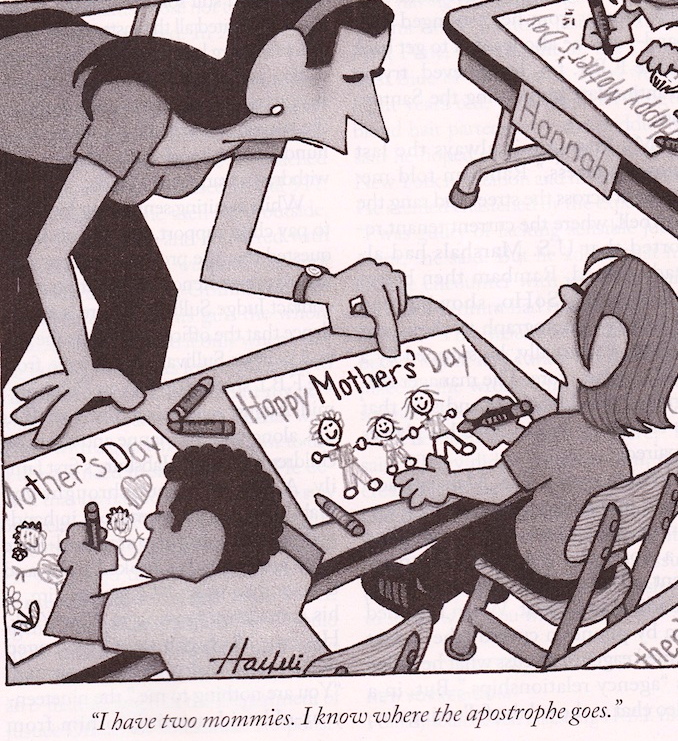
May 2, 2011Presidents, Mothers, Fathers. All arouse punctuational angst, and much variation. To take the next of these occasions to come upon us in the U.S.: is May 8, 2011, a day for mothers (Npl + N compound), a day that’s your mother’s (Nsgposs + N compound), or a day that’s our mothers’ (Nplposs + N compound)? This is a case where I tend to recommend jettisoning the apostrophe on the grounds of simplicity, since the meaning distinctions are so subtle, but I have to admit that my own usage varies.
Still, there are times when the placement of that apostrophe is significant, and William Haefeli has hit on one in the latest (May 2) issue of the New Yorker:
A while back, I assembled an inventory of postings on apostrophes on Language Log — the work of some hours, alas — but haven’t added things from this blog, or (omigod) annotated the inventory to make it really useful, so it’s not ready for unveiling to the world. But one thing I discovered in my searches through LLog was that the comments on all sorts of postings having to do with usage branched off into peeving, or even rage, about “apostrophe misuse” as an example of something the writer absolutely couldn’t abide. Apostrophes missing in various places where they are prescribed, apostrophes used in places where they are proscribed.
Now, it’s not hard to concoct examples where apostrophe misuse can lead to ambiguity, out of context, for an uncooperative reader, but in fact most of the examples people collect or construct are easily interpretable in context by a cooperative reader (one who’s willing to try to divine the writer’s intent); they violate the (sometimes complex and tricky) conventions of standard written English, but they don’t produce uninterpretable gibberish. Mis-steps, but small ones, and not something to get in a froth about.
Still, sometimes where you put that apostrophe makes a subtle but important distinction, as for Heather in Haefeli’s cartoon, with her two mommies.
[Notice that the teacher could still object that the name of the holiday (a proper noun) is Mother’s Day and that the holiday isn’t about Heather personally, so Heather has no right to adjust the form of the expression to suit her own condition — an argument for WF (well-formedness according to some convention) over Faith (faithfulness, in this case fitting the expression to the context); on Faith vs. WF, see here. (Let me remind you that neither Faith nor WF is “right”; they are two equally valid, but often conflicting, general principles, in constant tension, resolved in different ways in different contexts, by different people.)
I’m with Heather in this case. But she might have a hard time working against a teacher committed to WF on holiday names, especially a teacher who finds the whole two-mommies business distasteful.]
Racy photos on my X blog
May 2, 2011-sauruses
May 1, 2011From Chris Ambidge yesterday, a set of images that he collected for me. Most of them I’ve posted on my X blog, because of their “adult” content (I’ll post a list of these soon), but here’s a whimsical one (from a Finnish site) that’s WordPressable:
Beware of automobile-devouring dinosaurs (species Autophagosaurus?)!
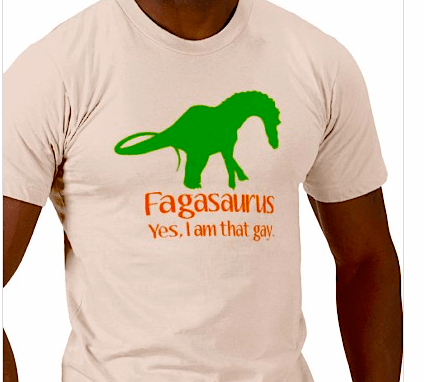
And then, on an entirely different project, having to do with uses of the word faggotry, I came across this jocular innovation, Fagasaurus, on a t-shirt:
(Lots of other references to Fagasaurus and Fagasaurus rex, which is presumably the species illustrated above, the totally gay Tyrannosaurus rex, the king of queers.)
Untabooing, maintaining the taboo
April 29, 2011I was struck recently about the delicate lines drawn around some taboo vocabulary in the media, in particular on television shows. On the series Charmed (on the WB network from 1998-2006, now endlessly in re-runs on TNT), displaced, non-literal uses of various words are fine:
Rainbow bull
April 29, 2011From Jack Hamilton on Facebook yesterday, this striking Mallorcan bull in rainbow-flag colors:

This might be a political statement, connected to the language politics of greater Iberia. Arne Adolfsen explains:
Those huge black bull signs are common throughout the countryside in Castile and Aragon (though not so much there) and are a symbol of Spanishness, or, really, Castilianness. Painting those bull signs any color other than black could be seen as an attack on the unitary Spanish (read: Castilian) state. In Catalunya signs are in català and castellano (it’s not called español). Also, bullfighting is against the law in Catalunya. And don’t forget that Mallorca is part of the Catalan-speaking part of the world.
More detail, on this site, via Gwendolyn Alden Dean on Facebook:
The advertising hoardings of black toros (bulls) have added to the Spanish landscape since the Nineteen-fifties, when bulls first appeared in large, cut-out silhouettes promoting the famous Spanish Brandy, Veterano. Then, the Osborne spirits company erected large images of bulls in black with the maker’s name, as advertising boards on sites near to major roads throughout Spain. The bull is, by some, regarded as a semi-official national symbol of Spain. The Osborne bull can been seen looming on hillsides all over Spain. When Spain outlawed billboards on national roads in the early 1990′s, the bulls had to be taken down. Many Spaniards protested, as they had become endeared to them. The original bull was smaller and of a slightly different design. It got bigger as publicity was prohibited within 150 meters of a main road. The bulls now have a height of 14 m. There are said to be around 70 of these giants placed throughout the country. You might have seen one yourself, perhaps the only one in Mallorca, between Algaida and Montuïri.
In Mallorca, as in Catalunya, the Osborne bull is not as welcome as in other parts of Spain. The Mallorcan cut-out toro often suffers from protesting graffiti (see my earlier blog entry). A couple of days ago, the billboard was defaced again but, this time in a cheerful manner. Now the black bull appears in the colours of the rainbow (see photo). Even though this colour spectrum is usually attributed to the Gay Pride movement, it is widely speculated that the latest toro misdeed was in fact carried out by the Spanish anti-bullfight movement who are known to have converged in Mallorca during the last few days.
Whatever you might think about bullfights, Osborne bulls, anti-bullfight protesters or the gay scene, the rainbow coloured toro between Algaida and Montuïri adds a bit of colour to the landscape. One has to applaud the creative impetus of the culprits.