Archive for 2011

1974

May 9, 2011

At lunch last week, the Gang of Three — the V, the D, and the Z (me) — somehow got onto the year 1974 and things that happened then, and the D’s musical memory pulled up “Sex on the Streets”, with a text that begins:

Nineteen hundred seventy-four is the year that they are now planning for sex on the streets in every major city from coast to coast. And — get ready for a shock — the music that they’re planning to use to crumble the morals of America is this rotten, filthy, dirty, lewd, lascivious junk called rock and roll.

This is from “An Important Message” by Dr. Jack Van Impe (1974), a radio/tv preacher given to apocalyptic messages. Delivered in a raging rant. (Notice the conspiracy theory, complete with things that They are planning, on a huge scale. The Rock Agenda, I guess, like the Homosexual Agenda.)

It was just too good for rock musicians to let pass.

(more…)

Romance languages

May 9, 2011

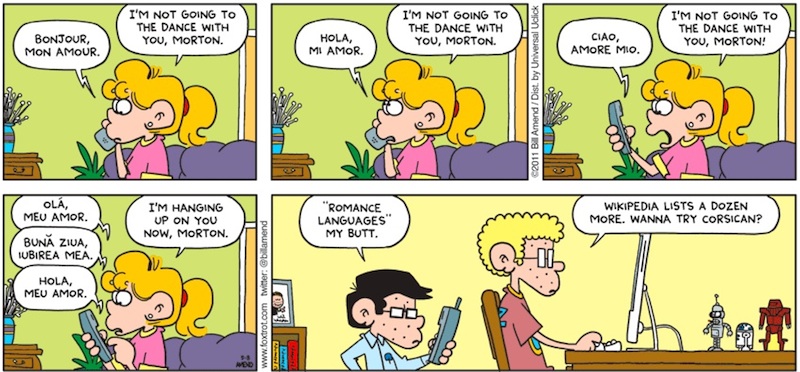
Yesterday’s Foxtrot:

Three points here, the main one (the one that the cartoon turns on) being the ambiguity of romance (in Romance languages vs. romance movies). Then there’s the question of counting Romance languages. And, finally, the side issue of the dismissive exclamation my butt!.

(more…)

Caravaggio

May 8, 2011

(Not about language, but about art and sexuality.)

For the people I send cards to every day, I recently got the postcard book Hidden Love: Art and Homosexuality (Prestel Publishing, 2003), with 30 images, most old friends, among them Caravaggio’s Amor Vincit Omnia (a.k.a. Amor Victorious; c. 1601-02), showing a beaming Cupid (well, a young man billed, not very convincingly, as Cupid) vanquishing the instruments of both war and peace (oh, the musical instruments!) — a surprising and delightful image. A reproduction:

(more…)

More conceptual art

May 8, 2011

Ed Ruscha a little while back (with links to earlier postings), and now (thanks to NPR’s Weekend Edition Sunday), conceptual artist Glen Ligon, whose show AMERICA is now at the Whitney Museum of Modern Art. From this show, his neon installation Ruckenfigur:

(more…)

Maypole and big guns

May 8, 2011

Annals of phallicity: an elegant maypole (a week after May Day) and very big naval guns:

Two very different phallic images.

The maypole appears here without dancers or flowers or any other accompaniments — just the pole and the ribbons (in pastel colors). The origins and meanings of the maypole are much debated, but it certainly can serve as a phallic symbol.

The big guns are in half of a photograph from Kevin Bentley’s Sailor: Vintage Photos of a Masculine Icon (2000), a collection of images assembled from auctions, estate sales, antique shops, flea markets, and the like. (The left half of the photo, not reproduced here, has a third gun with a sailor in it.) Sailors posing with their ships’ guns are a common theme from wartime. As I said in an earlier posting on phallicity,

The association between men’s weaponry and their masculinity, via their penises, is subliminal, but still potent (perhaps laughably potent) in images like this.

A conjugational visit

May 6, 2011

From Nancy Friedman, a link to this cartoon by Scott Hillburn:
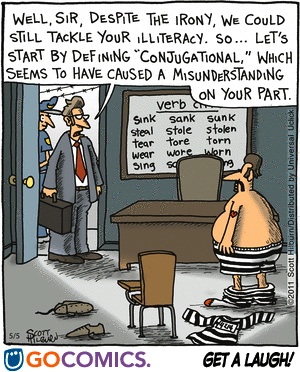
Oh, not a conjugal visit, a conjugational visit! Let’s conjugate, baby!

The Latin verb conjugāre ‘to yoke together’ (con- ‘together’ plus jugāre ‘to join, yoke, marry’) lies behind both words. Conjugate came to English as a technical term from Latin grammar, meaning ‘to inflect (a verb)’ (OED2’s first cite is 1530), though there are some later (rare) cites for the verb in the sense ‘yoke together, couple; join together, unite’ (but apparently not used for sexual union).

Conjugal ‘of or pertaining to marriage, matrimonial’ is also 16th century. Historically, sexual union was one of the central features of marriage (right up there with property rights), so that the specialization of conjugal to sexual matters in some contexts isn’t surprising. Conjugal visit (of the prison variety, as in the cartoon) isn’t in OED2, but will surely be added soon in the on-going revisions of the dictionary. (Surprisingly, it isn’t in NOAD2 or AHD4, either, though it’s a commonly used expression whose meaning certainly can’t be predicted by general principles from the meanings of its parts. Conjugal in this expression is an excellent example of a non-predicating modifier.)

[Bonus: on the Wikipedia page (which has information on conjugal visitation in a number of countries), we learn that

In June 2007, the California Department of Corrections announced it would allow same-sex conjugal visits. The policy was enacted to comply with a 2005 state law requiring state agencies to give the same rights to domestic partners that heterosexual couples receive. The new rules allow for visits only by registered domestic partners who are not themselves incarcerated. Further, the domestic partnership must have been established before the prisoner was incarcerated.

(Slowly, things change.)]
Jockstraps

May 6, 2011

Over on my X blog, seven remarkable items from Jockstrap Central (several of them unWordPressable), here. Note especially the well-named Cyclops jock, though all of the jocks have their entertaining points.

There’s a discussion of jockstrap (the item of clothing) and jockstrap (the word) on my X blog a while back, here, with illustrations.

And on this blog, a relatively innocent rainbow jock (in “Return to rainbow flagwear”, here) and then three remarkable items in “The Xmas package” (here), “The Xmas package 3” (here), and “The Xmas package 4” (here). Plus the Andrew Christian Shock Jocks in “Male vanity” (here).

idiocracy

May 5, 2011

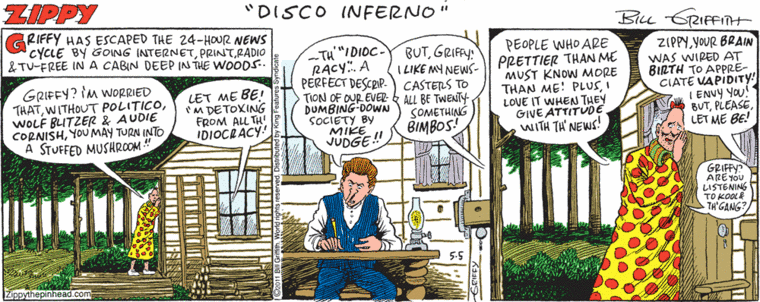
Today’s Zippy, ripe with pop culture references and the libfix -cracy in idiocracy ‘government or rule by idiots’:

The reference is to the film Idiocracy. As Wikipedia has it:

Idiocracy is a 2006 American satirical science fiction comedy, directed by Mike Judge and starring Luke Wilson, Maya Rudolph and Dax Shepard.

The film tells the story of two ordinary people who are taken into a top-secret military hibernation experiment that goes awry, and awaken 500 years in the future. They discover that the world has degenerated into a dystopia where advertising, commercialism, and cultural anti-intellectualism run rampant and dysgenic pressure has resulted in a uniformly stupid human society devoid of intellectual curiosity, social responsibility and coherent notions of justice and human rights.

The poster for the film:

and the DVD cover:

Plus a notable quote:

The film has attracted other cartoonists, as here.

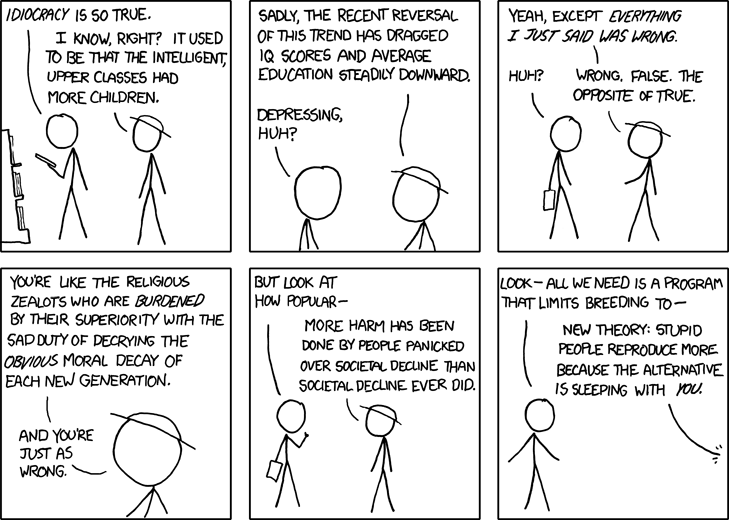
And xkcd:

Data points: P~Ø 5/5/11

May 5, 2011

On this morning’s traffic report on KQED:

If you’re traveling Sacramento, …

conveying ‘if you’re traveling in/through Sacramento’, but with transitive travel — “transitivizing P-drop”, as discussed most recently on this blog here, with reference to a much racier example.

(more…)

Comic reporting

May 5, 2011

In the May 2 New Yorker, Tad Friend achieves the classic tone of Talk of the Town reporting in the magazine, in his piece “Clothes Horse”, which begins:

The director Paul Feig was peacocking in a gray pin-striped suit (Ralph Lauren Purple Label), black double-monk-strap shoes (Santoni), black-framed eye-glasses (Gucci), and a don’t-fuck-with-me watch (Panerai).

The ostentatious verbing of peacock, the accumulation of technical descriptors and brand names, going through items labeled by neutral colors (gray, black, black), building to a surprise vernacular climax. (I suppose the last item could have been described as a power watch, but don’t-fuck-with-me is much more effective.)

(more…)