October 27, 2023
A wonderful wordless cartoon by Liana Finck from the 10/30/23 issue of the New Yorker presents a challenge in cartoon understanding: what do you have to know and what do you have to recognize in the cartoon if you’re going to understand what’s going on in it and why that’s funny?
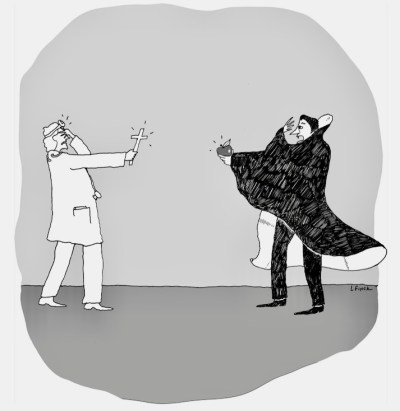
An intense confrontation between a doctor and a vampire: the doctor seeks to repel the vampire. while the vampire, in turn, seeks to repel the doctor; each is shielding their eyes, to avoid seeing the repellent brandished by the other (the crucifix threatening the vampire, the apple threatening the doctor); the confrontation appears to be a standoff
A full appreciation of this comical Mexican standoff requires that you recognize the two characters, one drawn from the real world, the other from a fictive world of popular culture, somehow (absurdly) joined, indeed frozen, in mortal combat — which means recognizing why the crucifix is a threat to the vampire (this requires your knowing some vampire lore) and why the apple is a threat to the doctor (this requires your recognizing the joke’s inspired mainspring, a subtle pun on a proverb in English). Truly awesome.
Read the rest of this entry »
Posted in Books, Fiction, Formulaic language, Implicature, Language and medicine, Linguistics in the comics, Movies and tv, Pop culture, Proverbs, Puns, Semantics, Understanding comics | 3 Comments »
October 22, 2023
Promised on 10/3 (yes, 19 days ago), in my posting “coming soon, two pun cartoons” (by Kaamran Hafeez and Tom Chitty), now realized: the puns hìp replácement (from KH, on the model híp replàcement) and you look like you’ve seen a goat (from TC, on the model you look like you’ve seen a ghost) — both of them (phonologically) imperfect, but close.
(Both KH and TC have Pages on this blog: KH here; TC here.)
Read the rest of this entry »
Posted in Idioms, Language and animals, Linguistics in the comics, Puns, Stock expressions | 1 Comment »
October 19, 2023
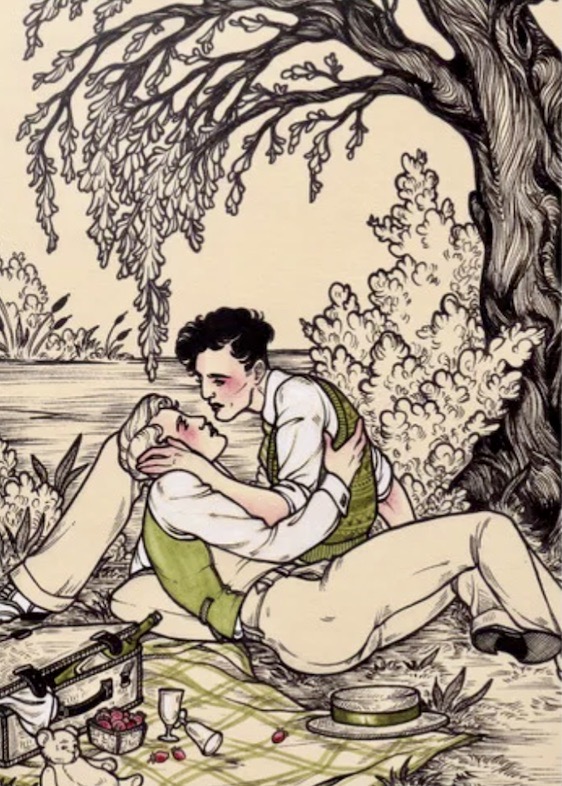
Glimpsed on Pinterest a little while back, this MMS (male-male sex) painting, Contra Mundum by Fyodor Pavlov: a pair of young men kissing, seductive male buttocks highlighted, their Edwardian-picnic amour unfolding beneath the point of a potent abstract phallic design, the down-pointing triangular shape of the male genitals (often given physical form as a hanging bunch of grapes, here as a cluster of leaves on the tree that shades the young men’s secret tryst):
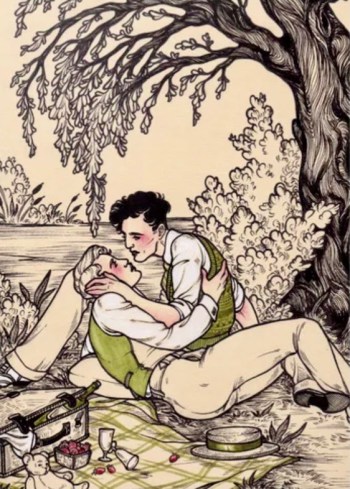
(#1) Packed with further details worthy of comment, among them: the dark-light (paired with dominant-submissive) contrast of the two men, the overarching U of the tree’s branches complementing the cupped U of the submissive man’s body, the red of the strawberries against a mostly b&w composition, the stuffed bear, the vibrant green of the men’s sweaters, the neck of the wine bottle poking out from the confines of the picnic hamper, the phallic reeds on the far shore of the lake
Things to comment on: picnics; contra mundum; and the artist. This turns out to be quite a lot.
Read the rest of this entry »
Posted in Art, Books, Homosexuality, Language and religion, Language and the body, Language of sex, Literature, Logos, Male art, Phallicity, Signs and symbols | 3 Comments »
October 18, 2023
Male underwear models minimally covered by garments designed for the sweaty dance floor of a raunchy fantasy gay club, so certainly not to everyone’s taste. And then (in somewhat distant homage to Barbie the movie), the garments in a full range of shades of butch-faggy pink: huge jutting packages wrapped in deep pink (the Brutus jockstrap); muscular buttocks, yearning for a depth pronging, framed by dark pink camo (the Combat jockstrap); and much more.
All this in the 10/17 e-mail ad from Daily Jocks, displaying some of its pink homowear for, surprise, Halloween. This year, the gaybros are tricking in pink.
The full ad, broken into three sections for this posting (label the whole thing as image #1):
Read the rest of this entry »
Posted in Color, Gender and sexuality, Holidays, Homosexuality, Masculinity, Underwear | 1 Comment »
October 13, 2023
In today’s Wayno / Piraro Bizarro cartoon, really wizard vases from the Harry Pottery Barn:

A POP (phrasal overlap portmanteau) Harry Pottery = Harry Potter + Pottery: vases in the style of J. K. Rowling (if you’re puzzled by the odd symbols in the cartoon — Dan Piraro says there are 2 in this strip — see this Page)
(plus my play on wizard in really wizard vases. From NOAD:
adj. wizard: British informal, dated wonderful; excellent: how absolutely wizard! | I’ve just had a wizard idea.
A little pun to go along with the extra POP in the Pottery Barn reference.)
Read the rest of this entry »
Posted in Books, Linguistics in the comics, Phrasal overlap portmanteaus, Puns | Leave a Comment »
October 13, 2023
This remarkable photo left me dumbstruck yesterday when Monica Macaulay passed it along on Facebook, having gotten it from the Art Deco FB group on 10/10:

The Pickle Sisters, a vaudeville group from the 1920s (photo: eBay.com)
[Here I repeat a note from the last posting I was able to manage, the 10/7 posting “THE shirts”, six days ago:
Note: this is massively a Mary, Queen of Scots, Not Dead Yet posting, indeed something of a celebration of my being able to post anything at all, not to mention through enormous pain in my swollen fingers. But no details about any of that here; at the moment, I truly am pleased to be still alive and want to show that I can manage a posting.
This caution applies fully to this Pickle Sisters posting.]
Read the rest of this entry »
Posted in Clothing, Costumes, Folklore, Language and food, Language and gender, Language play, Music, Phallicity, Pop culture, Signs and symbols | Leave a Comment »
October 7, 2023
… for THE Ohio State University. A posting inspired by this Facebook posting by Scott Schwenter (who is, among other things, Professor of Hispanic Linguistics at The Ohio State University in Columbus, Ohio), on 9/16:

(#1) SS — with Tammy Anderson, to whom he is married — before an Ohio State football game they were going to
SS is wearing a scarlet THE shirt for the occasion, TA a scarlet and gray shirt of her own, scarlet and gray being the school colors. For what is about to come, you also need to know that the school mascot is the buckeye, the nut of the Ohio buckeye tree Aesculus glabra, and that school teams are known as the Buckeyes; Ohio State fans like TA and SS are also known as Buckeyes, as indeed are natives of the state of Ohio. (I am not making any of this up.)
Note: this is massively a Mary, Queen of Scots, Not Dead Yet posting, indeed something of a celebration of my being able to post anything at all, not to mention through enormous pain in my swollen fingers. But no details about any of that here; at the moment, I truly am pleased to be still alive and want to show that I can manage a posting.
Read the rest of this entry »
Posted in Articles, Clothing, German | 12 Comments »
October 6, 2023
(I am wretchedly sick again and in great pain, for complicated reasons I won’t explain here. Had nevertheless hoped to show that I could do a posting using only my damaged right hand. This is as much as I’ve been able to get together, but I have to admit temporary defeat on the larger project, so this is another promissory note about pun cartoons.)
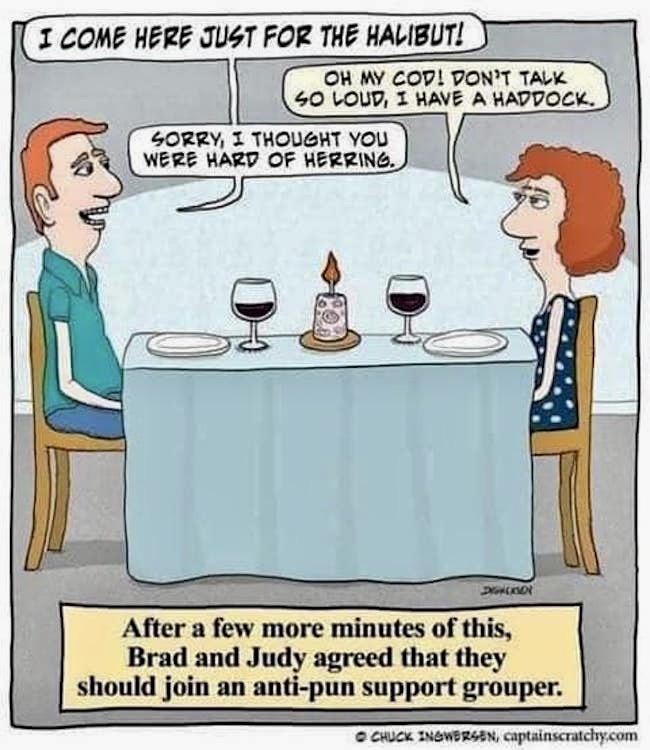
Through friends on Facebook yesterday, a Chuck Ingwersen cartoon with a cascade of four flagrantly imperfect puns — with a fish theme:

The pun census: halibut punning on hell of it; cod punning on god; haddock punning on headache; herring punning on hearing
A couple of these puns are phonologically very distant, but they can be understood easily because the context provides rich clues: halibut, in particular, is in the context of the idiom ‘(do something) just for the hell of it‘.
Though the word play is intricate, it’s merely phonological: despite the piscine theme of the puns, the cartoon is firmly located in just one world, that of diners in a restaurant; the characters are not also various species of fish, interacting in a metaphorical world. This isn’t a defect; almost all pun cartoons are merely phonological. But a few are also what I’ve come to call semiotically satisfying, evoking a parallel metaphorical world that complicatedly maps onto the base world. More on this below (I’m always on the lookout for semiotically satisfying cartoons).
Posted in Comic conventions, Language and animals, Language and food, Linguistics in the comics, Puns | 2 Comments »
October 5, 2023
(There will be a barely clad male model showing off his hot hairy body in Daily Jocks homowear ads; you have been warned. But otherwise this is, remarkably, a posting about art, in particular extraordinary public art)
The backdrop is yesterday’s posting “A remarkable table lamp” — about a “sculpture in bronze by George Sellers — one of his insect sculptures, in particular a magnificent staghorn beetle cast in solid bronze, on a walnut base, which Sellers has made into a lamp base”. Which I used as a proof of concept / principle, showing that it was now possible for me to post something, even with my swollen (but somewhat ameliorated) left hand, if I used my fingers on that hand gingerly. That posting was pretty bare-bones — no further illustrations of some of Sellers’s remarkable works — but it served its purpose, which was to demonstrate that I can once again post stuff, at least relatively short, uncomplicated stuff.
The current posting was intended as another relatively brief, easy affair, about a gesture, or pose, in a men’s underwear ad that happened by accident to surface on my desktop. But it led to that public art, in Fort Lauderdale FL. The two are unlikely to be connected, so there’s still a bit of a puzzle.
Read the rest of this entry »
Posted in Art, Language and the body, Language in advertising, Underwear | 1 Comment »
October 4, 2023
The generalization is that almost anything of the appropriate size can be used as the base of a table lamp, especially if it’s vertically oriented. If you happen to have a sculpture of the right size, or a piece of ceramic art, you could just display it as an art object, sitting around somewhere for admiration. Or you could put it to a good use as a lamp base, in which case it will be displayed right in the middle of things. And all sorts of art work has been exploited this way.
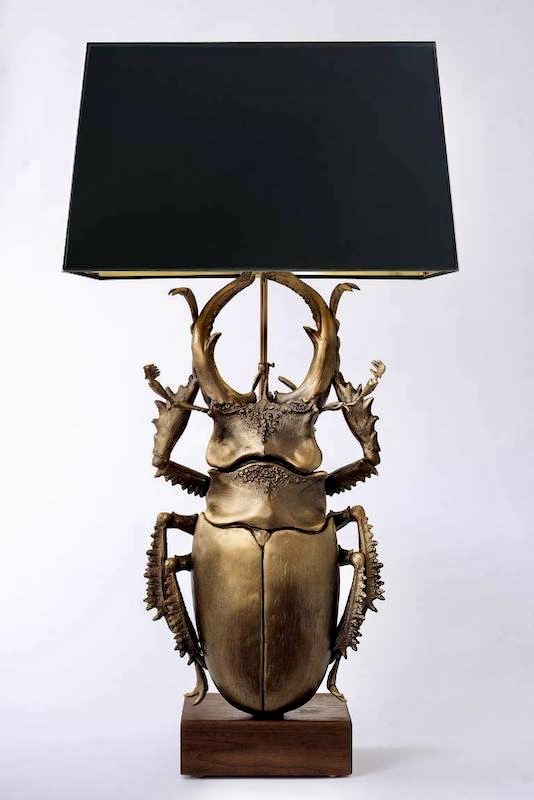
Suppose, more specifically, that you have scored a high-end sculpture in bronze by George Sellers — one of his insect sculptures, in particular a magnificent staghorn beetle cast in solid bronze, on a walnut base, which Sellers has made into a lamp base:

As reported on the 1stDibs site, where the lamp sold for $14,000
From the site:
Dallas based sculptor George Sellers studied in Italy, where he was trained in the traditional methods by a master carver. He creates seductively Gothic home furnishings and objets using plaster and bronze as his primary mediums. … large staghorn beetle sculpture table lamp cast in solid bronze on a walnut base, designed in a fine arts foundry using the lost-wax method of casting
The whole thing is 3 ft tall.
Read the rest of this entry »
Posted in Art, Furnishings and tools, Language and animals | Leave a Comment »