Trifecta time

February 12, 2024

(In the middle of this, with reference to my invention LDV Day, is a discussion of men’s bodies and of sex between men in elevated language — so technically not over the line, but certainly not to everyone’s taste.)

Three different occasions that happen around this time of year, on three different schedules, but this year come together in a single week. And we’re in the midst of it. First, two festivals of pleasure: the Valentine cluster (2/12 Lincoln Darwin Day; 2/13 LDV Day; 2/14 Valentine’s Day) and

Shrove Tuesday / Mardi Gras / Carnival / Pancake 🥞 Day / Fas(t)nacht / Doughnut 🍩 Day (in the land of my childhood). A day of — depending on where you are — food excesses, sexual excesses, raucous parading in the streets in fabulous costumes, role inversions, whatever, before the 40-day shriving of Lent, the Christian season of penance before Easter’s rebirth (through crucifixion and resurrection). (from my 2/13/23 posting “Abraham Lincoln hosts two festivals of pleasure”)

Mardi Gras — by the church calendar, tomorrow, though festivities are already in progress — is a moveable feast in the Christian liturgical calendar, dependent on the date of Easter, a date that’s calculated for each year from the phases of the moon. In 2024, the two festivals of pleasure happen to coincide; today is Lincoln Darwin Day and Wednesday is Valentine’s Day (which is also a family holiday for me, since it’s my daughter Elizabeth Daingerfield Zwicky’s birthday).

And then in 2024 these two festivals come during the continuing celebrations of the lunar new year according to traditional Chinese reckoning (in a 12-year cycle); a Year of the Dragon began on 2/10, and the parades and displays are still going on.

That’s the outline; a few more details, with some illustrations, follow. (Oh yes, this is also today’s MQOS Not Dead Yet posting, just more elaborate than usual.)

Read the rest of this entry »

Headline news for penguins: tiny sweaters Down Under

February 11, 2024

A Facebook alert today from Michael Palmer, reposting from Nadeesha Sonali Fonseka > Stranger Things in Stunning World on 2/9:

Australia’s oldest man Alfie Dates (109) knits tiny sweaters for injured penguins!


Some Aussie penguins in tiny sweaters

The Penguin Books sweater is especially sweet. And there’s a Rainbow Flag sweater too, for the politically conscious penguin.

(Yes, this is today’s Not Dead Yet posting. I have fantasies of writing somewhat longer-form entries, but life’s been difficult.)


Enter the dragon

February 10, 2024

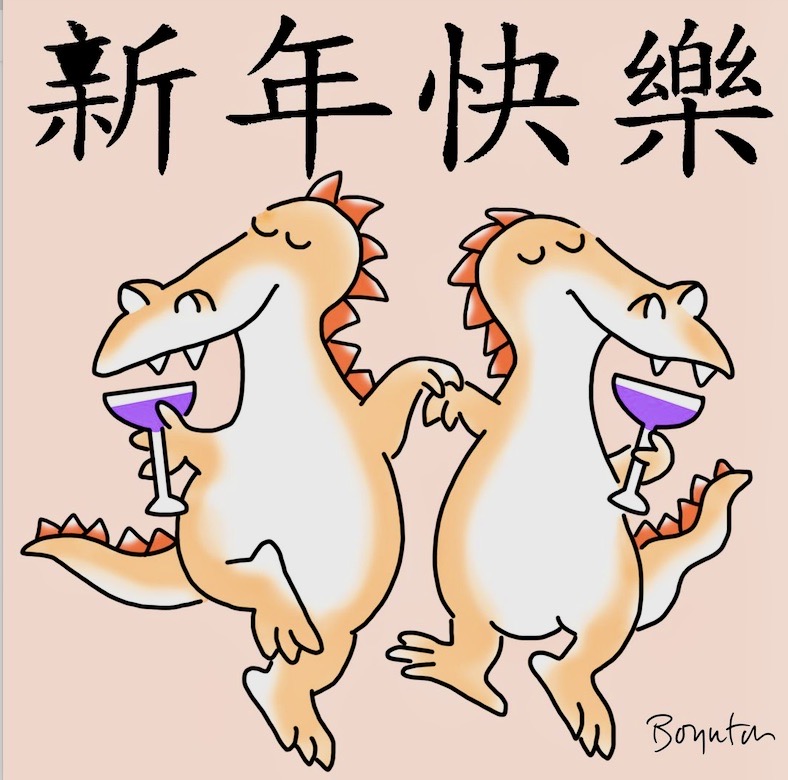
For this lunar new year, today the rabbit hops away and the dragon flies in, as it does every 12 years.  I am a dragon (born in 1940, 7 cycles ago), so for new year I have installed a cute stuffed dragon by my work space. Here’s Sandra Boynton’s celebratory artwork for the occasion (passed on to me by Chris Ambidge), with more cute dragons:


Gung hei fat choi / Gong xi fa cai

The full cycle: 1 rat, 2 ox, 3 tiger, 4 rabbit, 5 dragon, 6 snake / serpent, 7 horse, 8 goat, 9 monkey, 10 rooster, 11 dog, 12 pig


Pretty in a print

February 9, 2024

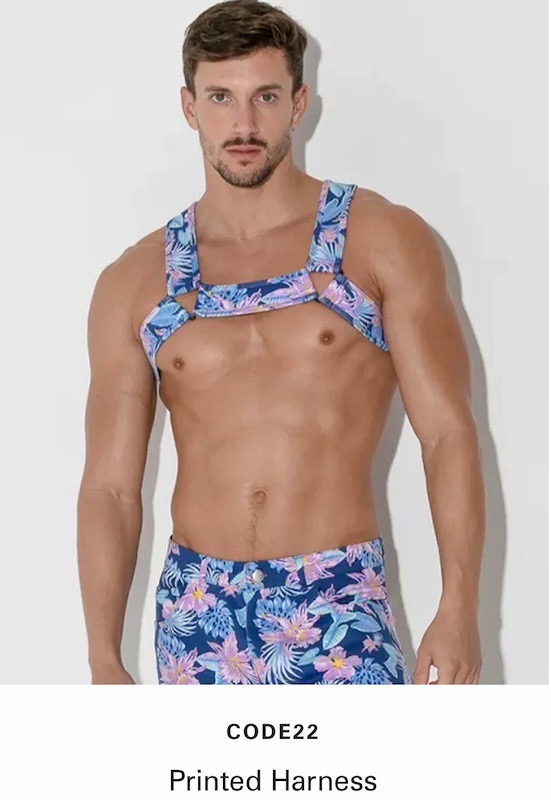
Lightning news: today’s MQoS Not Dead Yet posting (not dead yet, but emotionally in a dark valley), inspired by yesterday’s Daily Jocks mailing, which presented the company’s new styles: a set of remarkable, extravagant, showy pieces of fetish homowear, and this Code22 harness, which is instead just really pretty, like its matching shorts:


Beautiful shorts for men are no surprise, and knock-your-eyes-out harnesses (in shocking pink, flagrantly jeweled, whatever) can be read as defiant toughness, but a harness in a pretty print strikes me as sweet but out of place, like an XXL jockstrap pouch embroidered with cute cartoon flowers

Here’s the thing: harnesses for men (like dog collars for men) have moved from BDSMwear — harnesses as bondage, as restraint, and symbols of submission, but also as symbols of raw toughness (I can take whatever you put me through, sir) — and have largely yielded to harnesses as fashion statements, designed to show off the wearer’s pecs and nipples (as the Code22 harness does, quite satisfactorily).

Let’s dance

February 8, 2024

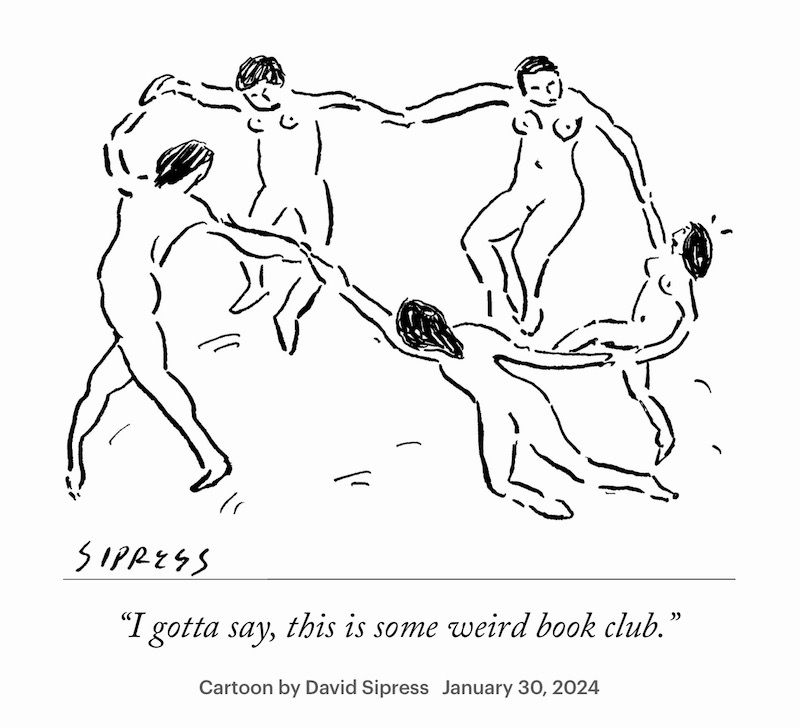
From the annals of visual allusion (bordering on parody or burlesque), this David Sipress cartoon in the 2/12&19/24 New Yorker:


(#1) A stripped-down, cartoonized, goofy reinterpretation of a key work of modern art, Matisse’s 1910 painting La Dance (the cartoonist is an old acquaintance on this blog; there is a Page here about my postings on his work)

Read the rest of this entry »

Santa sport

February 6, 2024

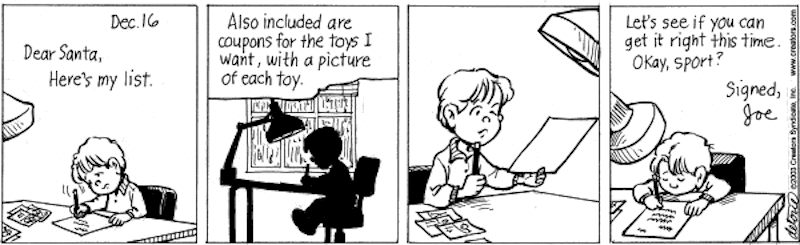
An old One Big Happy strip that recently came up in my comics feed:


Joe writes to Santa with a very specific gift list, with an accusatory flourish at the end (presupposing that in earlier years Santa had failed to honor Joe’s requests and telling Santa that now it’s time for the old guy to get it right) in which he addresses Santa as sport

This is one of those occasions where I pose questions that I’m in no position to answer, because I don’t have the resources to pursue them. I am an address terms guy — see the Page on this blog with links to my postings on the topic —  but sport isn’t a term I use myself, so I have no self-report data on it; and though dictionaries have some useful information on sport, they aren’t able to describe the complexities of usage of address terms like it; and, finally, sport is not one of the high-frequency address terms (like guy) that have gotten the attention of variationist sociolinguists, so we have no systematic data on the way it’s used.

Even so, my first response to Joe’s use was that it was odd. Somewhat antique, but more significantly, impertinent — treating Santa as if he were an equal, or in fact a subordinate. My impression is that Santa, in a somewhat old-fashioned way, might amiably address a little boy as sport, but little kids don’t talk to adults (especially powerful adults) that way. Such an impertinence would, however, fit right in with Joe’s challenge to Santa to get with the program of supplying Joe with the toys he’s asking for (well, demanding). Cheeky monkey.

Read the rest of this entry »

The joy of male love

February 4, 2024

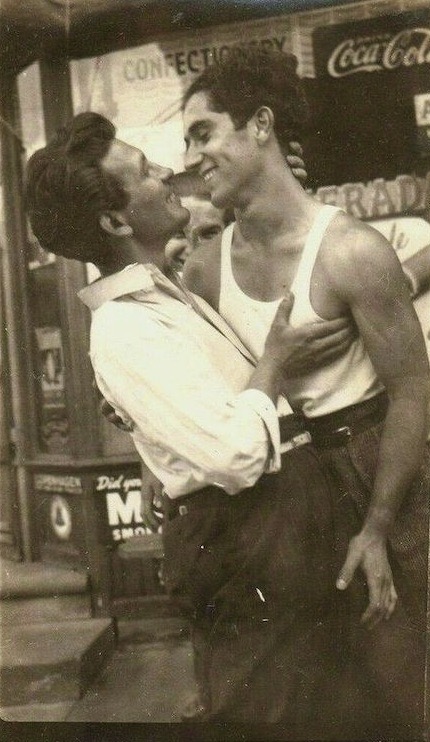
This vintage candid photograph, hot and sweet, which came up in my Pinterest feed this morning:


A joyful embrace, possibly the prelude to a kiss, with mutual hand-on-body action — from the setting and the men’s clothing, from the US in the 1930s or 40s

A Google images search yielded a ton of repostings of the photo with the claim that it comes from Loving: A Photographic History of Men in Love, 1850s-1950s. This caused me to go through my copy of the book, page by page, three times, hoping to glean some information about the source of the photo. But it’s not there. It’s very much in the spirit of the photos that are there, but it’s not in the book.

Eventually I found a couple of sources that reproduced the photo, with notes that it was a candid of unknown origin. I was hoping to get it fixed in time and place, at least approximately. Of course, what I really long for is to know who these men were and what their story was, how they risked having their sexy photo taken (by whom?), out on a public street, in a time of grave hostility to homosexuality, especially male homosexuality. Was this a fling moment, or a snapshot from their clandestine life together? What were they like, what brought them together, what happened to them?

Palilogia, we adore ya

February 3, 2024

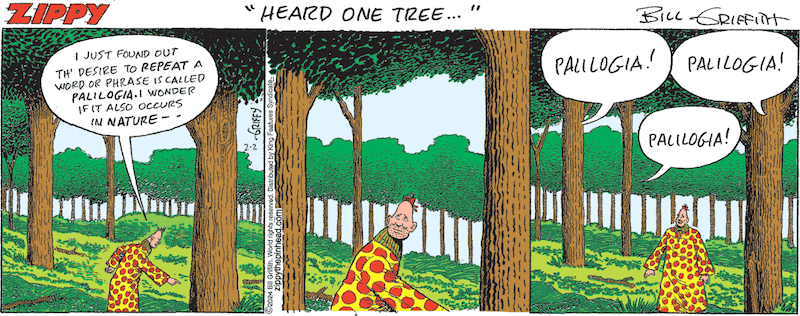
Yesterday’s Zippy strip shows our Pinhead submitting to (in his words) ‘the desire to repeat a word or phrase’, a condition that (borrowing from literature on rhetoric) he calls palilogia:


Here the palilogic impulse is to repeat the word palilogia itself — even by trees

Earlier Zippy strips referred to the clinical affliction phrase repetition disorder and the mantric or chanting practice onomatomania (there’s a Page on this blog about my postings on “Chants, cheers, mantras, onomatomania”). The rhetorical term — with Greek initial element pali(n) ‘again’ plus the ‘word’ stem log — merely refers to repetition; what Zippy’s usage adds is a note of impulse or compulsion that ties the term to phrase repetition disorder and onomatomania.

Read the rest of this entry »

The evil that AI chatbots can do

February 2, 2024

First thing. When AI chatbots first became available for private use, there was a fashion among my friends and colleagues in the academic world to ask a bot to compose their scholarly biography. The results were hysterically inaccurate, being composed of bits of actual fact embedded in largely confabulated narratives, with invented positions held, honors received, publications, and personal details as well. We laughed, but it was also more than a little scary: what if such bots were let loose on our public records?

Second thing. I have had a Wikipedia page for some years now. It was factual, and contained some things that are especially important to me, including a comment about my role in mentoring students (this was a significant part of my professorial life, in which I was able to encourage often-disregarded students — women, working-class students, black students, older students, lgbt students), and a mention of my most significant academic honor, election to the American Academy of Arts and Sciences; last time I looked, the page had not yet been revised to include my most recent honor, the creation of the Linguistic Society of America’s (annual) Arnold Zwicky Award, which “recognizes LGBTQ+ linguists who have made significant contributions to the discipline, the Society, or the wider LGBTQ+ community through scholarship, outreach, service, and/or teaching”.

The confluence of the two things. This morning I had occasion to check out my Wikipedia page (intending to recommend it to a Princeton classmate as  source of information about me), only to discover that it had been rewritten by a chatbot, which had of course fucked it up. My mentoring and my American Academy election were gone, and other parts of my life, personal and academic, were worked into a strange fiction (some details to come below), As with the bot-created scholarly biographies, it was possible to track down the sources of the misinformation, but very hard to see how to get any of this corrected, especially since the bot cited actual sources as backup for its mangled claims. (That is, real sources, but bizarrely interpreted by the bot. How can they be challenged? This is not the way Wikipedia was supposed to work.)

I can see no way out of this except to have my Wikipedia page deleted. Better nothing than this shit. Here I confess ignorance: what do I do to have my page deleted? Can any of my readers offer me solid advice?

Read the rest of this entry »

You’ve been seeing other fish

February 1, 2024

🐇 🐇 🐇 trois lapins to inaugurate the little month of February (which stretches this year to 29 days), beginning unfortunately in these parts in cold rains that will last for a week, and (this morning) in low air pressure that makes my joints so painful that I can barely get this posting typed and has depressed my vital signs (blood pressure, pulse rate, body temperature) so much that I’m light-headed, unsteady on my feet, and muzzy-minded (the upside is that low air pressure inevitably goes on to rise, so that if I can hang on a while things will get better)

But I’m not dead yet, and (for reasons I don’t understand) I’m not at all depressed — low air pressure often causes me to break into weeping in despair at the slightest provocation, and the unbroken gloom of these days would test anyone — just pissed off at being so incapacitated.

My morning has been cheered by today’s Rhymes With Orange comic strip (involving a talking pet fish and its keeper), which plays in a surprising way with two of the many verb senses of see:

Minimal lexicographic facts about the senses of see involved in this strip, from NOAD:

verb see: 1 [a] perceive with the eyes; discern visually … 4 [a] meet (someone one knows) socially or by chance … [c] meet regularly as a boyfriend or girlfriend

On hearing “You’ve been seeing other fish”, most people would understand it to be conveying sense 4c (for reasons I’ll explore below); what’s funny is that the strip sets things up — via three pieces of evidence that the keeper has just been to an aquarium, a place people go to to watch fish — so that we will take the fish to be using the unexpected sense 1a: surprise!

Read the rest of this entry »