Linguistics and its orthographically related disciplines

August 26, 2016

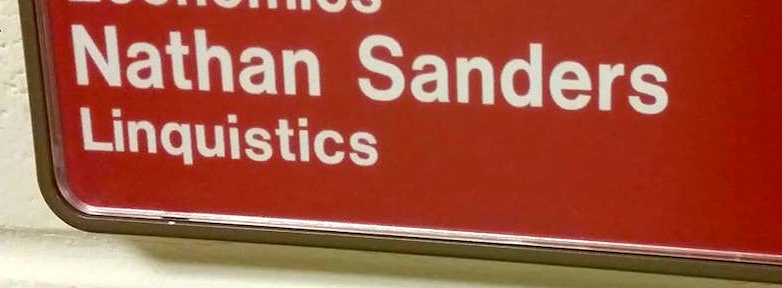
Nathan Sanders writes on Facebook to display the nameplate for his new position at Haverford College:

There are few people in LINGUISTICS who have not been afflicted by the spelling LINQUISTICS, or else LINGUSITICS. But it is a little-known fact that these are actual names of academic disciplines quite distinct from linguistics.

Read the rest of this entry »

Good poetic lines

August 25, 2016

From the 7/26 issue of the New York Review of Books, in “The Troubling Genius of Delmore” by Jonathan Galassi (a review of Once and for All: The Best of Delmore Schwartz, ed. by Craig Morgan Teicher and with an introduction by John Ashbery):

… The critic Michael Clune has written [where? Galassi doesn’t say, but maybe in Clune’s 2013 book Writing Against Time] about Ashbery that the basic unit of his poetic practice is not the book, or even the poem, but the line. I think the same can be said for Delmore; apart from his few best poems, what really stays with the reader are individual lines, some of them employed, with slight variations, as titles:

The heavy bear who goes with me…

In the naked bed, in Plato’s cave…

The beautiful American word, Sure…

Tired and unhappy, you think of houses…

We are Shakespearean, we are strangers.

The mind is a city like London, Smoky and populous…

The actual is like a moist handshake, damp with nervousness or the body’s heat.

It’s impossible to gainsay the brilliance of these phrases, even when great poems fail to rise out of them.

Read the rest of this entry »

More Ruthian re-shaping

August 25, 2016

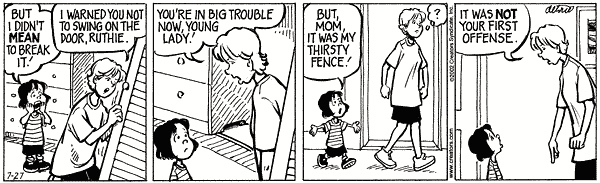
A One Big Happy (dated 7/27) in my comics feed today: once again, Ruthie re-shapes an unfamiliar expression, in this case the legal-tinged word offense (‘a breach of a law or rule; an illegal act’ — NOAD2), in the phrase first offense:

with first offense re-shaped as thirsty fence, a phrase that doesn’t make sense, but at least has the familiar word fence in it (and is very very close phonetically to first offense: initial f vs. 𝛉, unaccented ǝ vs. i or I).

I suppose it’s possible that at some point before the time of the strip, Ruthie heard first offense, didn’t understand it, and re-shaped it  But what the substitution really looks like is an old mishearing of first offense; mishearings very often don’t make sense, but do have parts that are recognizable words.

At this point, you’d really want to look at errors made by real, rather than cartoon, kids, in context.
 

November 11th, 2014

August 25, 2016

… was a banner day for cartoons in the New Yorker. Waiting a few minutes to get called in for routine blood tests at the Palo Alo Medical Foundation this morning, I chanced upon this particular issue of the magazine and found five cartoons of interest for this blog (plus some others I enjoyed but had no special interest here); all five were from artists already familiar on this blog.

Read the rest of this entry »

Ya gotta know the territory

August 25, 2016

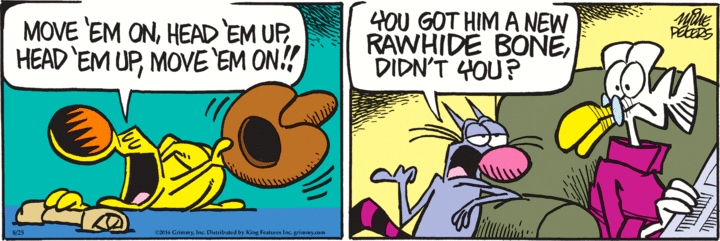
Another chapter in the long history of cultural background you need to see why some cartoons might be funny, or even to understand them at all. Today’s Mother Goose and Grimm, cat to Mother Goose about dog:

(#1)

Utterly baffling unless you know your 60s tv Westerns or are a big fan of Clint Eastwood.

Read the rest of this entry »

Four more Steinbergs

August 25, 2016

Posting recently on Edward Gorey reminded me of another wonderful artist / illustrator / cartoonist (artillustoonist?), admittedly of rather different tone, and I’ve created a Page for him. Herewith, four more (language-related) drawings by Saul Steinberg.

Read the rest of this entry »

Cartoon characters’ self-awareness

August 24, 2016

Yesterday’s Bizarro, way meta:

(If you’re puzzled by the odd symbol in the cartoon — Dan Piraro says there’s just one — see this Page.)

The conceit here is that the characters that appear in comic strips are in fact actors playing roles, so that they can go on strike (among other things). Even more, when the actors are absent, the activities in the strips just go on without them, as if the actors had simply become invisible. Invisible waiter (on strike) takes order from invisible diner (also on strike).

It’s not called Bizarro for nothing.


Associating with Zippy

August 24, 2016

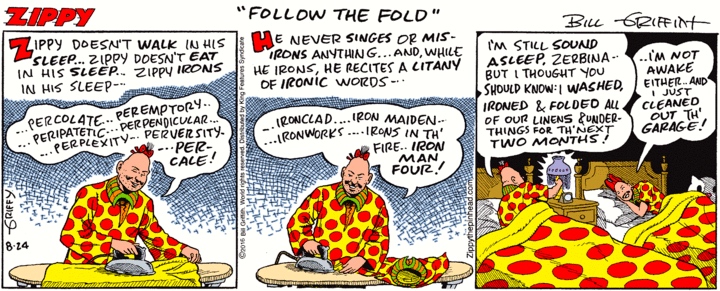
In today’s Zippy, our Pinhead falls into reveries of word association, prompted by the flatiron in his hand:

 width=

Not ironic words, but ferrous words, which takes us into the world of Ferris wheels, Ferris Bueller’s Day Off, Ferris mowers, Ferris State (in Big Rapids MI), Tim Ferris (the self-help writer and entrepreneur), Ferris TX and Ferris IL, Southern folklorist Bill Ferris (former chairman of the NEH), and from there we could branch into ferries and fairies and all sorts of good stuff.

Meanwhile, from percolate and percale, we can get all the perks available to those who only stand and iron.

Gorey on evil

August 24, 2016

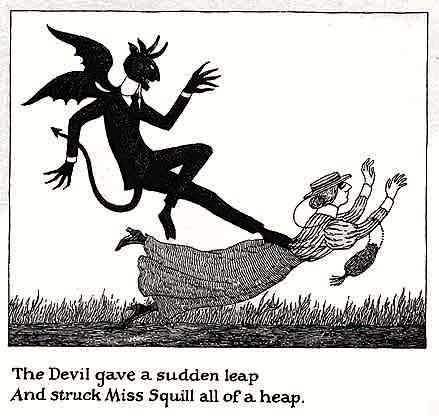
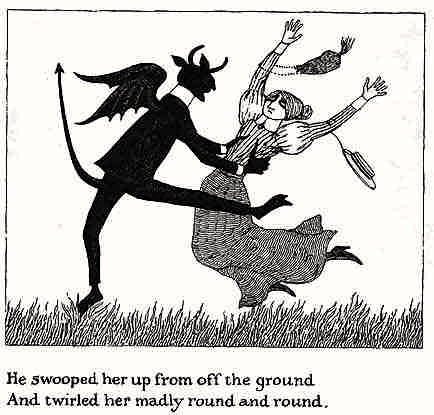
On Pinterest this morning, the first two panels of Edward Gorey’s The Disrespectful Summons (1971) (also in the collection Amphigorey Too):

(#1)

(#2)

Pleased by contemplating this reign of evil, I’ve assembled postings on Gorey into a Page on this blog.

Read the rest of this entry »

Briefly: vice-presidential anagrams

August 24, 2016

In the August 2016 issue of Funny Times, a reprinting of a Dave Barry column (from the 7/26 Miami Herald), “Is this what really goes on inside the Democratic dance and beer hall?” (about the Democratic National Convention in Philadelphia), ending:

I will conclude today’s report with the following:

UPDATE ON TIM KAINE: At this point, all we know for certain about him is that the letters in “Tim Kaine” can be rearranged to spell “I eat mink.”

Even better: “Ain’t Mike”.

As for his Repblican counterpart: “Mike Pence” anagrams to “Keep mince”, or better: “Pink emcee”. I love the idea of anti-gay Pence flouncing on stage in pink.

That concludes today’s political commentary.