Q-Neg scope in the comics

August 23, 2016

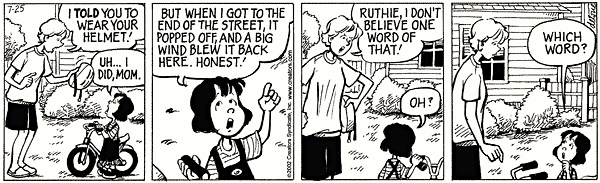
The One Big Happy in my feed today (dated 7/25):

It’s a question of the relative scoping of a quantifier ∃, of existence, and ¬, negation, with respect to the propositional-attitude verb (Ibelieve. In a crude informal symbolism:

¬ (∃ (X: one-word-you-said, I-believe X)) ‘there’s not one word you said that I believe’ (equivalent to ‘every word you said, I didn’t believe it’) — what Ruthie’s mother intends

∃ (X: one-word-you-said, ¬ (I-believe X)) ‘there’s one word you said that I don’t believe’ — what Ruthie understands


More on the David

August 23, 2016

News for Italian Renaissance penises, part 2. Material from the New York Times Magazine on the 21st — racy topic, but not officially X-rated.

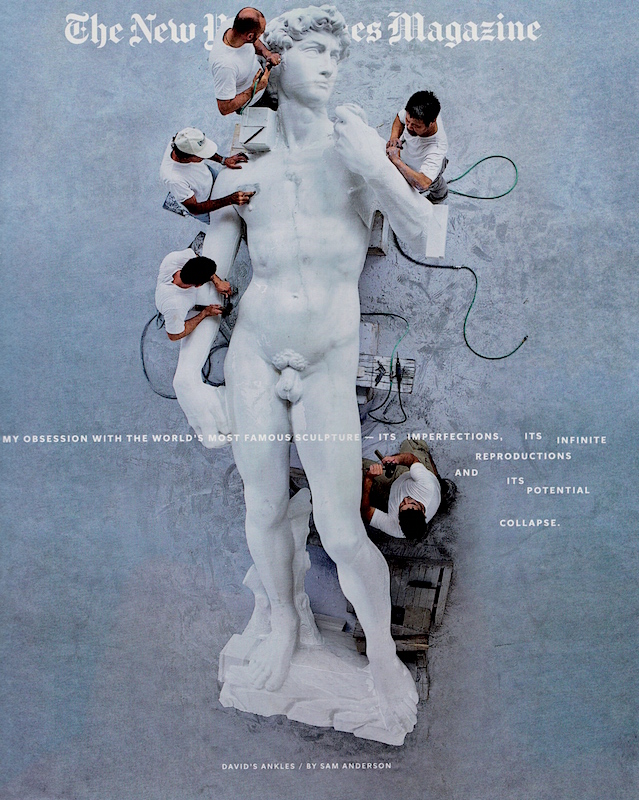
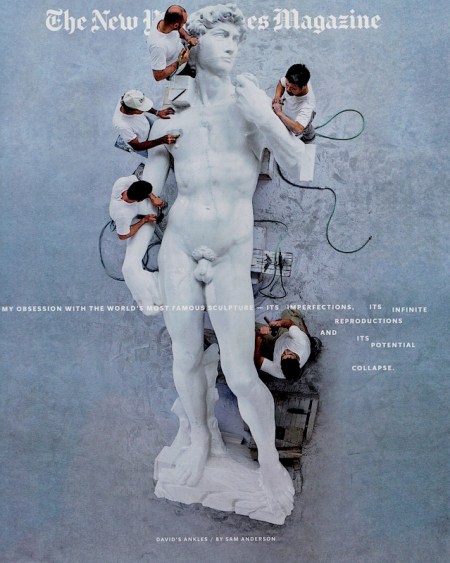
Part 1 yesterday, with the cover of the issue, showing a crew working on a reproduction of Michelangelo’s David in Carrara, Italy (photo by Maurizio Cattelan), with David’s penis right in the center of the image. Then the story, “David’s Ankles: How Imperfections Could Bring Down the World’s Most Perfect Statue: My obsession with the flaws, reproductions and potential collapse of Michelangelo’s masterpiece” by Sam Anderson. Not ordinary reportage, but a “personal essay”, about Anderson’s experiences and emotions — though with plenty of research about the city of Florence (Firenze), its history, the artist Michelangelo, and the creation of the statue (which Anderson refers to as the David), also with Anderson’s interviews with significant parties in the current rescue efforts.

The penis of the David — probably the most famous and the most viewed penis in the Western world — is a recurrent theme in Anderson’s essay. A few words about the David’s genitals, and then on to excerpts from Anderson’s essay.

Read the rest of this entry »

The Fine Art Exemption

August 22, 2016

The media news for penises.

The cover of yesterday’s New York Times Magazine, illustrating a story about Michelangelo’s David:
Shocking! A penis in the NYT! The word penis, quite a lot, but photographs, sculptures, drawings, etc. of penises, no. They would be at the very least crude, tasteless, and offensive, at the worst dangerous, because viewing them (so the story goes) is by its very nature damaging to sensitive people: to women in general, to children in general, hence especially to girls.

There is a customary Fine Art Exemption to the general ban on penises (or accurate representations of them)  in “family publications” (where the sensitive might come across them). This clause exempts penises in fine art, especially of high reputation and considerable age, where fine art is

creative art, especially visual art, whose products are to be appreciated primarily or solely for their imaginative, aesthetic, or intellectual content (NOAD2)

I’ve always found the FAE baffling, at least in its application to children.

Read the rest of this entry »
A ewer in the morning

August 22, 2016

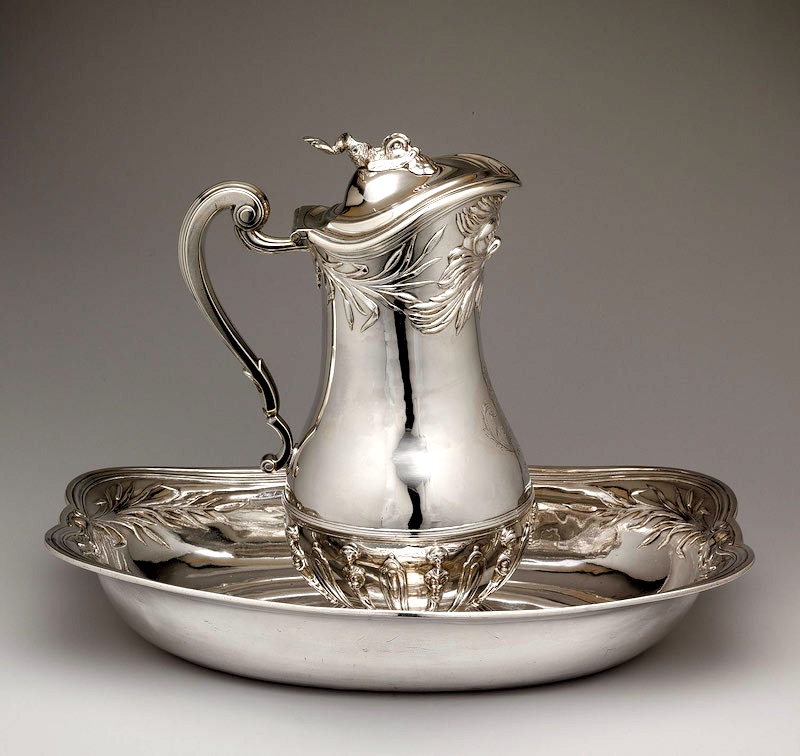
Today’s morning name: ewer. An eminently useful object that has received the attentions of designers for millennia, craftsmen who lavished their skills on these objects to create items of great beauty. for instance;

(#1)

Read the rest of this entry »

Leading by jargon

August 21, 2016

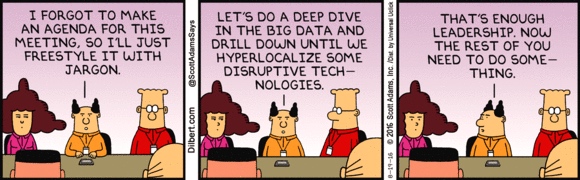
The Dilbert from a couple days ago, the pointy-haired boss exhibiting leadership:

I have often defended some uses of what outsiders think of as mere jargon as useful, even necessary, for insiders’ purposes. But there are fashions in everything, vocabulary included, and there are occasions when people paper over a lack of thought with verbiage.

When necessary, the pointy-haired boss can roll out a veritable jargonaut. And then pass the baton of leadership on to his nonplussed staff.

A compound puzzle

August 21, 2016

Thursday on ADS-L, a report from Wilson Gray, with his baffled reaction (shared by others in the mailing list):

Headline of political ad: “Meet TPP Champion [Name]!”

Body of political ad: “Among a handful of shining examples of fighters for social, economic, and environmental justice stands [Name], who has opposed the TPP and TTIP since before most of us had even heard about them!” [TPP: Trans Pacific Partnership; TTIP: Transatlantic Trade and Investment Partnership]

Is this headline meant to convey the idea, somehow, that [Name] is a “TPP champion” not in the obvious sense that he champions the TPP against the left, but, instead, in the opposite sense, that he champions the left against the TPP?

How are we to interpret X champion? It’ll be helpful to get away from the particulars of this particular example by introducing an X that (I hope) will have no political associations for my readers: Fosdick. What might Fosdick champion refer to? In NPs like:

a Fosdick champion, the Fosdick champion, our Fosdick champion

an early Fosdick champion, the celebrated Fosdick champion, our greatest Fosdick champion

Read the rest of this entry »

Jamie Dornan

August 21, 2016

The actor and model, on this blog yesterday because of his starring role (with Gillian Anderson) in the disturbing tv series The Fall. And now here as well for his uber-hunkiness as a fashion model.

A publicity head shot of Dornan, looking amiable:

(#1)

(If you’ve seen The Fall, you might put a different interpretation on this photo — an observation about how our perceptions can be colored by our experience.)

Read the rest of this entry »

“What you done, sunshine, is criminal damage”

August 21, 2016

The 1975 quotation (in Green’s Dictionary of Slang) is from a (British working-class) policeman, who “levelled a finger at” a man and made this accusation. My interest here is in the address term sunshine, which has become familiar to me though British (occasionally Canadian) police procedural tv shows, where the cops (or private detectives) often use this form of address, aggressively, to male suspects. From the New Partridge Dictionary of Slang and Unconventional English (ed. Tom Dalzell & Terry Victor, 2015), p. 2192:

used as a form of address, often patronizing with an underlying note of disapproval or threat UK, 1972

A (very natural) extension of literal sunshine to ‘cheerfulness, happiness’ has been around for some time, as has the extension to someone who exhibits or elicits cheerfulness or happiness, in both referential and vocative uses. Then, the address term sunshine (like any other) can be used sarcastically, aggressively, or truculently, but the conventionalization of such uses specifically in British (and not American) English, for use to men by men, especially by official authorities, is yet a further development, one that I hadn’t experienced until I got into modern police procedurals, in books and on tv.

Read the rest of this entry »

Give me some men who are square-jawed men

August 20, 2016

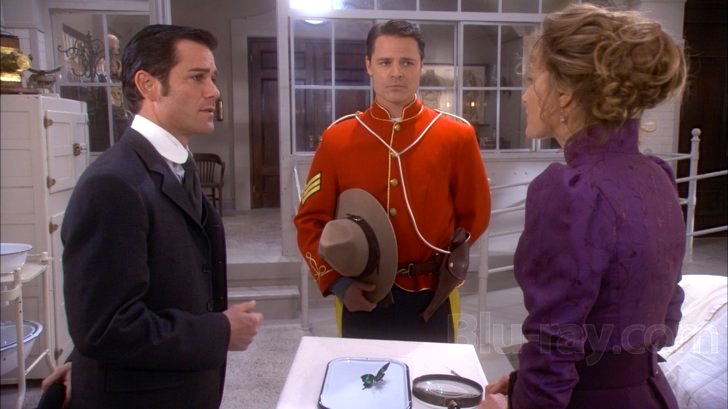
Taking a break from the almost unrelieved despair of two dark British detective series (Broadchurch and The Fall), I returned to more entertaining murders, in the Canadian series Murdoch Mysteries, where I came across S2 E13 (“Anything You Can Do…”,  originally aired 5/27/09), in which Victorian-era Toronto Detective William Murdoch (played by Yannick Bisson) confronts Sergeant Jasper Linney of the Mounties (Dylan Neal) over a murder case. Here are Murdoch and Linney with medical examiner Dr. Julia Ogden (Hélène Joy):

(#1)

You’ll see that both the men have notably strong jaws, Neal-as-Linney almost absurdly so; no doubt he was cast to be a caricature of the Mountie of myth: from Renfrew and Sergeant Preston on through the comic figures Dudley Do-Right (in Rocky and Bullwinkle) and Constable Benton Fraser (Paul Gross) in Due South (1994-99).

In principle, this posting is about square jaws on men, but there will be many side trips, including shirtless photos of Bisson.

Read the rest of this entry »

Meatballs!

August 19, 2016

My breakfast this morning — my breakfasts are often hearty — was Cajun meatballs with sauteed vegetables (prominently, okra) and rice. Quite pleasant, but I can’t help thinking that meatballs are intrinsically funny. Maybe it’s the balls thing, or maybe the assortment of deprecatory uses of meatball(s), or maybe just the appearance of four sizable stolid globes of ground meat on a plate. (I would blame the kid song “On Top of Spaghetti” — see here — if I could, but it wasn’t written until well after my childhood.)

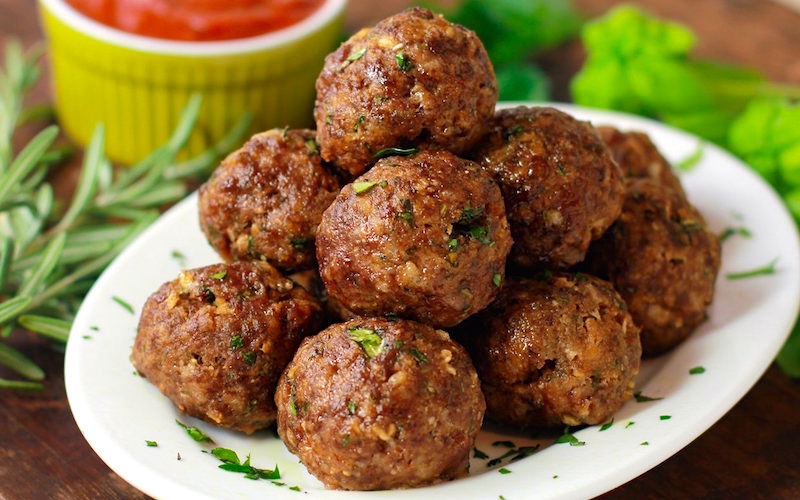
An arrangement of (as it happens, Italian) meatballs on a platter, looking much like an array of cannonballs:

(#1)

Then I began wondering about the conventionalized phrase meatball surgery, which I remember from the American television show M*A*S*H and also from an overheard argument among my surgeons about how to handle the necrotizing fasciitis advancing on my right arm.

And now my meatball bulletin.

Read the rest of this entry »