February 4, 2025
(saintly male bodies seen through worldly eyes and treated in sometimes very plain talk, so not to everyone’s taste)
From Susan Benson Hamel yesterday:
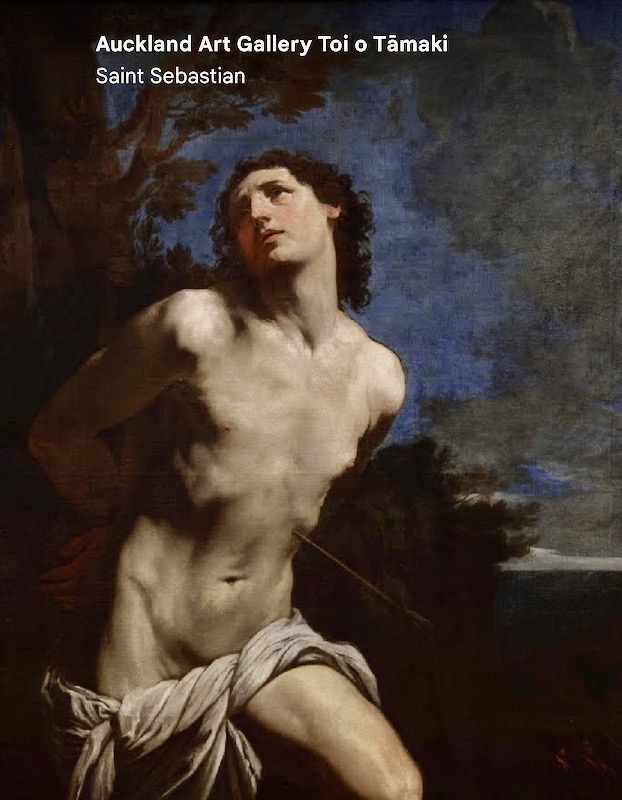
Thought of you yesterday when I was in the Auckland art gallery and came across this delightfully coy St Sebastian by Guido Reni:

(#1) There are an astonishing number of St. Sebastians out there; this Reni really is wonderful (I said to SBH), in its dreamy gaze welcoming death, and all done with a single mortal arrow (plus, Reni dwells lovingly on the saint’s body, giving what many have seen as a homoerotic cast to the painting; and his private parts are just barely concealed, as in a cock tease)
Read the rest of this entry »
Posted in Art, Gender and sexuality, Language and religion, Language and the body, Signs and symbols | Leave a Comment »
February 3, 2025
Nathan W. Pyle’s Strange Planet strip from 1/27/25:

Pyle’s beings on an alien planet cope with the sociocultural world of this one with their views framed in a variety of English that lacks the usual terms, so they concoct fresh ones (slicer for knife, stabber for fork, scooper for spoon, ingest for eat); in this strip, the subject is the education of the young in the etiquette of dining, and it comes with a meta-lesson
Read the rest of this entry »
Posted in Linguistics in the comics, Social interactions, Social life, Sociocultural conventions, Words and things | Leave a Comment »
February 3, 2025
Caught out of the corner of my ear on 2/1 and 2/2, discussions on MSNBC (which might have been re-plays from earlier dates, I haven’t been able to tell) with Nikole Hannah-Jones (creator of The 1619 Project), about the Nadir, or Great Nadir, of American race relations. I’ve since looked up some information on the subject (see below), but what got my attention was the pronunciation of nadir — back-accented nuh-DEER /nǝdír/ or sometimes nay-DEER /nèdír/ — that everyone involved used all throughout these exchanges; it stood out like the proverbial sore thumb because, I’m sure, I’d never heard it before. It was totally bizarre.
Read the rest of this entry »
Posted in History, Pronunciation, Race and ethnicity | 5 Comments »
February 2, 2025
Links from Wayles Browne (a regular visitor to this blog from far above Cayuga’s waters), attached to my Ancho Rabbit posting from yesterday, which I will now expand into a posting for Groundhog Day (2/2):
The BBC reports on Groundhog Day: it’s six more weeks of winter.
And of linguistic interest: a Pennsylvania Dutch poem about the groundhog and his, or rather her, day [the BBC report “How the Pennsylvania Dutch created Groundhog Day”; in PaDu, it’s die Grundsau ‘the groundsow’] (as read by Cornell’s old grad student Mark Louden).
Read the rest of this entry »
Posted in Ethnonyms and demonyms, German, Holidays, Language and animals, Language and class, Language and ethnicity, My life, Poetry, Variation | Leave a Comment »
February 1, 2025
🐇 🐇 🐇 rabbit rabbit rabbit to welcome the month of February, the month of Lincoln Darwin Day and of Valentine’s Day (this year, Mardi Gras doesn’t come until early in March)
It’s Rabbit Day, and what happens to be at the top of my posting queue has nothing to do with rabbits; it’s a Bizarro cartoon (from yesterday, 1/31) with a tasty culinary artmanteau:

(#1) The portmanteau Michelancho = Michelangelo (the 16th-century Italian artist Michelangelo Buonarotti, painter of the ceiling of the Sistine Chapel in Rome) + ancho (the dried poblano chili / chile pepper) (if you’re puzzled by the odd symbols in the cartoon — Wayno says there are 3 in this strip — see this Page)
(an alternative culinary artmanteau: (Michelangelo) Anchorotti = ancho + Buonarotti)
(plus, I note that #1 is about Michelangelo the Ancho Honcho, the Man of La Mancho, also one of the lesser-known film Manchowiczes, etc.)
Now some brief notes on anchos, and then a surprise finale in which today’s rabbits get cooked with anchos, in the triumph of culinary artistry conejo en adobo with red chiles, which you can think of as Rabbit Michelancho.
Read the rest of this entry »
Posted in Art, Events and occasions, Language and animals, Language and food, Language and plants, Language play, Linguistics in the comics, Portmanteaus, Puns, Spanish | 4 Comments »
January 31, 2025
(dirty verse — a raunchy burlesque of some scurrilous doggerel — so not for kids or the sexually modest)
This is what I wrote to cease my weeping at a moment this morning when a number of MSNBC commenters, who were variously black, Jewish, female, and queer, struggled not to break down in hurt, anger, and despair in reporting on Anaranjado Grabpussy’s apparently declaring a ban on federal celebrations of DEI occasions (Black History Month, Pride, etc.). Further inspired by someone ranting, I don’t know why, on Facebook about Dildo as if it were the name of a person, a character in some social drama.
Read the rest of this entry »
Posted in Latin, My life, Parody, Poetic form, Quotations, Taboo language and slurs | 4 Comments »
January 31, 2025
🐅 🐅 🐅 three tigers for ultimate January, and a day continuing the theme of late-January early-death birthdays: Robert Burns, Wolfgang Amadeus Mozart, and Edward Sapir in an earlier posting of mine (“Luminous birthdays” from 1/26); now, Anton Chekhov two days ago and Franz Schubert today
Meanwhile, tigers savage rabbits, but the rabbits of February are clamoring at the door, growing in size and ferocity, and are now prepared to chew up the tigers like mere blades of grass. A monument in bread to the coming triumph of these adorable but gigantic bunnies:

(#1) Today: from Benita Bendon Campbell, who got it from Jacqueline Martinez Wells
Read the rest of this entry »
Posted in Clothing, Events and occasions, Hats, Language and animals, Lexical semantics, Linguistics in the comics, Metaphor, Variation | 2 Comments »
January 30, 2025
Yesterday, Laura Michaelis (Univ. of Colorado-Boulder co-author of, among other things, the 2020 Cambridge book Syntactic Constructions in English) alerted me to an article by Philip Miller (Université Paris Cité) & Peter W. Culicover (Ohio State Univ. & Univ. of Washington), “Lexical be“, Journal of Linguistics (2025), 1-24 — truly, hot off the press — which argues, in elegant detail, for a constructional approach to syntactic description, involving the positive licensing of constructions (rather than (negative) constraints on syntactic structures), and also honors Geoffrey K. Pullum (Professor Emeritus of General Linguistics at the University of Edinburgh).
So, yes, a fair amount of technical stuff, showing a bit of how (some) linguists approach the description of the syntax of one language and how they dispute with one another over the form of such descriptions. (I’m mostly just an observer here, but you should know that everyone I just mentioned — Michaelis, Miller, Culicover, Pullum — has been a departmental colleague or co-author of mine, so I have to be seen as a participant-observer, as we say in sociolinguistics.)
Read the rest of this entry »
Posted in Compositional semantics, Constructions, Context, Linguists, Pragmatics, Semantics, Syntax | 1 Comment »
January 29, 2025
elegantized insult: a replacement for an insulting word or phrase that’s notably more elegant than the replaced item, by using material from either the specialized or technical Greco-Latin stratum of English vocabulary or its very formal registers, for the purpose of humor, either pointed mockery (amplifying the insult) or droll playfulness (entertaining the audience).
Two examples conveying ‘without courage’. An example of the first type (and conveying mockery) came to me a few days ago in e-mail: anorchídic as a replacement for the insult ball-less. Then an example of the second type (and conveying jocularity): lacking intestinal fortitude for the insult gutless. I’ll go through the examples in some detail, and then riff some on sophisticated insults, in various senses of sophisticated.
Read the rest of this entry »
Posted in Euphemism, Figurative language, Humor, Insults, Metaphor, Pragmatics, Slang, Style and register, Taboo language and slurs | 5 Comments »
January 28, 2025
Returning to a very old topic on this blog, making small advances on some outstanding puzzles. It starts with my 6/8/11 posting (yes, 14 years ago) “Parasites and the body politic”, about
my dismayed reaction to recent political assaults on teachers (and, more generally, public employees) as drains on the economy, selfishly demanding decent wages and benefits while being “unproductive”, producing nothing of significance. Lots of things are going on at once here — contempt for the working classes and for service workers like maids, cooks, gardeners, and janitors (and, yes, teachers); classic American anti-intellectualism (cue Richard Hofstadter); marketplace valuation of people’s worth; and more — but parallel attitudes surface in the way many people view academics, so it hits close to home for me.
Then the anecdote. Some years ago I was at some large public function involving people of money and substance and, wine glass in hand, struck up a conversation with another attendee. This guy plunged right in by asking me what I do [for a living]. (In many cultures, the leading question would be some version of “Where are you from?”, meaning “Who are your people?”, but in ours it has to do with occupation. All such questions are designed to position a stranger socially.)
I said I was a university professor, and, without waiting to identify himself occupationally, he said
Artists and scholars are parasites on the body politic. [call this State Suckers, SS for short]
Read the rest of this entry »
Posted in Academic life, Formulaic language, Idioms, Insults, Language and politics, My life, Speech acts | Leave a Comment »