The One Big Happy from May 11th, in which Ruthie discovers that there are contractions and then there are contractions:
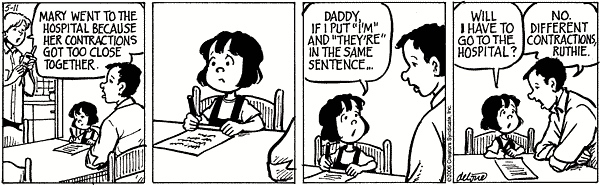
The One Big Happy from May 11th, in which Ruthie discovers that there are contractions and then there are contractions:
Kim Darnell, laboring to assemble a Page for this blog on postings about Switzerland and the Swiss, passed on a charming BBC News video from the 4th, “The Swiss master watchmaker running out of time”:
 (#1)
(#1)
Philippe Dufour [born 1948 in Le Sentier, Canton of Vaud, Swtzerland] has been making watches by hand for 50 years but has no-one to pass his skills on to.
He tells the BBC what it means to be one of the very few watchmakers remaining in the craft.
The watches sell for $50,000 and up each — but then each watch takes months of labor to make, and they are artworks in themselves.
I then thought to look for Zwickys in the Swiss watch business, and immediately netted Joëlle Zwicky, at the International Watch Company in Schaffhausen — industrial watchmakers, but at the very high end of the industry. And with an office of Corporate Social Responsibility, which JZ heads.
(Underwear and race / ethnicity / nationality / religion among gay men.)
News from Daily Jocks: a birthday for the Australian premium men’s underwear firms 2eros and Supawear (brothers in sexwear):

(#1) 2eros
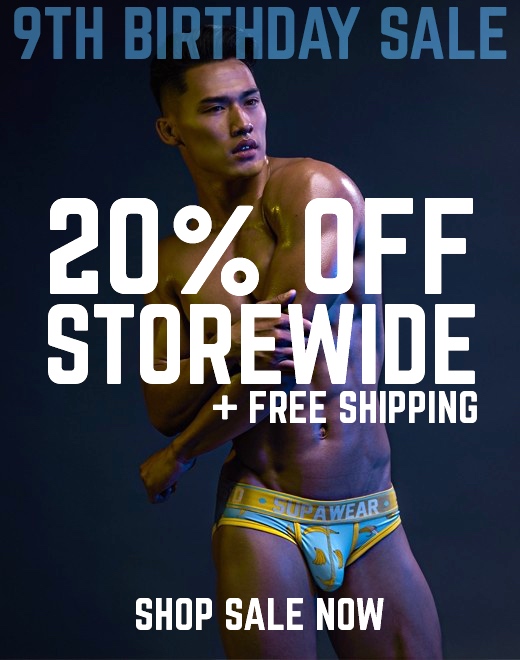
(#2) Supawear
Notably, Asian models for the birthday celebration. Most sexunderwear firms are very light on black models, Latino models, Asian models (of all ethnicities and nationalities), and, for that matter, identifiably Jewish models. Andrew Christian is, on the whole, a stunning exception: his advertising reflects the use of “exotic” models in the fashion industry rather than the custom in the premium men’s underwear industry of relying on models whose looks are pumped-up mirrors of their customers’. The customers are mostly SAE-D — standard average European-descended — men (“standard average European” here is a little linguist’s joke, making reference to Standard Average European (SAE) languages, in Benjamin Lee Whorf’s terminology); the products either flatter their self-images or feed their fantasies of exotic men (for certain values of exotic).
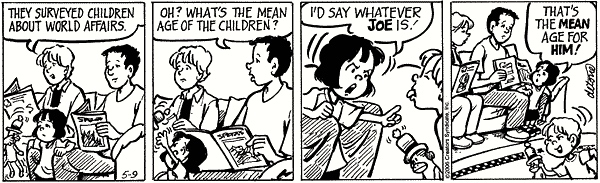
In the May 9th One Big Happy, Ruthie is faced with the ambiguity of modifying mean — and, unsurprisingly, opts for a familiar sense rather than a technical one:
For 2018’s Pride Month…
From the UK Pink News, “Antarctica is about to have its first ever Pride” by Jess Glass on 5/28/18:
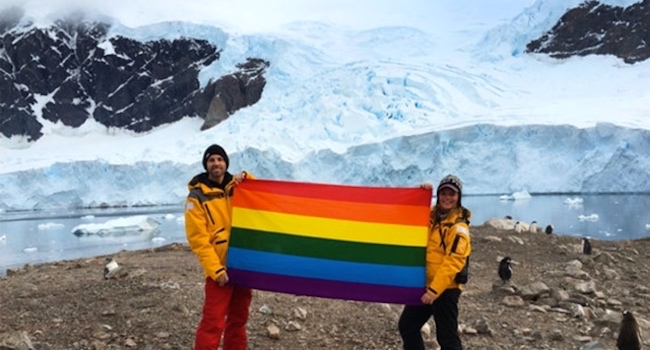
Antarctica is set to have its first ever Pride event – thanks to a group of LGBT people based in an Antarctic research centre.
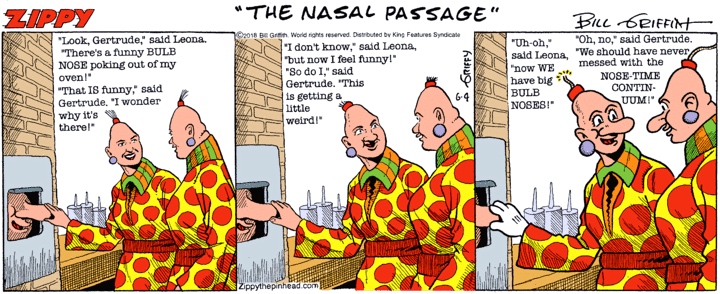
Today’s Zippy is a re-play of a drawing from 2015, now with dialogue:
 (#1)
(#1)
Stroke the nose and you slip through the nasal passage in the nose-time continuum to the bulbous-nose Cartoonosity region of Zippyland.
Posted by a Facebook foaf today, this Bizarro from 10/14/10:

(If you’re puzzled by the odd symbols in the cartoon — Dan Piraro says there are 5 in this strip — see this Page.)
The Psychiatrist meme, with a talking dog as a bonus. Plus, in my title, a nominal with the pseudo-adjective canine — and it’s ambiguous.
(After some extended moments of reflections on religious belief, this posting will venture into the sexual wilds, and the later material will not be suitable for kids or the sexually modest.)
Two design drawings by Elizabeth Daingerfield Zwicky (from a set available to the public in an Instagram file): one a rose window (alluding indirectly to such images at Stanford’s Memorial Church, which serve as potent Christian symbols); and one suggesting tongues of flame / fire (alluding to those that figure in the Christian religious holiday of Pentecost, which fell this year on Sunday, May 20th). Two religious symbols, with associated linguistic expressions (rose window; tongues of flame/fire, to speak in tongues).
First, things: the rose, and flames.
Then, these things serving as symbols in Christian ways of thinking (actually, each can have several different symbolic values, even within this specific sociocultural context).
Then, these symbols, with these values, deployed in art, music, film, and fiction, and even in food and in plant names.
Then, the original things — rose and flames — serving as symbols in other sociocultural contexts: in particular, as sexual symbols, for body parts and for sexual acts.
Link passed on by Nelson Minar to a MetaFilter posting yesterday on “Approaches to Metered Verse”:
At The Paris Review, Anthony Madrid works through “A Homework Assignment from W. H. Auden” that others have also tried. At Herbert Tucker’s For Better For Verse, two introductory exercises are worked out on the instructions page, and another explains itself; for the rest, click above, on, and right of each line to try to solve. Several linguistic introductions are available online too, e.g. Mark Liberman, “An Internet Pilgrim’s Guide to Accentual-Syllabic Verse” (etc., etc.); Arnold Zwicky, “Word Accent, Phrase Accent, and Meter” [PDF]; and Bruce Hayes & Russell Schuh, Linguistics 251: Metrics (+ earlier version). Incidentally, Auden’s original [PDF] “hardest course in the humanities” [PDF] required memorization of poetry–a practice historically linked with meter.