Archive for the ‘Writing’ Category

Losing the author’s “voice”

March 8, 2011

In the “Lives” feature of the NYT Magazine on March 6, an affecting piece by Justin Horner, “The Tire Iron and the Tamale”, about three roadside breakdowns and the people who stopped to help Horner (Mexican immigrants who didn’t speak English, every time, including the occasion he recounts in this column). In the story, Horner not only gets help with his flat tire, the daughter of the family gives him a tamale to slake his hunger, and her father refuses to accept payment for his services, telling Horner, in effect, to pass it on. (I’ve had experiences like this myself, several times.)

Then comes the information at the bottom of the page:

Justin Horner is a graphic designer living in Portland, Ore. This essay was adapted from a message-board posting on reddit.com.

Considerably adapted, as it turns out, with some alterations that are predictable for the NYT (prudishly replacing or omitting shit and fuck), others that alter the tone of the piece (eliminating dude and other vernacular expressions), and some more subtle.

(more…)

Rough Boy

March 7, 2011

In the NYT New York section today, a delightful story about public art and gender politics (“For Unloved Queens Statue, Brooklyn Cemetery May Be the Last Stop” by Jay Maeder), with some entertaining writing as a bonus.

(more…)

Paper magazines

January 22, 2011

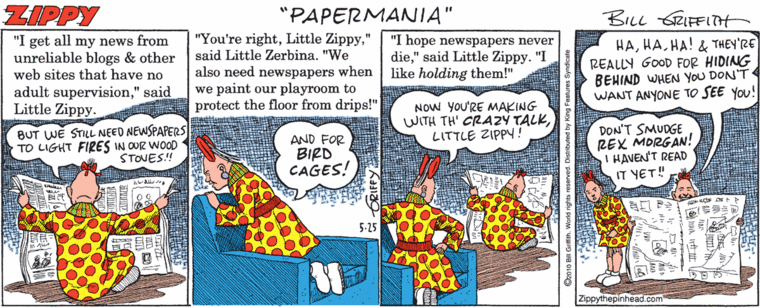
Today’s Zippy, another one in which Griffy bemoans the digitalization of everything:

Child spelling

January 16, 2011

… and the mechanical conventions of writing.

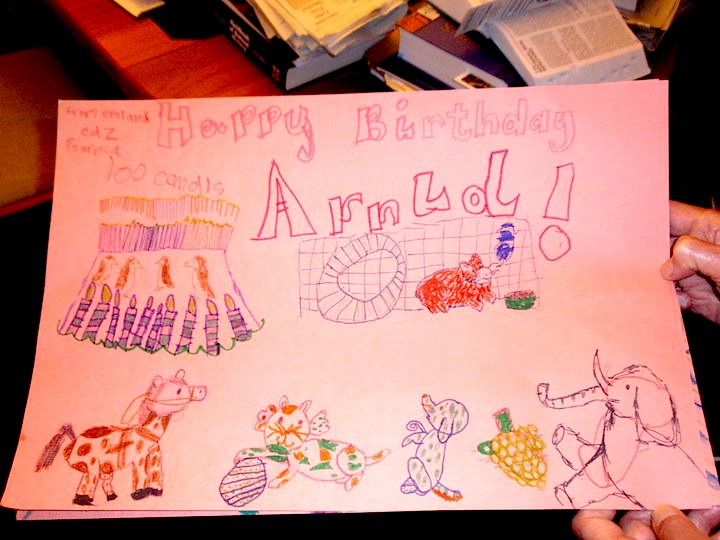
Exhibit A, a drawing that my grand-daughter Opal made for me on the occasion of my 70th birthday, back in September:

(Those are 100 candles, because Opal didn’t think 70 were enough.)

The point is the carefully outlined spelling of my name: ARNLD.

(more…)

Quotes and footnotes

January 7, 2011

Two volumes of bookish cultural history that I’ve been reading: Willis Goth Regier’s Quotology (Univ. of Nebraska Press, 2010), about quotations, and Anthony Grafton’s The Footnote: A Curious History (Harvard Univ. Press, 1997), about, obviously, footnotes. Both packed with fascinating detail, though their style and audiences are rather different.

(more…)

Internet writing rant

January 3, 2011

A way-over-the-top rant on internet writing, here (hat tip to Bruce Webster):

Hey, Y R U Not Paying Attention?

Strong language warning, but it’s all in a good cause. Besides, you probably need this or know someone who does.

The long text begins:

Y, R & U
ARE FUCKING
LETTERS
NOT FUCKING WORDS

and goes on to bitch about texting abbreviations, apostrophe misuse, comma misuse, and common misspellings. I’m not able to post the thing here, because the resolution of the image is too poor, but you can enjoy the version on the American Digest site.

Writing and typing

October 20, 2010

Entertaining Deborah Solomon brief interview with biographer Stacy Schiff in the October 17 New York Times Magazine, ending with three snappy answers:

Why do you think you became a biographer?
Some people will do anything to get out of writing about themselves.

What hidden details should we know about you?
I have three children, each of whom is having an idyllic childhood, probably because I have been at the office the entire time.

Did your children celebrate when you won the Pulitzer Prize in biography, in 2000?
Yes, they understood I had won a big award for typing.

Oh my, well, what the kids saw was her typing away.

Story on my daughter at age 3. She was holed up in my University of Illinois office one day, doggedly working away at a pad of paper. She’d scribble something wildly on a sheet, tear it off, put it off to the side, and then attack the next sheet. The sheets of paper piled up.

A visitor — I think it was Haj Ross — came by, watched this scene with amusement, and asked Elizabeth what she was doing.

“I’m writing my dissertation!” she answered, in a tone suggesting that that should have been obvious. Well, it was what she saw my graduate students, and her mother, do.

I think we explained that she could take a break whenever she needed one.

Her daughter, at 6, is up to “inventing a language” in collaboration with another kid. Actually it’s a cipher for English, with a novel glyph for each letter of the alphabet. All very methodical, with all the letters, in the right order.

(I wonder if she could learn to alphabetize things. A kid who can alphabetize things — Elizabeth could at a pretty young age, and was soon better at it than many of the students I hired for such tasks — is a genuinely useful person to have around.)


More on writing and memory

October 15, 2010

Back in June, I wrote some here on “Memory and fictobiography”, including a section of quotes on memory and writing. An addition to this bank of quotes, from an “Up Front” column (New York Times Book Review of September 12) interviewing novelist and memoirist Dani Shapiro:

Readers [Shapiro says] … “often think that writing a memoir must be cathartic, But, if anything, I found [in writing the memoir Slow Motion] that it embeds the story more deeply in the writer. The story becomes frozen, in a way, by the crafting of it. Memory is mutable, and the relationship between writer and the story at the particular moment the story is written becomes the story.”

The story becomes frozen by the crafting of it. So in writing pieces of Reflections on a Sexual Life (which I’m beginning to think of as a set of episodes, fictobiographical short stories, rather than as a sustained novel-like narrative), I found that the act of writing fixed my memories: the way I fashioned the stories became my memory for the events and feelings of the past, even when I understood that I was shaping the telling for artistic purposes. Increasingly, I could no longer access alternative, more “immediate”, recollections.

Unsurprisingly, this freezing effect held for stories told at considerable remove from the real-world events they purport to describe (like the first three gay-baths stories linked to here). But it happened even when my first drafts came very soon after those events, as for the last two gay-baths tales. And then as I rewrote, edited, and polished, I was not so much recovering more details from the past as improving and elaborating the material using details that came from god knows where (memories of different events, stories I’d been told, things I’d read or seen in movies, dreams, fantasies, sheer invention).

It’s like a family story that improves over time, eventually to settle into a canonical version that displaces all the earlier versions — and, very often, gets retold virtually verbatim after that. (Sometimes people can’t even recall whose story it was in the first place; it’s become everybody’s story to tell.)


The Two Z’s and innovation

May 30, 2010

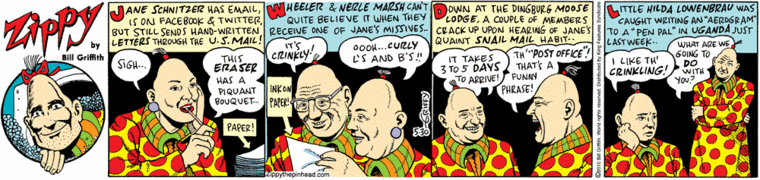
A triple feature for (U.S.) Memorial Day weekend, from the Two Z’s of the cartoon world. First, from Zippy World, Dingburgers reacting to the decline of print and hand-written communication:

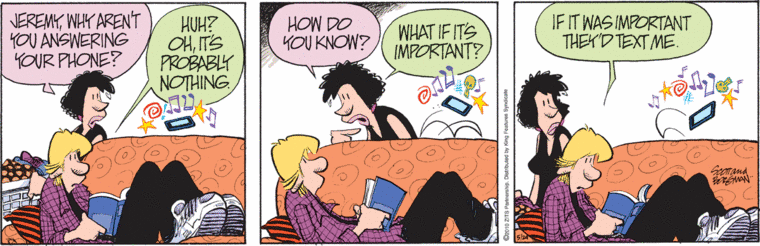
Then, from Zits World, Jeremy rockets into the electronic future, past cellphones and on to txtng:

Old vs. new technologies

April 14, 2010

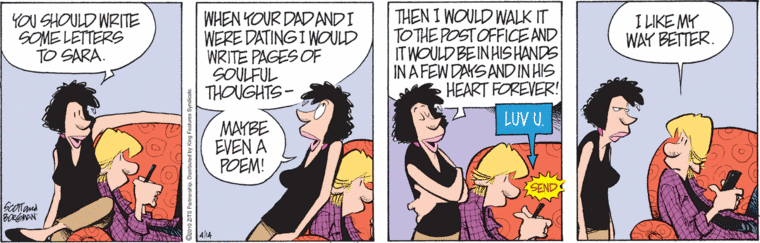
The Zippy and Zits series on old vs. new communications technologies (most recently posted about in this blog here) continue with today’s Zits, on letters vs. txtng: