The Zippy and Zits series on old vs. new communications technologies (most recently posted about in this blog here) continue with today’s Zits, on letters vs. txtng:
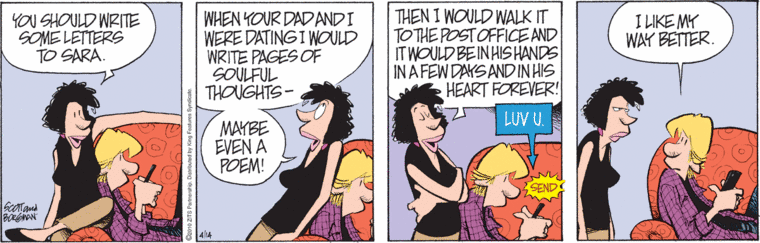
The Zippy and Zits series on old vs. new communications technologies (most recently posted about in this blog here) continue with today’s Zits, on letters vs. txtng:
The Zippy strip continues its defense of old-fashioned writing materials against the wave of electronica:

But Jeremy in Zits is past the great electronic divide:

From Thomas Mallon’s review of Martin Stannard’s biography of Muriel Spark, in the New Yorker of April 5:
[later in life] She battled agents and accountants and editors with unusual fierceness. [note fierceness rather than ferocity] Edith Sitwell advised her to regard book businessmen witheringly, as if “through a pair of lorgnettes.” Spark eventually refused editing altogether. “If I write it, it’s grammatical,” she informed the novelist Christine Brooke-Rose, a friend, who had brought an infelicity to her attention. The galactic perspective from which she laughed at her characters’ earth-bound follies could not keep her from waging epic combat with a paperback editor over one poorly chosen word of jacket copy.
In an op-ed piece (“The Next Surge: Counterbureaucracy”) in the NYT on December 8, Jonathan J. Vaccaro describes the baleful effects of bureaucracy on the conduct of the campaign against the Taliban in Afghanistan; multiple approvals from many different authorities are required before action can be taken. And then:
The red tape isn’t just on the battlefield. Combat commanders are required to submit reports in PowerPoint with proper fonts, line widths and colors so that the filing system is not derailed.
No report, however, of requirements on punctuation, spelling, and the like, not to mention grammar and usage.
Over on Language Log, I’ve posted about a grade-school workbook exercise on writing “interesting” sentences. The instructions were minimal:
A good sentence should be interesting.
“I have a dog” is not a good sentence with which to begin a story. If you are writing a story about your dog that was lost, it would be better to begin the story, “Last week my dog Shep ran away from home.”
Can you change the following sentences into interesting sentences?
On the basis of that, the kids were unleashed on six other sentences, like “I have a bicycle”.
Now, this is a workbook about how to write, so the suggestion is that the problem with the sentences is their form. I looked at two ways in which an English teacher might view such sentences as defective: they “lack vitality” because of their syntax; and they are information-poor (ultimately, a criticism about discourse organization). But of course the sentences (considered with no other context — this is important) are uninteresting because of their content, which is not only minimal but also scarcely gripping. If a stranger came up to me on the street and announced “I have a bicycle”, I’d be worried. (If the stranger was a young child, I wouldn’t be worried at all; kids often confide information that’s important to them. Context, context, context.)
Letter in the 29 March New York Times Book Review:
Knitted Brows
To the Editor:
In his back-page essay about George Steiner (“Our Steiner Problem — and Mine,” March 15), Lee Siegel calls The New Yorker “middlebrow” and The Times Literary Supplement “bourgeois.” Thank heavens the Book Review is neither of these terrible things.
JIM HOLT
Manhattan
The actors in this little play:
Lee Siegel is a writer and cultural critic who has been published in, among other places, The Atlantic Monthly, Harper’s, The New Yorker, and The New York Times.
Jim Holt is a writer and cultural critic who has been published in, among other places, The New Yorker, The New York Times, The New York Review of Books, and The London Review of Books. He is the author of the recent Stop Me If You’ve Heard This: A History and Philosophy of Jokes.
Figurative language is a tricky thing. It can be tremendously evocative, or it can call attention to itself too insistently. Some critics have seen the late John Updike’s writing as sometimes coming perilously close to the line; usually the images seem fresh and insightful, other times they arrest the progress of your reading, like precious jewels embedded in the text.
Other writers — Alice Munro, for example — rarely strike people this way, even though what they write has plenty of figurative language in it.
And then there are cases where I’m just not sure.