A recent Zippy, in which Griffy is fascinated:

Don’t know about carving words into animal bones in England, but sheep’s knuckle bones were used as paving stones, devices for divination, and dice-like pieces in games.
A recent Zippy, in which Griffy is fascinated:
Don’t know about carving words into animal bones in England, but sheep’s knuckle bones were used as paving stones, devices for divination, and dice-like pieces in games.
Reported in the Sic! (errors) section of Michael Quinion’s World Wide Words #794 this morning:
A health report of 18 July on the BBC site about the risks of not taking physical exercise was spotted by Martin Wynne: “The public needed to be warned about the dangers of inactivity rather than just reminded of the benefits of it.”
Here, it at first appears to refer in inactivity, but a bit of thought will convince you that the writer intended it to refer to activity; but activity is inside the word inactivity, and so would (on many accounts) be unavailable as an antecedent for it. The relevant putative generalization is known as the Anaphoric Island Constraint (AIC): words are “islands” for anaphora; anaphora can’t “reach inside” words. (Brief discussion here; examples of AIC violations here and here.)
But things aren’t that simple.
Carl Hiaasen, interviewed in the NYT Book Review on June 3rd:
What book is on your night stand now?
“Raylan,” by Elmore Leonard, one of my writing heroes. There is nobody better at lowlife dialogue.
That is, at representing the speech of small-time crooks, con men, wiseguys, and the like. Well, white American lowlifes; there’s plenty of social and geographical variation in these things.
From David Samuels’s essay “Wild Things: Animal nature, human racism, and the future of zoos” in the June 2012 Harper’s magazine:
[p. 30] On March 24, 1897, Mayor William Strong granted a tract of South Bronx Park to Madison Grant and his New York Zoological Society … Grant selected William Temple Hornaday, at that time the most famous conservationist in America, as the zoo’s director … To build and maintain the collections, Grant chose Henry Fairfield Osborn, a notably pompous and deceitful man who served as the head of vertebrate palentology at the American Museum of Natural History and sponsored the excursion to Montana that discovered the frst fossilized remains of a lordly predator that he named Tyrannosaurus rex.
I admire the turn of phrase, “a notably pompous and deceitful man”.
More on Grant to come.
On Facebook, Serene Vannoy has reminded her readers of this 1981 Peanuts cartoon, featuring Snoopy as an aspiring writer:

This cartoon is a favorite on writers’ websites, for obvious reasons: every writer has been rejected, usually many times (goodness knows I have), and it hurts. So it’s entertaining to see Snoopy’s childlike assumption that his intentions and desires should rule and his bafflement that other people don’t recognize this.
Two items this morning in which lexical items are understood in new ways: look down reanalyzed as V + Prt rather than V + P; and circadian in circadian rhythm understood as an ethnonym, denoting some group of people, the Circadians.
Michael Winerip in Monday’s New York Times:
Despite Focus on Data, Standards for Diploma May Still Lack Rigor
The next time people try to tell you how much the data-driven education reform programs of President George W. Bush (No Child Left Behind) and President Obama (Race to the Top) have raised academic standards in America, suggest that they take a look at the Jan. 24, 2012, New York State English Regents exam.
A Zippy in which The Toad (formerly Mr. Toad) takes control:
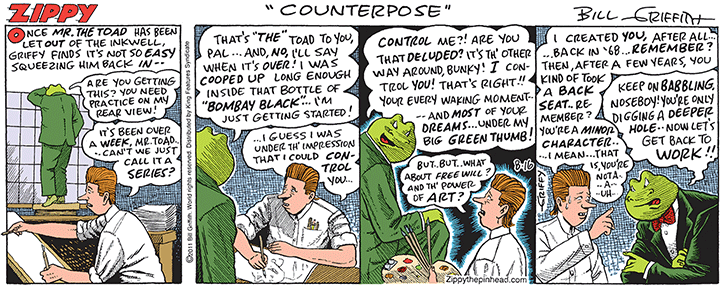
Writers regularly say that once they embark on a story, their characters “take over” and direct the flow of fictional events. Bill Griffith takes things one step further, as he becomes The Toad’s creature rather than vice versa — in the strip.
In the New Yorker of July 4 (p. 19) a writer and scholar recounts writing The First Book:
[in a windowless basement] “I listened to Madonna sing ‘Like a Prayer’ over and over again, and I had one picture of Tom Cruise from when he was still hot, and I wrote for sixteen hours a day”
Through McSweeney’s, a pointer to The Boring Store in Chicago (1331 N. Milwaukee Ave.), with a wonderful website. Part of the store’s sign:

Ironic reversal, attraction by denial: “the only store in Chicago that denies its own existence”. The store bills itself in one place, positively, as “Chicago’s only Secret Agency Supply Store” (it actually sells disguise kits, X-ray specs, and other spy gear for kids) and in another, negatively, as “Not a Clandestine Supplier of Espionagical Wares”.