.Yesterday’s Bizarro, and a Liam Walsh cartoon from the May 30th New Yorker:
 (#1)
(#1)
(If you’re puzzled by the odd symbol in the cartoon — Dan Piraro says there’s one in this strip — see this Page.)
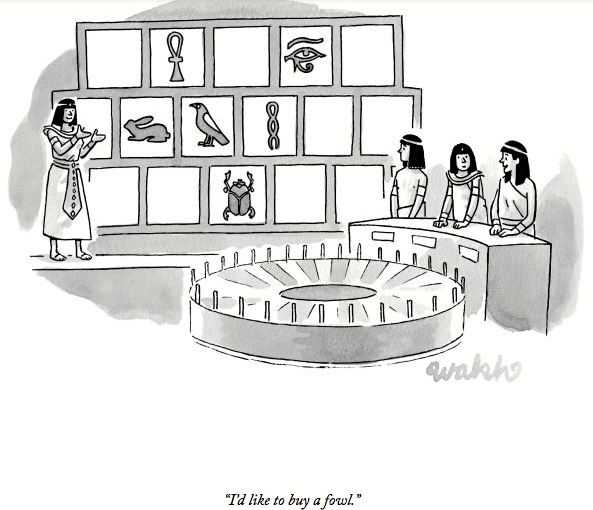 (#2)
(#2)
(Some sexual topics to come.)
They’ve been piling up while other things happen. But here’s the recent crop: Futhark, eructation, sex sling. Definitely a mixed bag.
In the April 13th New Yorker, a Talk of the Town piece “The Musical Life: New Translation” by Alec Wilkinson about Cassandra Wilson:
The title of the Egyptian funerary papyrus “Book of the Dead” is more accurately translated as “Coming Forth by Day.” It was called “Book of the Dead” by Wallis Budge, who translated the manuscript for the British Museum, in 1895. “Coming Forth by Day” is also the title of Cassandra Wilson’s new record, which is an homage to Billie Holiday, who would have turned one hundred on April 7th.
The other morning, Wilson visited the Egyptian wing of the Met, waiting in the security line among schoolchildren on field trips.
… “I’ve been fascinated by Egyptology for ten years,” she said. “Ancient Egypt was called Kmt. Their language didn’t have vowels, much like Hebrew. The Greeks called the people from Kmt the Aegyptos. ‘Kemetic’ is how you refer to the culture. The Kemetics didn’t believe in death. They believed that you were always coming back and forth from the unknown to the actual. Going to the afterlife they referred to as ‘westing,’ since the sun set in the west. For me, the thought of Billie Holiday’s spirit being reinvented in the twenty-first century connected with the concept of returning, of coming forth by day.”
Whoa! The writing system is not the language. The Ancient Egyptian writing system didn’t have symbols for vowels, but the language certainly had them. Every language does.
A crop of three comics for today, on three very different topics: a One Big Happy with an inventive reinterpretation of an expression; a Zits on the evolution of writing systems; and a Zippy with another Xmas parody:
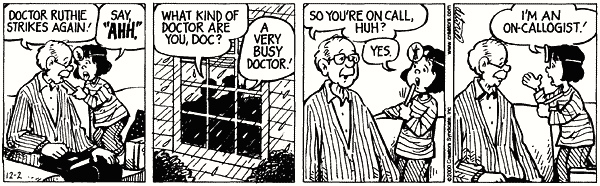 (#1)
(#1)
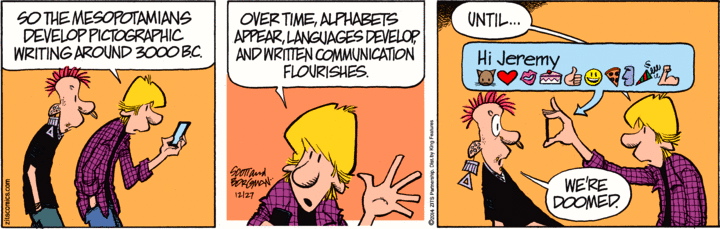 (#2)
(#2)
 (#3)
(#3)
One by one:
… in the latest (9/29/14) New Yorker: a Zach Kanin on writing systems and a Joe Dator with a snow cone snowclone:
 (#1)
(#1)
 (#2)
(#2)
Today’s Bizarro:

I before E except after C.
Today is Hangul Day, a holiday to celebrate the Korean writing system. Here’s a video from some years ago with the great linguist Jim McCawley explaining why this is an important day in the calendar:
[Enjoy the Scottish accent. By the way, it’s the University of Chicago, not Chicago University.]
This is holiday season. From this blog on October 14th in 2011:
We’ve just had the holiday triple play — Hangul Day [October 9th], Columbus Day (U.S.) / Thanksgiving (Canada) [both the second Monday in October], National Coming Out Day [October 11th] … — and next up is Dictionary Day, October 16th, celebrated on Noah Webster’s birthday. Words running amok in the streets!
A few weeks ago, from Benita Bendon Campbell, two cartoons from the strip One Big Happy (information on the strip here), with little kids coping with English. Ruthie plays with alphabetical ordering:
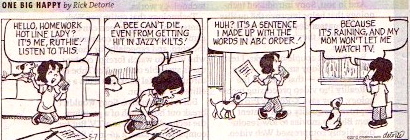
And Joe commits an eggcorn on unnamed source, using a topic he knows something about, namely dinosaurs:

Passed on from the Archaeosoup site (via Facebook), this New Yorker cartoon (1/26/63) by Ed Fisher:
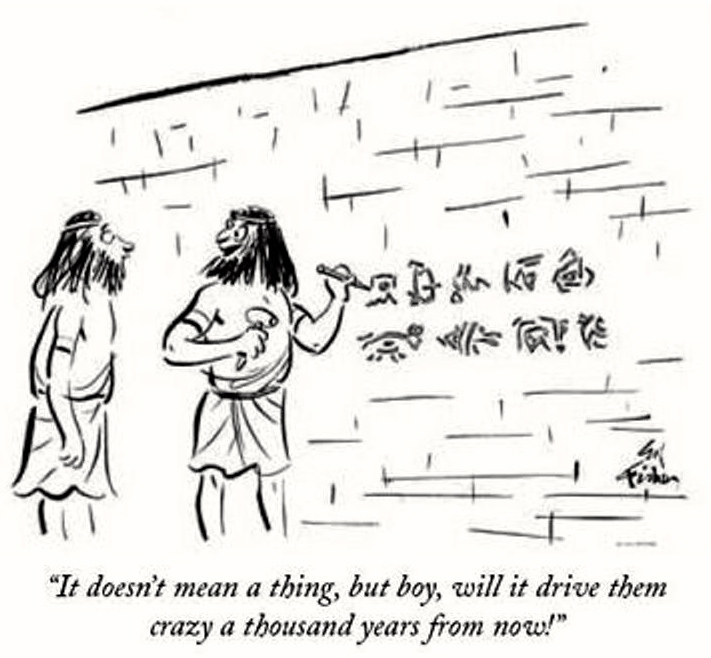
This tickles archaeologists’ funny bones. And epigraphers’, of course.
My friend Max Vasilatos has been creating wooden fridge magnets for various alphabets. She’s a woodworker, and the project is an exercise in art and craft. Yes, you can get plastic fridge magnets for a number of alphabets, but that’s not the point.
From last month, the Hebrew alefbet as carved by Max:

The medium determined many of her choices, so her letters are more stylized than, say, the plastic Megcos Magnetic Hebrew Letters.
Note: The Hebrew alefbet has 22 letters, but five of them are written differently when they appear at the end of a word (rather than at the beginning or in the middle), so that there are 27 different forms. Here’s the full alefbet as printed by hand: