Archive for the ‘Variation’ Category

Do Californians have an accent?

December 19, 2012

That was the question this morning at 10 (PST) on KQED-FM, on the Forum program with host Scott Shafer and guests Penny Eckert (variationist sociolinguist, scholar of language and gender and of the language of adolescents, and director of the Stanford Voices of California project, described here) and Geoff Nunberg (semanticist, public intellectual commenting broadly in the media on issues involving language, and author of books on language in public life).

A really good hour, covering most of the topics people want to hear about and most of the topics linguists would like to explain to a general audience. An mp3 of the show is on the KQED site, here.

The answer to the question in the show’s title is: Yes, of course; everyone does. But the actual question being asked was something like “Is there a (single) California accent?”, the answer to that one is: No, but there are recognizable dialect areas within the state, plus a lot of variation that has to do with factors other than geography: class, sex, race and ethnicity, etc.
 

Nightmare stories

November 30, 2012

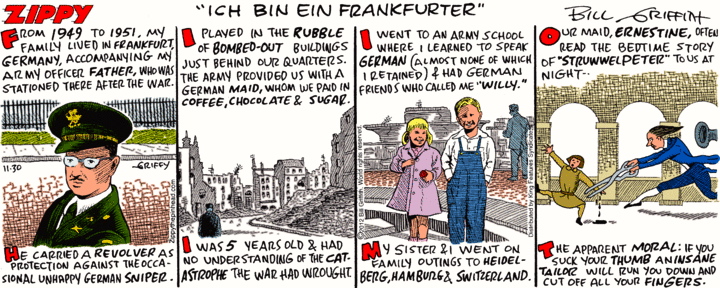
Today’s Zippy, with recollections by Bill Griffith of his childhood:

My main interest is in the last panel, with its recollection of the children’s story “Struwwelpeter”, but first a few words on other points.

(more…)

Fixing things

November 22, 2012

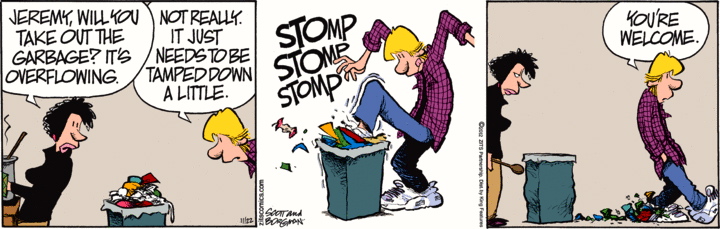
This morning’s Zits, in which Jeremy responds to his mother’s call for help:

Note the facial gestures, and the subversion of the mother’s request, in which Jeremy does not in fact take out the garbage, but does what strikes him as less work — though it makes a major mess.

(more…)

Repetitions

November 8, 2012

On Monday Nancy Friedman offered this awkward example to me:

“One of the things that you always want to be for, whether you’re a Democrat or a Republican, is that you want everyone who’s eligible to vote to vote.” – Steve Schmidt, McCain strategist in 2008 (link)

There’s nothing syntactically wrong with this sentence, but the repetition of to vote might give you a moment’s pause. Nevertheless, the first to vote is an ordinary infinitival complement of be eligible (They are eligible to vote), in a relative clause modifying everyone (Everyone who’s eligible to vote is coming), and the second to vote is an ordinary infinitival complement of want in combination with a direct object of that verb (We want everyone to vote), and to vote to vote is merely part of what you get when you put these pieces together in ordinary ways.

Repetitions like this one — repetitions I’ll call Toto examples (Totos for short), after to vote to vote and in recognition of the passing feeling of oddness that they can produce (“Toto, I’ve a feeling we’re not in Kansas anymore”) — are quite common, though a careful stylist might want to avoid some of them as distracting. But then there are syntactic constructions that specifically call for repetitions of constituents. And still other configurations that you’d expect to be acceptable — more Toto examples — that are nevertheless just ungrammatical (for some speakers).

(more…)

Gunpowder treason

November 5, 2012

It’s that day. In the rhyme as I remember it,

Remember, remember, the fifth of November:
Gunpowder, treason, and plot!

And from this event, in 1605, we get the colloquial noun guy ‘man’.

(more…)

Brief mention: more impastas

October 31, 2012

Following up on the Flying Spaghetti Monster and impastas (here), here’s another take on the same pun, done in rotini:

(From Bob Mugele’s Facebook site, passed on by Avery Andrews and Tony Aristar.)


Pronouncing names

October 15, 2012

In the NYT on Saturday, a front-page piece (“Missouree? Missouruh? To Be Politic, Say Both”, by Sarah Wheaton) about the pronunciation of names, with a political connection.

(more…)

Complex reversal: confuse

October 8, 2012

From the weekly report (10/5/12) of the Bowman International School in Palo Alto, this note from a student in room 5:

The sand tiger shark lives near the shore. Sometimes they [sand tiger sharks] confuse surfers for seals and attack them.

This is certainly non-standard, but there are two distinct possible sources of the problem:

the choice of verb: confuse rather than, say, take or mistake (mistake surfers for seals); or

the choice of preposition: for rather than with (confuse surfers with seals)

What remains constant in all the examples so far is the assignment of participant roles (which I’ll refer to as RIGHT and WRONG, indicating correct and incorrect identification, respectively) to non-subject syntactic arguments (direct object and oblique object); all fit the template for “misidentification verbs”:

V  DirObj:RIGHT  P  OblObj:WRONG

That is, the sharks are confronted with surfers (RIGHT), but perceive them as seals (WRONG), whether the event is packaged syntactically as (A) mistake surfers for seals, (B) confuse surfers with seals, or (C) confuse surfers for seals.

C-type examples (with a V of type A and the P of type B) are by no means rare, and there’s more to come.

(more…)

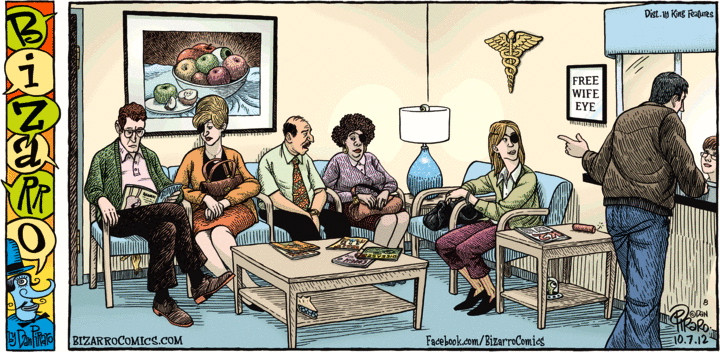
Today’s dreadful pun

October 7, 2012

Today’s Bizarro:

Grotesque, but then the strip is called Bizarro.

(more…)

From the reflexives files

September 23, 2012

From Steven Weinberg‘s article “Why the Higgs?”, New York Review of Books 8/16/12, p. 78, two conjoined objects with a personal pronoun as 2nd conjunct. First, in par. 5, with the first 1sg pronoun in the piece:

This is what happens in the theory of weak and electromagnetic forces proposed in 1967–1968 by Abdus Salam and myself.

and then, in par. 8, after an occurrence of Salam and I as subject:

One of the consequences of theories in which symmetries are broken by scalar fields, including the models considered by Goldstone and the 1964 papers and the electroweak theory of Salam and me, is that …

That is, Weinberg introduces himself into the text with a reflexive pronoun, myself. A nominative  form I follows, in When Salam and I used ...; after it, an accusative me (and then another nominative I, in Salam and I found …). Those exhaust the 1sg pronouns in the text.

What’s notable about this is the myself, an “untriggered” reflexive, neither anaphoric (with an antecedent in its clause) nor emphatic (doubling another NP, as in He himself did it). The usage literature is pretty much dead set against untriggered myself, which means that this literature doesn’t even consider what writers like Weinberg are doing with it.

(more…)