A note on the pronunciation of actor/model Kellan Lutz’s family name. This is so uncontroversial that sources seem never to comment on it: it’s /lʌts/, with the vowel /ʌ/ of luck. But where I grew up, in Pennsylvania Dutch (i.e., Pennsylvania German) country, where there were a great many people with the family name Lutz, it was uniformly pronounced /lʊts/, with the vowel/ʊ/ of look — following German pronunciation rather than the English spelling.
Archive for the ‘Variation’ Category
Briefly noted: pronouncing Lutz
July 1, 2013Class accents
June 6, 2013From “Pedigree” by Walter Kirn, a personal history in the June 10 & 17/13 New Yorker (the Crimes and Misdemeanors issue), about a con man and convicted murderer he knew as Clark Rockefeller:
He spoke with an accent, clipped and international, and occasionally tossed in a word (“erstwhile,” “improprietous”) that tied a bow on the sentence that included it. I’d met a few people like him during college [Princeton] — pedigreed, boastful, overschooled eccentrics who spoke like cousins of Katharine Hepburn and always seemed to have prematurely thinning hair and delicate, intestinal-pink skin. But I was brought up in rural Minnesota, deep in manure-scented dairy country, and never succeeded in getting close to them. Their clubs wouldn’t have me; I didn’t play their sports. (p. 91)
Turns out that Clark Rockefeller was born Christian Karl Gerhartsreiter in rural Bavaria and had
fashioned a manner based on a pop-culture travesty of wealth: Thurston Howell III, of “Gilligan’s Island.” (p. 92)
In the U.S. he ran through a number of identities, often connecting himself to famous people — among them, Christopher Chichester (Sir Francis Chichester), Christopher Crowe (Cameron Crowe), and of course Clark Rockefeller.
Speaking like a cousin of Katharine Hepburn is a nice touch.
hairy Harry and the asparagus
May 21, 2013Today’s Rhymes With Orange, with a portmanteau:
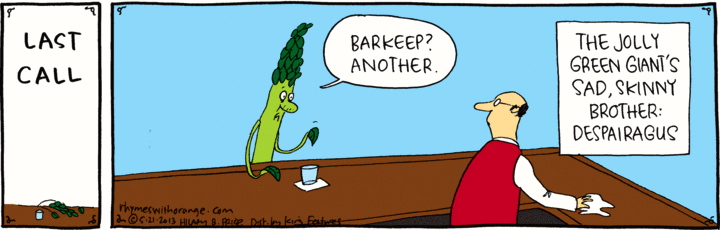 (#1)
(#1)
That’s despair + asparagus. This is a stretch as a portmanteau for me, because the accented vowels in the two contributing words are distinct for me: [e] in despair, [æ] in asparagus. For me and some other American speakers — and for virtually all English speakers outside of North America. But for other Americans, the vowels are quite close (with [ɛ] in asparagus) or identical (with [e] in asparagus). This is merry–Mary–marry territory.
The far reaches of GoToGo
April 27, 2013From Laura Staum Casasanto this morning:
Here is a sentence taken straight from an email about encouraging students to fill out course evaluations at Stony Brook:
[(1)] Did you know? Students can complete their evaluations on their mobile devices, and some instructors have found success with taking the first 10 minutes of class and ask their students to do the evaluations.
Wow, she said, and I concur. This is formally like classic GoToGo, but deviating from central examples in two respects. And it’s the second such example Laura has found.
Dialect time in the comics
April 24, 2013A Frazz passed on by a number of people on Facebook:

Well, you scarcely need to go to the Bronx to find sprain and sprayin’ falling together in casual speech. Or walls with spray-painted graffiti.
But I long to see what the kid does with euphemism.
NPR team and the perils of transcription
April 16, 2013Yesterday on NPR’s Morning Edition, a piece announcing a new NPR feature:
NPR Team Covers Race, Ethnicity And Culture (by David Greene and Gene Demby)
NPR this week is introducing a new team that will cover race, ethnicity and culture. Code Switch is the name of the new blog. Code-switching is the practice of shifting between different languages or different ways of expressing yourself in conversations.
Greene and Demby chat for a while about code-switching, with examples, bringing in linguist Tyler Schnoebelen as a consultant at one point. But if you read the transcript rather than listening to the segment, you might be puzzled.
twangs
March 7, 2013Widely reported back in January, for instance in this Los Angeles Times story, “Texas talk is losing its twang: Fewer Texans are speaking in the traditional dialect, as urbanization, pop culture and an influx of newcomers have conspired to displace the local language” (by Molly Hennessy-Fiske, 1/27/13). My interest here is the use of twang.
In a syntactic quandary
February 9, 2013An abstract I have submitted for the 2013 Stanford Semantics Fest (on March 18th). The abstract is quite compressed; it had to fit in a single page of text.
boys
January 27, 2013Back on December 31st, I posted on male photographer David Arnot and his Boy Next Door calendars (for 2012 and 2013), with a full set of the images from the 2012 calendar. On Facebook, Michael Newman then inquired:
On a language point, doesn’t “boys next door,” imply a kind of (pseudo)unposed twinkish look? If so, these guys may be hot, but not in a boy-next-door way.
Michael is both a card-carrying linguist and a gay man, so brings two kinds of inside information to the discussion, both relevant, and, in this case, his critique is right on. These guys might or might not be hot — that’s a matter of taste — but they’re not boys next door, in modern American English, at any rate
Accent on Santa Skivvies
January 17, 2013A late entry in the gay Santa category, Dean Allemang at the Santa Skivvies run for charity:

(Dean is wearing only his Santa cap, sunglasses, his watch, the armband for the run, his nipple ring, his ring, his excellent striped briefs, and (not pictured here) socks and running shoes.)
On Santa runs, see my posting on gay Santas; in general, there’s no requirement that participants in these events be gay, but if you get Dean, you get gay (and a profound, and endearing, lack of modesty; unsurprisingly, Dean did the No Pants! BART Ride on Sunday).
Meanwhile, Dean commented on my “Do Californians have an accent?” posting, asking about a sentence-final rise in pitch that he’s been hearing here in California, referring to the feature as an “accent”. This will take some sorting out.