Archive for the ‘Variation’ Category

Linguistic drones

January 14, 2014

From Ellen Seebacher on Facebook, on All Things Linguistic a little while back, “5 Linguistically Valuable Uses For Drones”. Ellen notes that

Someone has finally combined LingBuzz (the archive of linguistics articles) and BuzzFeed … into LingBuzzFeed, your source of linguistics listicles. There’s only one up at the moment, but it’s pretty great: 5 Linguistically Valuable Uses For Drones.

I think my favourite might be the Isogloss Enforcement Drone, especially because of the illustration.
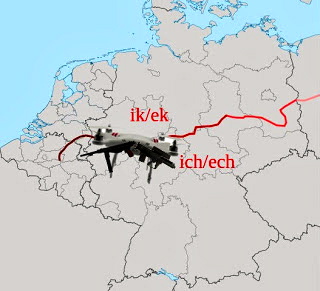
Accompanying text:

Isoglosses are the neat lines on a map that divide dialects from one another according to their linguistic features. Unfortunately it’s long been known that isoglosses are an inadequate representation of dialect reality, since outliers can usually be found on both sides of the line.

With the Isogloss Enforcement Drone, we can finally do something about this lamentable situation! Equipped with an SMG and mini grenade launcher, this drone will patrol up and down the isogloss, punishing dialect offenders and occasionally launching seek-and-destroy missions for outlying deviant speakers. All while you bake a cake or watch a DVD of Downton Abbey.

House men

October 27, 2013

(Not really about language, but just about popular culture on a Sunday morning.)

Re-runs of House have been going past me this morning. On the show, from Wikipedia:

House (also known as House, M.D.) is an American television medical drama that originally ran on the Fox network for eight seasons, from November 16, 2004 to May 21, 2012. The show’s main character is Dr. Gregory House (Hugh Laurie), a drug-addicted, unconventional, misanthropic medical genius who leads a team of diagnosticians at the fictional Princeton–Plainsboro Teaching Hospital … in New Jersey.

The show is formulaic, tying medical drama (with the team running through a series of diagnoses in the face of baffling symptoms) into the seriocomic soap-operatic drama of the characters’ lives.

(more…)

Apostrophe in plural

October 16, 2013

A friend wrote me yesterday with this punctuational query (edited here to cloak some details):

I am teaching an online course … this semester …  The course material is mostly pre-written for me, but I’ve been going through it myself, of course.  One thing I noted is that acronyms [what I would call initialisms; see below] are sometimes made plural with the letter s, sometimes with apostrophe s.  I guess what bothers me most is the inconsistency.

I was looking through Language Log and your blog for the topic of plural acronyms with and without apostrophes, but came up blank.  Do you know of anything on current thoughts on this topic, or have any yourself?

MBA (Master in Business Administration) is an initialistic name of a degree; is its plural MBAs (no apostrophe) or MBA’s?

(more…)

Yes we can

October 7, 2013

This image came to me via Ann Burlingham on Facebook (I don’t know the ultimate source):

[Added 10/8/13. Arthur Prokosch posted the source on Facebook: Preserving TraditionsPreserving our harvest, our heritage, our community, and our future.]

(#1)

A pun on can ‘be able’ vs. can ‘preserve (food) in a can’ (or, in this case, a Mason jar).

(more…)

Miscellany for 9/19/13

September 19, 2013

Twelve items that have come by me recently.

(more…)

Like, uptalk, and Miami

September 10, 2013

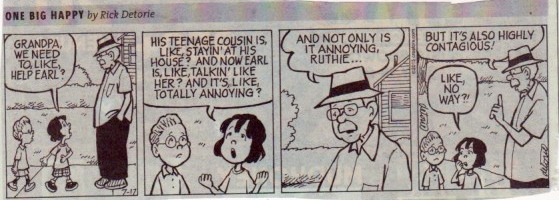
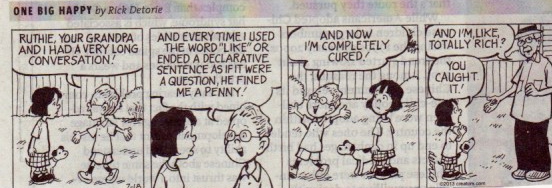
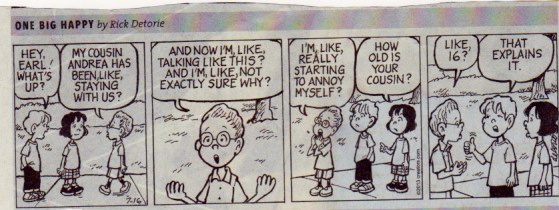
I’ll start with a three-strip series from One Big Happy:

(#1)

(#2)

(#3)

The two features at issue here — the discourse particle like and “uptalk” (a high rising intonation at the end of declaratives) — have been much discussed in the linguistic literature. The popular, but inaccurate, perception is that both are characteristic of young people, especially teenagers, especially girls, and both features are the object of much popular complaint.

(more…)

Dialect notes for geeks

August 1, 2013

From several sources on Facebook, a pointer to a Mental Floss piece from July 29th on American dialects — by a linguist, written for a non-linguist audience. Arika Okrent talking about three phenomena in commonly disparaged dialects:

Appalachian a-prefixing; Southern American English liketa; and African-American English stressed bin

(more…)

Brief notice: judg(e)ment

July 17, 2013

Comment from strangeguitars on my “Internet enlightenment” posting, about the difficult road to the Zen state of Internet enlightenment (no longer caring when someone is wrong on the Internet):

A difficult road, indeed; I wouldn’t have made it past “judgment” (it hurts to type that!).

(more…)

Steve Grand, DNA, Timoteo

July 11, 2013

(Not a lot about language, but mostly about music, sexuality, and the display of men’s bodies.)

[Note 7/10/14: at the request of the photographer (see comments), most of the images have been removed from this posting. As far as I know, they can all still be accessed by Google image searches on Steve Grand, DNA, or Timoteo.]

This is about the country musician Steve Grand, the cover musician Steve Starchild, and the underwear models Steve Chatham and Finn Diesel — who are all the same young man, now getting wild media attention through a music video. From Wikipedia:

Steve Grand [born 1990] is a country music performer from Lemont, Illinois. He was acclaimed as the first openly gay male country singer after the music video of his song “All-American Boy” went viral on YouTube in less than a week.

“All-American Boy” is a sweet song of unrequited love, between the gay singer and his straight best buddy. It’s notable for including a kiss between the men that passes without eliciting “gay panic”, either in the buddy or in most of the video’s many viewers. Grand is also a strong singer with an attractive voice (hence Starchild’s career as a cover singer) and a very attractive body as well (hence Grand’s career as an underwear model, under various names).

(more…)

Sconic sections

July 10, 2013

From several sources on the net, this entertaining story posted 6/25/13 on the Evil Mad Scientist site:

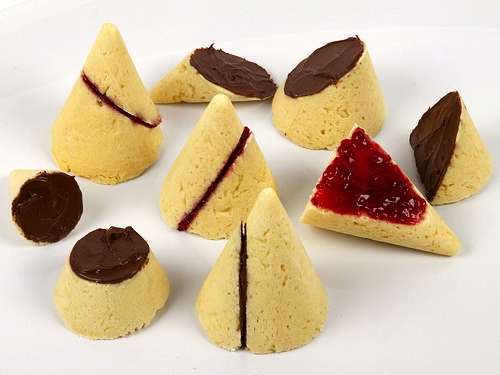
Play with your food: How to Make Sconic Sections

The conic sections are the four classic geometric curves that can occur at the intersection between a cone and a plane: the circle, ellipse, parabola, and hyperbola.

The scone is a classic single-serving quick bread that is often served with breakfast or tea.

And, at the intersection of the two, we present something entirely new, delightfully educational, and remarkably tasty: Sconic Sections.

Detailed instructions follow. The edges of the sections can be highlighted by jam, chocolate, or Nutella (as above).

(more…)