(Well, consider the title if this posting, which tells you that it’s going to get into some vivid descriptions of sexual parts and sexual acts — plus a photo that’s just barely WordPressable — and you’ll see that it’s not suitable for kids or the sexually modest; and from here on, you’re going to get the C-word raw and unconcealed, but your enthusiasm for this dirty talk will probably be diminished when it turns out that this posting is mostly about lexical semantics)
Archive for the ‘Dialects’ Category
“I have a ##”
October 20, 2024So my caregiver León Hernández Alvarez said to me last Tuesday; ## represents a word I totally failed to recognize, at the most elemental level; I didn’t recognize any of the sounds in the word, though I thought it was probably of the form CV. L then came closer to me and said it again, more slowly: “I have a n#”. Ah, an initial n — a Spanish n (distinct from an English n), but clearly something in the [n] zone, and followed by a vowel. On the third repetition, I was able to identify the vowel: u — a Spanish u (distinct from an English u), but clearly something in the [u] zone. Apparently, L was telling me that he had a [nu].
I recognized the word phonetically, but still totally failed to recognize the lexical item he was talking about. Surely he didn’t have a GNU. Is there such a thing as a NOO? Ah, finally it dawned on me: L was telling me he had a NEW. Hmm, a new what? And then, finally, the realization that he was telling me that he had a piece of news, that he had reconstructed a singular NEW ‘report of a recent event’ from the word NEWS ‘report of recent events’. This is clever, but alas mistaken.
Namesakes and surnamesakes
October 12, 2024This is going to take us surprising places. Our guide will be the distinguished Slavist Wayles Browne, in (edited) excerpts from e-mail he sent me on 10/9:
I discovered your blog when [WB’s Cornell colleague] Michael Weiss wrote about early attestations of the term ruki rule [in Sanskrit and elsewhere: see the 4/22/24 posting “On the transmission of ideas: RUKI gets around”]. Since then I’ve been looking at older postings as well as your day-to-day ones. On 1/9/14 [in the posting “A recent birthday”, on the birthday of Nikolai Marr], you wrote, after quoting this from Wikipedia:
Marr earned a reputation as a maverick genius with his Japhetic theory, postulating the common origin of Caucasian, Semitic-Hamitic, and Basque languages. In 1924, he went even further and proclaimed that all the languages of the world descended from a single proto-language which had consisted of four “diffused exclamations”: sal, ber, yon, rosh.
that
Marr eventually fell out of favor with Stalin.
Quite true, and there’s more to the story than that. After Marr died, his follower Ivan Meščaninov and others managed to get Marrism accepted as the official Marxist approach to linguistics, but finally in 1950 a Georgian linguist went to his fellow-Georgian Stalin and persuaded him that it was all fatuous and bad for the whole science of linguistics. Stalin then published an article in Pravda with essentially common-sense views of language. The name of the Georgian linguist? He was a namesake of yours: Arnold Chikobava.
In Bosnian, Croatian and Serbian, the language(s) that I work on the most, ‘name’ is ime, ‘namesake’ is imenjak, ‘surname’ is prezime, and a person you share a surname with is, quite logically, prezimenjak. It would be nice to introduce surnamesake into English too.
So we start in Ithaca NY (with the Cornell Indo-Europeanist scholar Michael Weiss), pass through Ancient India (and the Sanskrit language, which was the topic of my PhD dissertation, back in the Cretaceous Period) on our way to the Soviet Union under Stalin, where we encounter the nutcase linguist Nikolai Marr, who takes us to Soviet Georgia (in the Caucasus) and the linguist Arnold Chikobava, whose name, coupled with mine, reminds WB that the Slavic language(s) BCS (in the Balkans) have the eminently useful term prezimenjak ‘surnamesake’. In this is concealed a good bit of complexity in the notion of namesake (which I have, in fact, posted on, so we’ll get to that eventually), plus a wonderfully sly choice of wording in WB’s reference to BCS as
the language(s) Bosnian, Croatian and Serbian
(which will require some explanation for readers who are not entirely up to date on the linguistic situation in the Balkans).
When X means yes
October 9, 2024… in one sense / use of yes: ‘yes, I select this one’. Which came up yesterday as I was ordering an Original Italian Sub from the Jersey Mike’s Subs in Mountain View CA, just south of Palo Alto (they’re a huge national chain, offering a wide range of submarine sandwiches that are, in my experience, excellent examples of their kind — and Grubhub delivers from them); it turns out that their on-line menu software involves this positive selection-X, which took me a moment to get used to, especially since I’d posted not long ago on associations of the letter X, which included the X of NO — of prohibitions, bans, and denials — but not the X of YES. Well, X is a symbol, it’s just stuff (as I say) and can accumulate any number of uses, even ones that look contradictory.
The Jersey Mike X is the X of election ballots: an alternative to a check-mark ✓ or a plus-sign + in a box or circle (or to filling in an oval) to indicate selecting an item. In a use that was initially confusing to me, since the JM X is in contrast with the JM +, which turns out to convey something like ‘this is one of the available choices’; I eventually figured out how JM deploys X and + through a certain amount of trial-and-error fiddling with the menus. Yes, I’ll illustrate all of this in a little while.
But first, one more groaner penguin-pun joke, on the occasion of my consuming, at lunch today, the last of my birthday McVitie’s Penguin bars.
This idiom has had the radish
September 25, 2024In e-mail on 9/24 from Masayoshi Yamada, Emeritus Professor of Linguistics, Shimane University (author of, inter alia: A Dictionary of Trade Names and A Dictionary of English Taboo and Euphemism), substantially edited:
Recently, I happened to read the newspaper comic strip Zits; on September 23 and 24, the main character Jeremy uses the expression “I had the radish”. One of the few dictionaries which defines it:
have had the radish ‘to be no longer functional or useful; to be dead or about to perish’. Local to the state of Vermont. Primarily heard in US. (Farlex Dictionary of Idioms, 2024) (Free Dictionary link)
However, I don’t have any clue to its etymology: why radish? And is it so local to Vermont? I have no idea which language source the Farlex Dictionary is based on. [AZ: It cites the Free Dictionary, which aggregates information from many sources, so that’s not especially helpful.]
I pointed out to MY that in the strip, Jeremy decides to just invent (make up) some expression, to see if he can get it accepted. And picks had the radish. Presumably in the belief that no one had ever used it as an idiom. The first three strips (in strips to come, Jeremy eventually concedes that his idiom has had the radish):
Cadbury’s puds
September 6, 2024On Facebook today, an astonished observation by Martyn Cornell:
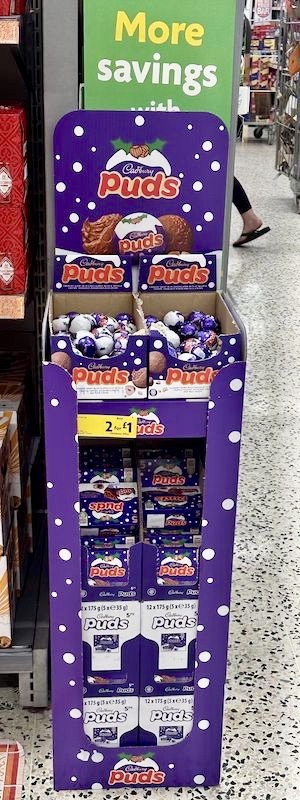
It’s early September — must be time for selling Christmas confectionery in the supermarkets of Britain …
Providing us with this store display for Christmas versions of Cadbury’s Puds:
The original Cadbury Pud — a brand name — is a Cadbury milk chocolate bar with a truffle centre, hazelnut pieces, and crunchy puffed rice pieces
frill
June 20, 2024An old One Big Happy cartoon that’s been sitting on my desktop for some time: casual speech collides with dialectal variation to confound Ruthie’s grandfather (usually it’s Ruthie who misunderstands, but not this time):
(#1) What Ruthie has that her grandfather lacks is inside knowledge: experience with the speaker and how she talks
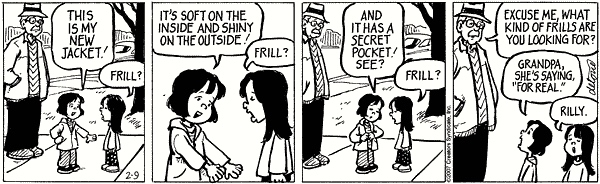
Ok, first the linguistics, then the frills. On the principle that a spoonful of linguistics helps the ruffles, sharks, and lizards go down.
N1 of N2
May 1, 2024🐇 🐇 🐇 from my 5/1/20 posting “Trois lapins pour le premier mai”:
It’s the first of the month, which I have learned to greet with three rabbits — by starting the day saying “rabbit, rabbit, rabbit”. More than that, it’s the first of May — by some cultural reckonings the beginning of spring in the northern hemisphere and also (in some countries) International Workers Day, so: dance around the maypole, set bonfires for Beltane or Walpurgis, prepare for outdoor bo(i)nking (rabbits again!), break out the lilies of the valley (muguets pour le premier mai), cue the choruses of L’Internationale, and march in solidarity with the workers. (Feel free to choose from this menu, as your taste inclines and your schedule allows.)
But enough of lapins; time to attend to our moutons, the sheep of the day being English NPs of the form N1 of N2 (like bouquet of flowers and tons of stuff) and how they work as subjects of clauses. These sheep came to us on 4/29 from Steven Levine, who wrote on Facebook:
Here’s a sentence I just came across that seems odd to my ears:
By the mid century a variety of celebrations was engaging morris dancers.
I know that the subject is variety [AZ: no no no; the subject is a variety of celebrations; this is important] and the verb is was, and yet it seems off to me — I was expecting were. I’m not asking for a grammatical analysis, I’m asking if this would stop you for a second if you were just reading along.
To which I wrote:
Steven said he didn’t want a grammatical analysis, but here it comes anyway.
I warned you.
The Ruthie versions
April 2, 2024An old One Big Happy strip, recently up in my comics feed, has Ruthie once again coping with vocabulary unfamiliar to her:
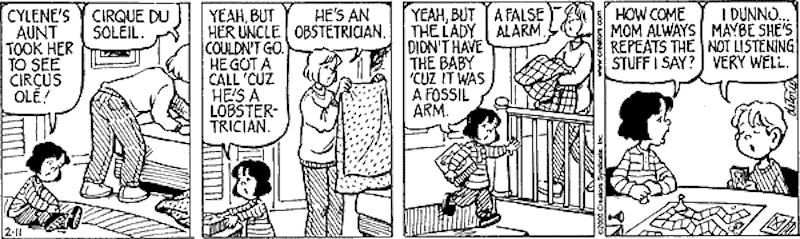
Cirque du Soleil (presumably pronounced in English, as if it were Sirk do sew-lay), obstetrician, and false alarm (which Ruthie takes to be circus ole, lobstertrician, and fossil arm, respectively). These are three different cases, as I’ll explain below.
But then — knowing that in the world around her, different people have different pronunciations for expressions — she takes her mother’s intended corrections of her creative misinterpretations to be just repetitions of them (“Mom always repeats the stuff I say”), but with a pronunciation alternative to hers. Attempted corrections of kids often run aground in similar ways.
The vomiting and nauseated emojis
December 6, 2023A posting in which I realize, once again, that an emoji (say, the vomiting (face) emoji) can look different on different platforms (in this case, Facebook vs. Microsoft Word), even though you use the same code to call it up — an effect that’s analogous to a letter of the alphabet (say, the lower-case letter whose English name is /ti/) looking different in different fonts (notably, being serifed in some, sans serif in others). And even more distantly analogous to a phoneme of a language, in a specifc position (say, /t/ after an accented vowel and before an unaccented syllable, as in battle and blotto), being pronounced differently in different social varieties of the language (as an voiceless stop in BrE but a voiced tap in AmE). Autres lieux, autres moeurs.
The emoji action went down this morning on Facebook, prompted by Gadi Niram getting set off by US Senator Tommy Tuberville’s having ceased his months-long blocking of a big pile of military promotions (for a reason that has nothing to do with the merits of the promotions). The FB exchange: