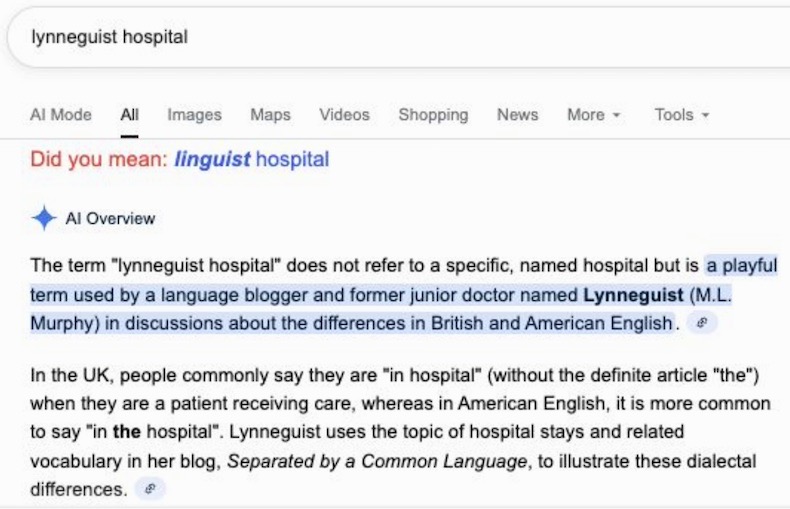
On Facebook today, a report on a Google AI search on “Lynneguist hospital” that inspired the bot to satisfy the search term by giving Lynne Murphy a medical degree:
[LM:] Adding medical qualifications to my cv.
I mean, here’s the evidence.
On Facebook today, a report on a Google AI search on “Lynneguist hospital” that inspired the bot to satisfy the search term by giving Lynne Murphy a medical degree:
[LM:] Adding medical qualifications to my cv.
I mean, here’s the evidence.
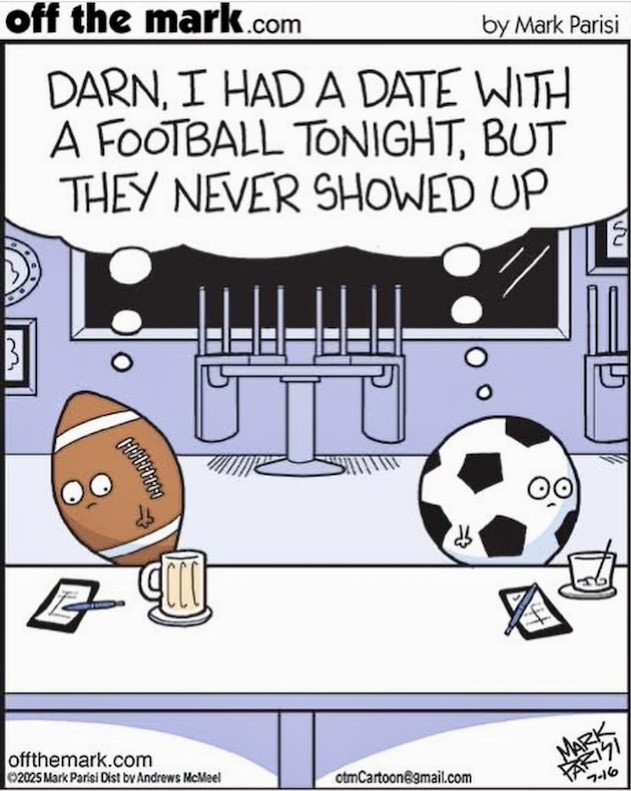
Very briefly (it’s been a hellish day). In my comics feed for today, penultimate July, Mark Parisi’s off the mark cartoon of 7/16/25, in which an AmE football and a BrE football fail to hook up with a sportsball of their own kind — next to one another in a bar.
In the RomCom version, of course, they go on to find satisfaction in hooking up with (aka dating) one another, in the thrill of the new and different.
Otherwise, you see the pitfalls of dating through text only; if they communicated by voice, they’d get nationality information. (Though in the real world, a British football would know that such a brown sportsball was called a football in the US. Whether an American football could be depended upon to know that a soccer ball was called a football in the UK is not so clear to me.)
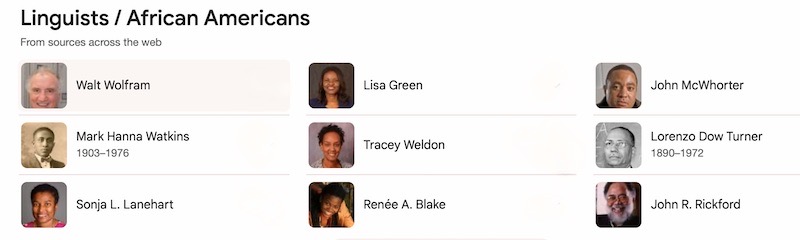
This morning, for complex reasons that shouldn’t concern you here, I did a Google search on “African American linguists”, not reckoning on what might happen with Google’s AI-guided search. This astonishing result, a page with the first 9 of 13 items retrieved:
2 historical figures, 7 living linguists; of those living linguists, 4 are women, 3 are men; of those men, two are African Americans, but the linguist in the position of greatest prominence, at the top left, Walt Wolfram, is not like the other 8 linguists: WW is a strikingly European — specifically German — American
Now, if there were a gold medal for wokeness, WW would surely have retired it for life, but he doesn’t belong in a display of African American linguists.
Thing is, Google hasn’t answered the question that I (implicitly) asked, Who are some linguists who are African American? (which might have pulled up, say, Ken Naylor, who studied the dialectology of what was then called Serbo-Croatian), but instead answered a somewhat similar question it had the answer to, Who are some linguists who have studied African American English? (which should pull up at least Bill Labov, Roger Shuy, and WW, all of whom are white).
Wokeness. From NOAD:
adj. woke: alert to injustice and discrimination in society, especially racism … (1960s: originally in African American usage)
Expanded on in a Wikipedia article:
used since the 1930s or earlier to refer [AZ: especially by African Americans of other African Americans] to awareness of racial prejudice and discrimination, often in the construction stay woke.
… By 2019, the term was being used sarcastically as a pejorative among many on the political right and some centrists to disparage leftist and progressive movements as superficial and insincere performative activism. [AZ: heavy sigh]
Encomia. I was sure that I had posted an encomium to WW and his remarkable career studying the language of, and supporting the communities of, African Americans (and Appalachians and Carolina Tidewater folk too), with all the passion he has devoted to sports (he played basketball, baseball, and football at Olney High School in north Philadelphia many years ago, and seems never to have met a sport he didn’t like). But I can’t find it in my files. Well, you can see the outlines of it from what I just said; he’s been a model of engagement and energy for the rest of us.
It’s probably a garrulous-codger thing, but I’ve been into encomia recently (see my previous posting, on Sonja Lanehart); well, it’s a great pleasure to write encomia for living people, rather than elegiac death notices.
One of these things. Music by Joe Raposo, lyrics by Jon Stone for Sesame Street (1968):
One of these things is not like the others,
One of these things just doesn’t belong,
Can you tell which thing is not like the others
By the time I finish my song?
Of course you can.
🦉 🦉 🦉 three wise owls for Superb Owl Day, an annual American Sunday holiday devoted to the relaxed enjoyment of uncrowded public places — (weather permitting) in sight-seeing, strolling on city streets, visiting parks and zoos; or (indoors) shopping in stores, exploring museums, attending concerts and theatrical performances (when I was much younger, Superb Owl Day was an excellent occasion for a visit to the gay baths; no doubt you have your own spots that can provide relaxing pleasures)
Meanwhile, back at Ramona St. …
Playing on the Apple Music in my bedroom during my 2:30 whizz break: a ravishingly joyous soprano concert aria, or (as it turned out) Lied (with a warm and playful piano trio accompaniment), with some vocal figures worthy of the Queen of the Night. I thought of it as the Queen of the Day’s Song. In some Germanic language I couldn’t quite comprehend.
Ah, obviously one of Beethoven’s folksong compositions; when I actually got up, at 3:30, I went to my computer to track the song down:
“Wann i in der Früh aufsteh” (‘When I arise in the early morning” — celebrating morning on a Tyrolean dairy farm), Beethoven WoO 158a/ 4 — that is, #4 in his 23 Lieder Verschiedener Völker (‘Songs of Different Peoples / Various Nationalities’); from a 1997 Deutsche Grammophon recording; Janice Watson is the soprano; and the language is Tyrolean, a High German variety spoken in the western Austrian state of Tyrol (where it’s the majority language) and areas of northern Italy (in any case, in a region south of Bavaria and east of the part of Switzerland where the Zwickys come from)
You can listen to this very recording here.
Another Rabbit Day item in the stew (see my earlier posting today “Rabbit stew 1: Asian soup spoons”), taking off from this Facebook posting by Greg Morrow yesterday (with some editing by me):
In sort of an opposite of the pen–pin merger [AZ: in which syllable-offset /ɛn/, as in pen, and /ɪn/, as in pin, are both realized as [ɪn]], local dialect (including mine) has [vǝnɛlǝ] vanella as the pronunciation of vanilla [vǝnɪlǝ].
(Heard it today in the grocery, and I was like, yes that’s right, wait a second…)
A further comment went on with the idea that this ɪ > ɛ (before l) that gives widespread US vanella was in some way the opposite of the ɛ > ɪ (before n) shift that gives us US midlands inkpin [ɪŋkpɪn] ‘(ink)pen’.
So my caregiver León Hernández Alvarez said to me last Tuesday; ## represents a word I totally failed to recognize, at the most elemental level; I didn’t recognize any of the sounds in the word, though I thought it was probably of the form CV. L then came closer to me and said it again, more slowly: “I have a n#”. Ah, an initial n — a Spanish n (distinct from an English n), but clearly something in the [n] zone, and followed by a vowel. On the third repetition, I was able to identify the vowel: u — a Spanish u (distinct from an English u), but clearly something in the [u] zone. Apparently, L was telling me that he had a [nu].
I recognized the word phonetically, but still totally failed to recognize the lexical item he was talking about. Surely he didn’t have a GNU. Is there such a thing as a NOO? Ah, finally it dawned on me: L was telling me he had a NEW. Hmm, a new what? And then, finally, the realization that he was telling me that he had a piece of news, that he had reconstructed a singular NEW ‘report of a recent event’ from the word NEWS ‘report of recent events’. This is clever, but alas mistaken.
This is going to take us surprising places. Our guide will be the distinguished Slavist Wayles Browne, in (edited) excerpts from e-mail he sent me on 10/9:
I discovered your blog when [WB’s Cornell colleague] Michael Weiss wrote about early attestations of the term ruki rule [in Sanskrit and elsewhere: see the 4/22/24 posting “On the transmission of ideas: RUKI gets around”]. Since then I’ve been looking at older postings as well as your day-to-day ones. On 1/9/14 [in the posting “A recent birthday”, on the birthday of Nikolai Marr], you wrote, after quoting this from Wikipedia:
Marr earned a reputation as a maverick genius with his Japhetic theory, postulating the common origin of Caucasian, Semitic-Hamitic, and Basque languages. In 1924, he went even further and proclaimed that all the languages of the world descended from a single proto-language which had consisted of four “diffused exclamations”: sal, ber, yon, rosh.
that
Marr eventually fell out of favor with Stalin.
Quite true, and there’s more to the story than that. After Marr died, his follower Ivan Meščaninov and others managed to get Marrism accepted as the official Marxist approach to linguistics, but finally in 1950 a Georgian linguist went to his fellow-Georgian Stalin and persuaded him that it was all fatuous and bad for the whole science of linguistics. Stalin then published an article in Pravda with essentially common-sense views of language. The name of the Georgian linguist? He was a namesake of yours: Arnold Chikobava.
In Bosnian, Croatian and Serbian, the language(s) that I work on the most, ‘name’ is ime, ‘namesake’ is imenjak, ‘surname’ is prezime, and a person you share a surname with is, quite logically, prezimenjak. It would be nice to introduce surnamesake into English too.
So we start in Ithaca NY (with the Cornell Indo-Europeanist scholar Michael Weiss), pass through Ancient India (and the Sanskrit language, which was the topic of my PhD dissertation, back in the Cretaceous Period) on our way to the Soviet Union under Stalin, where we encounter the nutcase linguist Nikolai Marr, who takes us to Soviet Georgia (in the Caucasus) and the linguist Arnold Chikobava, whose name, coupled with mine, reminds WB that the Slavic language(s) BCS (in the Balkans) have the eminently useful term prezimenjak ‘surnamesake’. In this is concealed a good bit of complexity in the notion of namesake (which I have, in fact, posted on, so we’ll get to that eventually), plus a wonderfully sly choice of wording in WB’s reference to BCS as
the language(s) Bosnian, Croatian and Serbian
(which will require some explanation for readers who are not entirely up to date on the linguistic situation in the Balkans).
… in one sense / use of yes: ‘yes, I select this one’. Which came up yesterday as I was ordering an Original Italian Sub from the Jersey Mike’s Subs in Mountain View CA, just south of Palo Alto (they’re a huge national chain, offering a wide range of submarine sandwiches that are, in my experience, excellent examples of their kind — and Grubhub delivers from them); it turns out that their on-line menu software involves this positive selection-X, which took me a moment to get used to, especially since I’d posted not long ago on associations of the letter X, which included the X of NO — of prohibitions, bans, and denials — but not the X of YES. Well, X is a symbol, it’s just stuff (as I say) and can accumulate any number of uses, even ones that look contradictory.
The Jersey Mike X is the X of election ballots: an alternative to a check-mark ✓ or a plus-sign + in a box or circle (or to filling in an oval) to indicate selecting an item. In a use that was initially confusing to me, since the JM X is in contrast with the JM +, which turns out to convey something like ‘this is one of the available choices’; I eventually figured out how JM deploys X and + through a certain amount of trial-and-error fiddling with the menus. Yes, I’ll illustrate all of this in a little while.
But first, one more groaner penguin-pun joke, on the occasion of my consuming, at lunch today, the last of my birthday McVitie’s Penguin bars.
In e-mail on 9/24 from Masayoshi Yamada, Emeritus Professor of Linguistics, Shimane University (author of, inter alia: A Dictionary of Trade Names and A Dictionary of English Taboo and Euphemism), substantially edited:
Recently, I happened to read the newspaper comic strip Zits; on September 23 and 24, the main character Jeremy uses the expression “I had the radish”. One of the few dictionaries which defines it:
have had the radish ‘to be no longer functional or useful; to be dead or about to perish’. Local to the state of Vermont. Primarily heard in US. (Farlex Dictionary of Idioms, 2024) (Free Dictionary link)
However, I don’t have any clue to its etymology: why radish? And is it so local to Vermont? I have no idea which language source the Farlex Dictionary is based on. [AZ: It cites the Free Dictionary, which aggregates information from many sources, so that’s not especially helpful.]
I pointed out to MY that in the strip, Jeremy decides to just invent (make up) some expression, to see if he can get it accepted. And picks had the radish. Presumably in the belief that no one had ever used it as an idiom. The first three strips (in strips to come, Jeremy eventually concedes that his idiom has had the radish):