Archive for the ‘Usage advice’ Category

Zomlingbies

August 7, 2012

A piece of prime silliness, from the ZombieLaw site (“ZombieLaw blogs about zombies in law, politics and current events”): Zwicky’s Zombie Rules of Grammar (here). References to linguablog discussions, illustrated with these images of me, John McIntyre, and Geoff Pullum:

We lurch on, pursued by Abraham Lincoln and others.


When English teachers snap

July 25, 2012

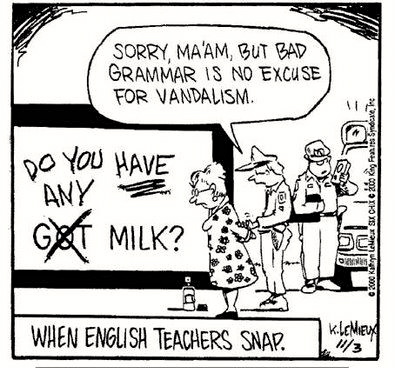
Passed on on Facebook by Bert Vaux, from Trust me, I’m a “Linguist”, ultimately from Funny Times, this cartoon by Kathryn LeMieux:

It’s not unknown for posses to form to “correct” signs in public places, but this almost always involves spelling and punctuation (and not actual grammar, as in this case), and so far as I know, English teachers don’t join these posses, despite the stereotype of them as peevers about vernacular English, and (especially) non-standardisms, a stereotype that’s exploited in cartoons on the theme of the rampaging English teacher.

(more…)

On the garmmra watch: The Oatmeal

July 6, 2012

From Alon Lischinsky on Google+ this morning:

The Oameal has a series of “Grammar” posters berating, sometimes quite aggressively, some typical mistakes. Unsurprisingly, none of them are really grammatical; rather, they concern spelling, punctuation, or disputed word usage (i.e., “irony”). One more for Arnold Zwicky’s garmmra watch.

(more…)

The hopefully files

June 1, 2012

An inventory of some postings on the adverb hopefully, divided into the pre-AP Stylebook period and the post-AP Stylebook period.

(more…)

like you and I

May 16, 2012

Caught this morning on public radio station KALW, during its beg-a-thon:

… because listeners like you and I agree that …

It’s the nominative case of I that’s the issue, and the example illustrates two different points of usage:

(a) pronoun case in combinations with like (and as, beside(s), including, and than); and

(b) pronoun case in coordination.

Collecting examples of people like you and I — there’s a huge number of them — then led me to blogger Melanie Spiller, puzzling over such examples in 2006 and concluding (via tortured grammatical reasoning) that I was the correct pronoun form.

(more…)

Damn you, Dryden!

May 3, 2012

John McIntyre has just posted a piece on his Baltimore Sun blog that ends with with a footnote:

A friend on Facebook apologized today for a sentence ending in a preposition. Damn you, John Dryden, I can forgive almost anything for the author of “Mac Flecknoe” and those lovely translations of Virgil’s Georgics, but I wish to God you had kept your mouth shut about stranded prepositions in English.

Amen to that. Dryden is the sad source of years of utterly unnecessary grammatical unhappiness.

(more…)

live close?

May 1, 2012

Back on April 13th, mail (lightly edited below) from someone who had just found Language Log and my “Open and closed” posting of 3/28/08:

I just discovered this site tonight & I swear I see an error.

No offense. I am no linguist, but you said “Since there’s no adjective close /kloz/ in English, the stative adjective closed gets to fill its slot in the pattern”.

I’d like to differ in opinion. Close, as in proximity of objects to others or near, drives me nuts.

There are signs in Minneapolis that read “live close” in advertisement of college-time housing.

When I first drove by the signs I only noticed the word live having double meaning. I hadn’t thought of close initially but there were multiple signs along that road so I always saw the phrase more than once at a time.

Two points here: one about spellings and pronunciations, and one about judgments of usage.

(more…)

Anniversaries

April 20, 2012

Chris Ambidge wrote to report a mailing from the San Francisco LGBT Community Center, celebrating its ten-year anniversary; on-line story here. Chris would have said tenth anniversary, and found ten-year anniversary redundant (like PIN number, he said), because ‘year’ is already contained in anniversary. This is one of two complaints about the usage of anniversary: the perceived pleonasm of n-year anniversary. The other complaint is about the perceived contradiction in n-span anniversary for spans other than year, especially month (one-month anniversary, six-month anniversary, six-week anniversary) — again, because ‘year’ is contained in anniversary. The second complaint seems to be the older one; it’s the only one reported in MWDEU (in 1989).

The second innovation presumably arose from a weakening appreciation of the etymology of anniversary, so that the word can be extended to recurring spans of time other than a year (though the default span of time was still a year). Then people began supplying year, for clarity, giving us things like ten-year anniversary, as distinct from ten-month anniversary and ten-week anniversary.

And the complaints piled up.

(more…)

hopefully

April 5, 2012

It’s one of those topics in English usage that just will not die. It erupted on ADS-L yesterday, with this query from Dan Nussbaum:

In the sentence, “Hopefully, the sun will rise tomorrow” the word hopefully is being used incorrectly. What word should be used?

And then we were off on a familiar path. Larry Horn got in first, noting that there was nothing incorrect about the example; Lisa Galvin reported that she had a professor long ago who said that the proper usage should be I hope rather than hopefully, since as it stands the sentence says “that the sun itself is full of hope that it will rise tomorrow”; and Larry replied:

“Hopefully” is a sentence adverb in such contexts and has been used as such for decades — while also being a manner adverb in “The dog is sitting hopefully by her food dish”.  (Not arguing with Lisa here, but with her long-ago professor and my fellow [AHD] Usage Panelists who vote with the majority to condemn this perfectly ordinary and proper usage.)

Pretty much everyone who writes about English usage has taken on hopefully, and the informed consensus is solidly with Larry, but a bizarre irrational prejudice continues against sentence adverbial hopefully.

(more…)

where … at

March 28, 2012

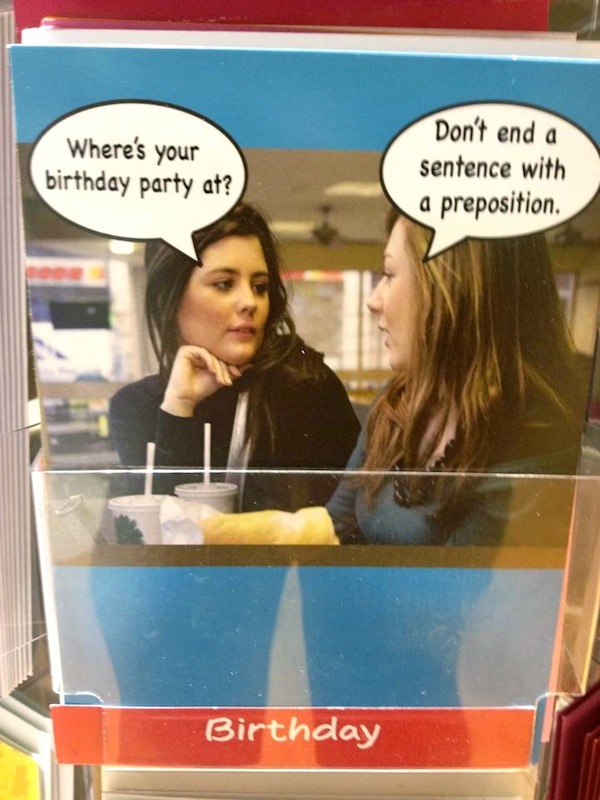
A birthday card found on the net (it’s been reproduced on a number of sites):

Two things here: ending a sentence with a preposition (i.e., stranding rather than fronting a preposition); and the construction whereat? The first is a total red herring; the second has been the subject of considerable usage advice.

(more…)